
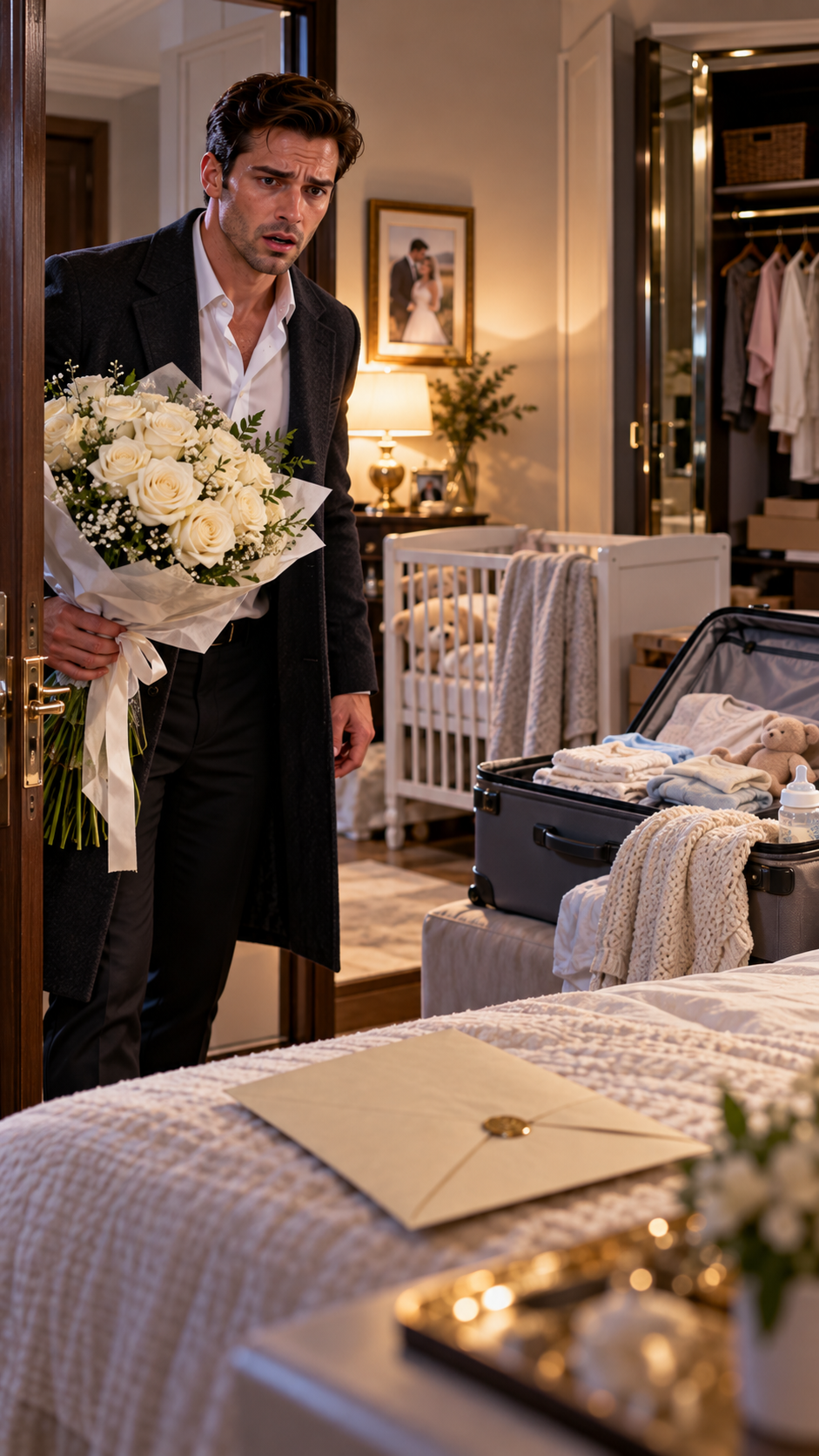
The first thing I noticed when I unlocked my front door was that nobody came to greet me. Not my wife, not the housekeeper, and not even the newborn son whose cries had become the soundtrack of our home during the weeks before my departure. I stood beneath the chandelier in the marble entrance hall, a suitcase beside my leg and a bouquet of ivory roses in my hand, listening to a silence that seemed to stretch into every room.
“Corinne?” I called.
My voice traveled up the staircase and disappeared. I waited for the familiar sound of her footsteps, followed by a tired remark about how late I was or a question about whether I had remembered to pick up the prescription she needed. Nothing came. I glanced toward the living room, expecting to find the bassinet beside the tall windows, where she liked to keep Owen during the afternoons. The space was empty. Only a pale rectangle on the rug remained where its legs had stood.
For nine days, I had imagined returning home. In every version, Corinne was waiting upstairs with Owen in her arms. She would be upset because I had stayed away longer than planned, and I would offer an explanation about the development project outside Charleston. I would tell her the meetings had been complicated, that the investors had demanded more of my time, and that the poor telephone reception had made calling difficult. Then I would hand her the roses. She might not forgive me immediately, but she would eventually soften. She always had before.
I had never questioned why I relied on that pattern so confidently. I behaved as though forgiveness were one of the permanent features of our marriage, like the staircase, the oak floors, or the view from our bedroom. I could leave, disappoint her, return with flowers, and expect the familiar world to arrange itself around me again. Standing in the silent hall, I still believed there had to be a simple explanation for what I was seeing.
The truth about those nine days was considerably less complicated than the story I intended to tell. I had spent a little time inspecting the development and meeting prospective investors. The work had occupied perhaps three and a half hours altogether. The remaining days belonged to Tessa Vaughn, the woman I had been seeing for nearly a year. We had dined beside the ocean, ordered champagne in the evenings, and spent long afternoons in a private villa while my wife recovered at home from childbirth.
I had purchased Tessa a diamond bracelet during the trip. It cost more than I cared to calculate, although I had charged it through one of my company’s accounts and convinced myself the accounting details could be sorted out later. When Corinne had previously questioned a similar expense, I told her it was a retirement gift for a senior colleague’s wife. She had looked at me for a moment, then returned to whatever she was doing. I interpreted her silence as acceptance. It never occurred to me that she might simply have recognized a lie and decided not to waste another question on it.
I placed my suitcase beside the console table and walked into the kitchen. The counters were spotless. There were no bottles drying beside the sink, no small towels draped over the backs of chairs, and no feeding schedule held to the refrigerator with the little wooden magnet Corinne had bought before Owen was born. The kitchen had always been orderly, but this was different. It looked as though someone had deliberately removed every trace of a person who had recently lived there.
I opened the refrigerator, although I had no reason to believe I would find an answer inside it. A container of milk, a jar of mustard, and a few neatly arranged vegetables remained on the shelves. Corinne’s prepared meals were gone. So were the small containers of expressed milk she had labeled with dates and times. The absence of those ordinary things unsettled me more than an overturned room would have. Nobody had fled in a panic. Someone had planned carefully.
“Corinne!” I called again, louder this time.
A door opened on the upper floor. Mrs. Pearl appeared at the head of the staircase, carrying a cardboard box against her hip. She had worked for us for six years, long enough to remember the house before our wedding and to know which rooms Corinne preferred to keep closed when she was working. She had cried when Owen was born. On previous occasions, she had greeted me with a warm smile and asked about my travel. Now she looked at me with a guarded expression I had never seen before.
“Mrs. Pearl, where is my wife?”
She descended slowly. When she reached the final step, she set the box on the small table beneath the staircase.
“Mrs. Keaton has left, sir.”
I stared at her. “Left where?”
“She didn’t tell me where she was going.”
“When did she leave?”
“Twelve days ago.”
I laughed once, an involuntary sound caused by the impossibility of the answer. “That’s not possible. I left nine days ago.”
“I know exactly when you left, sir.”
The certainty in her voice silenced me. I looked toward the box, then back at her.
“Did she take Owen?”
Mrs. Pearl’s expression changed. “Of course she took Owen.”
The words struck me with unexpected force. I had been so focused on finding Corinne that I had not fully considered the possibility that my son was gone too. I moved toward the staircase, then stopped, uncertain what I intended to do. I wanted Mrs. Pearl to tell me that Corinne had gone to visit a relative, that she would return before dinner, and that I had frightened myself over an ordinary absence.
“Did she go to her mother’s house?”
“I don’t know.”
“Her sister’s?”
“I don’t know, sir.”
“Did she leave a telephone number?”
Mrs. Pearl looked down at the box. “She asked me to give you something. She said I was not to move anything in your office until you had read it.”
“What is it?”
“An envelope.”
I followed her gaze. On top of the box lay a thick cream-colored envelope bearing my name in Corinne’s careful handwriting. Beneath it, a second line read: For Grant, when he returns.
I reached for it, but Mrs. Pearl held the other end for a moment. Her fingers tightened around the paper, and when I looked at her, I saw that she was struggling to keep her composure.
“There’s something you should know,” she said.
“What?”
“I drove your wife to the hospital the night Owen was born.”
I felt the floor shift beneath my feet. “Her sister took her.”
“No, sir. I drove her.”
“That’s not what Corinne told me.”
Mrs. Pearl released the envelope. “You should read what she left.”
She turned toward the staircase before I could ask another question. I watched her go, trying to reconcile her words with the story I had repeated to friends and colleagues. I had told everyone that I was delayed by business travel when Corinne went into labor unexpectedly. I had arrived at the hospital as soon as I could, I said. I had done everything possible to be there for my wife and son.
I had never mentioned that I was in Atlanta with Tessa when Corinne’s labor began. I had never explained why I ignored the first telephone call, or why I waited before returning the second. I had built the story carefully enough that even I sometimes remembered it as if it were true.
I carried the envelope into my office and shut the door. The room smelled faintly of leather, polished wood, and the coffee my assistant had brought before I left. Framed photographs of completed developments lined the shelves. A magazine cover featuring me stood near the window, and a silver frame on my desk held a photograph from my wedding. Corinne was laughing in it, her head tilted toward me, one hand resting on my arm. I tried to remember what had made her laugh that day. Nothing came to mind.
The envelope was too thick to contain an ordinary letter. I opened it carefully and removed the contents. The first page was a bank statement. The second was a hotel invoice. Behind those lay a restaurant receipt, a jewelry purchase confirmation, and a printed record of electronic transfers between accounts associated with my business.
Every page contained marks in Corinne’s handwriting. Dates were circled. Amounts were underlined. Certain transactions were connected by fine pencil lines, and small notes appeared in the margins. I turned through the papers, initially irritated by what looked like an elaborate attempt to embarrass me. Then I recognized the hotel name from Charleston.
It was the resort where Tessa and I had stayed.
The next receipt was from the restaurant where I had taken her on our second evening. I remembered the table beside the windows, the candlelight reflected in her glass, and the way she had laughed when I told her the business trip might need to be extended. Beneath that receipt was the invoice for the diamond bracelet. Corinne had not merely found the purchase. She had traced the payment to a company account and noted the discrepancy between the expense description and the merchant’s records.
I turned another page. A lease for an apartment in downtown Nashville appeared beneath the invoices. Tessa’s name was printed on the document, but the monthly rent had been paid through an account connected to one of my holding companies. Corinne had marked every transfer. She had also attached copies of several payments I had made during earlier trips, including hotel reservations in Savannah and Atlanta.
For the first time, I began to understand that I was not looking at a collection of suspicious purchases. I was looking at the results of a financial investigation.
Corinne had worked as a forensic financial analyst before we married. She knew how to follow payments through layers of accounts, how to recognize expenses disguised as legitimate business costs, and how to compare a written explanation with the transaction beneath it. When she left her career, I told myself she had chosen a quieter life. I encouraged her to stay home after Owen’s birth, insisting that my income made her work unnecessary. I had even joked in front of friends that she had exchanged spreadsheets for baby blankets.
Now the spreadsheets had returned, and they were telling a story I could not dismiss.
At the bottom of one statement, Corinne had written a short note. While I spent the final weeks of my pregnancy attending appointments alone, you paid for another woman’s apartment. While I stayed awake with our newborn, you booked a private villa.
I lowered the paper. For several seconds, I could hear nothing except the air conditioner humming above the door. I wanted to call her immediately, but I did not know what I would say. I wanted to accuse her of invading my privacy, although I knew the accounts were shared and the company expenses were subject to review. I wanted to tell her she had misunderstood, although every date and amount was correct.
Instead, I opened my laptop and attempted to log into our primary company account. A red notice appeared across the screen: access temporarily restricted pending legal review. I tried a second account. The same notice appeared. The third account was also unavailable.
I grabbed my telephone and called Wesley Crane, my attorney. He answered after several rings.
“Grant,” he said. His voice sounded unusually cautious.
“Something is wrong with the accounts. They’re restricted.”
“I know.”
I stood up so quickly that my chair rolled backward. “How do you know?”
“Your wife filed an emergency application to protect marital assets.”
“She can’t do that without my approval.”
“She doesn’t need your approval to ask a court for temporary protection.”
“What documentation did she submit?”
“Before we get into that, I need to ask you something. Have you been charging personal expenses through Keaton Development Group?”
“They were business expenses.”
“Every one of them?”
I looked at the bracelet invoice. The hotel receipt. The lease.
“Wesley, this is a family matter.”
“Not if company money was used to pay personal bills. Your board has scheduled an emergency meeting for tomorrow morning.”
I sat down slowly. “Why?”
“Because the board has questions about several expense categories. I don’t yet know the full extent of the problem, and I don’t want you guessing at answers. Don’t delete anything. Don’t move money. And don’t contact anyone involved until we have reviewed the records.”
“This is my company.”
“You have partners, Grant. You have lenders. You have a board. The fact that your name is on the building doesn’t mean the money belongs to you personally.”
I gripped the edge of the desk. “Where is my wife?”
“I don’t know.”
“Does her lawyer know?”
“Almost certainly.”
“Give me the lawyer’s number.”
“No.”
“Wesley.”
“The last thing you need to do is call Corinne’s attorney while you’re angry and frightened. Read what she sent you. Then let me review the documents.”
“I’m not frightened.”
There was a pause.
“I’ve known you for eighteen years,” he said. “You don’t have to convince me.”
The call ended, leaving me alone with the papers. I looked again at the wedding photograph, then pulled the final item from the envelope. It was a photograph of Corinne in a hospital bed, her face pale and her hair damp against her forehead. Owen lay against her chest, wrapped in a blue-and-white blanket. Beside the bed stood an empty chair.
On the back, Corinne had written the date and the time: 2:14 a.m.
I knew exactly where I had been at 2:14 that morning. I had been in a hotel room in Atlanta with Tessa, ignoring the calls from the woman who was giving birth to my son.
Beneath the photograph was one final sentence.
When you see these statements, you’ll understand everything.
I read it twice. Until then, I had believed the envelope was meant to expose my affair. Now I wondered whether the affair was only the most visible part of what Corinne had discovered. I looked toward the closed office door, beyond which the house remained quiet, and realized that my wife had not simply left me.
She had prepared for the moment I came home and discovered that I no longer knew what was happening in my own life.
Click here to continue reading: PART 2: The Night My Son Was Born, I Chose Another Woman, and the Silence I Mistook for Forgiveness Began to Make Sense
The House Was Silent, the Nursery Was Empty, and the Envelope on My Desk Held the First Proof That My Wife Had Stopped Believing Me
Part 1 of 12

