
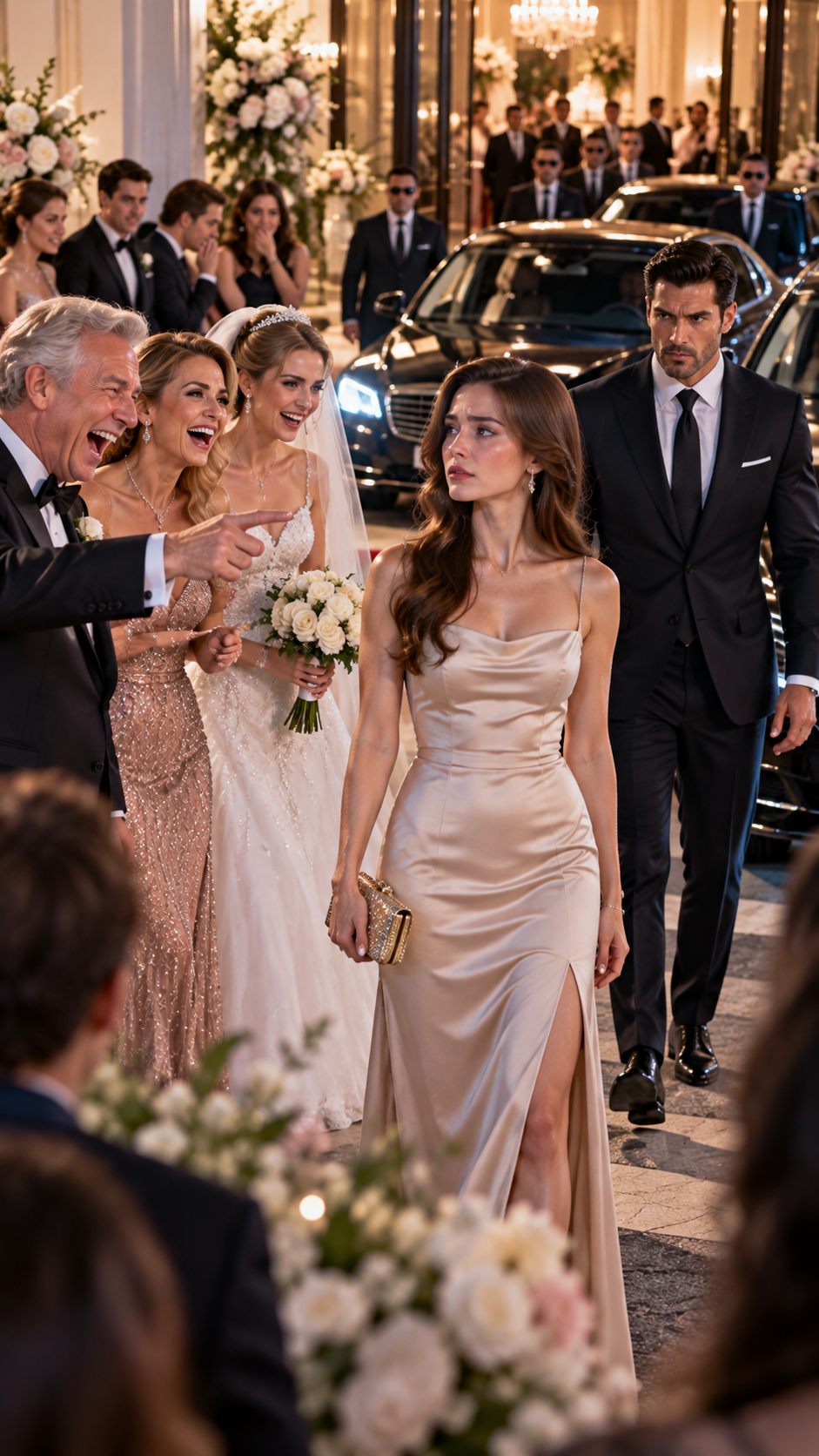
The first person to laugh when I entered my sister’s wedding reception was my father. The second was my sister’s new husband. By the time the rest of the ballroom joined them, I had already noticed the three black cars waiting beyond the glass doors, their headlights cutting through the October rain.
I kept walking.
The heels of my shoes clicked against the polished marble floor, and cold water slipped from the hem of my coat onto the cream-colored runner. Somewhere near the orchestra, a violinist missed half a note. Then my father lifted his champagne glass, turned toward the nearest tables, and made certain that everyone could hear him.
“Look who finally arrived. My younger daughter couldn’t even convince one man to accompany her.”
The laughter that followed was not accidental. It was the kind people produced when a powerful man invited them to participate in somebody else’s humiliation. A few guests glanced at me with uncomfortable sympathy, but most seemed relieved that the attention had settled on someone other than themselves.
My mother, Eleanor, stared at the bracelet around her wrist as though it required immediate examination. My sister, Vanessa, stood beneath a towering arrangement of white roses in a fitted designer gown, looking as if she had rehearsed this moment in front of a mirror.
“Daddy,” she said, with a sweetness that never reached her eyes, “don’t embarrass Emma. Perhaps her date had a last-minute emergency.”
Her husband, Daniel, covered his smile with his hand.
I stopped just inside the reception hall. My navy dress was simple, my hair was still damp from the walk between the car and the entrance, and my silver clutch felt unusually heavy in my hand. Inside it were my phone, three signed documents, and a small flash drive containing six years of financial records that my family had spent considerable effort concealing.
I had come alone because I wanted to arrive alone.
That distinction would have meant nothing to Richard Hale, a man who measured a woman’s worth by the company she kept, the jewelry she wore, and the number of people who stood when she entered a room. To him, independence was merely a polite word for failure when it belonged to his younger daughter.
“Your table is over there,” he announced, pointing toward the far end of the ballroom. “Try not to look so offended. We did make room for you.”
A wedding coordinator approached with the anxious expression of someone who had been warned about a difficult guest.
“Miss Hale? Your place is near the rear tables. I’ll show you.”
“Thank you,” I replied.
My father appeared disappointed that I had not argued. He preferred resistance because it allowed him to portray himself as the reasonable parent dealing with an ungrateful child. Silence left him with fewer opportunities, although he had never been particularly good at recognizing that.
As I crossed the ballroom, I passed tall arrangements of imported flowers, crystal candleholders, gold-edged menus, and bottles of champagne that cost more than some families spent on a month’s rent. A quartet played beneath chandeliers that scattered warm light over the guests’ expensive clothing.
Everything had been arranged to communicate success.
I recognized the florist’s name from an invoice I had examined three weeks earlier. I recognized the event company from a payment routed through a consulting firm that existed only on paper. Even the deposit for the ballroom appeared in the financial trail I had spent months reconstructing.
The money had come from my grandmother’s trust.
My inheritance.
I sat at the assigned table and placed my clutch beside my untouched glass of water. A couple across from me exchanged glances before returning to their conversation. I could not blame them for wondering why I looked so calm. For years, I had learned to hide my reactions because every visible emotion became evidence against me in my father’s private courtroom.
If I cried, I was unstable. If I became angry, I was jealous. If I asked questions, I was ungrateful. If I brought documents, I was obsessed with money.
Eventually, I stopped trying to persuade him that I deserved to be treated fairly.
Instead, I learned how to prove what he had done.
Six years earlier, when my grandmother, Margaret, died, I was twenty-two and working my first serious accounting job. She had been the one person in our family who asked what I thought rather than telling me what I should think. She remembered my exam dates, kept every birthday card I sent her, and once told me that numbers were useful because they did not care who was sitting at the head of the table.
Before her death, she established a trust for me, with my father appointed to manage it until I reached the age specified in the documents.
He told me the fund was intended to provide security for my future. I believed him because he was my father, because my mother assured me the arrangement was proper, and because I had no reason then to imagine that the people closest to me would use a dead woman’s generosity as an opportunity.
When I turned twenty-eight and requested the complete account statements, Richard told me the money was gone.
Bad investments, he explained. Business losses. Legal expenses. Obligations that had supposedly benefited the entire family.
He delivered the news in his home office, standing beside a wall of framed photographs showing him with politicians, business executives, and charitable organizations. He spoke as though he were explaining an unfortunate weather event over which neither of us had any control.
I asked to see the statements.
He said I was insulting him.
I asked for the trust’s annual reports.
He said grief had made me suspicious.
When I insisted that I had a legal right to the information, he told the family I was becoming emotionally unwell.
For a while, I wondered whether I really was overreacting. That was the part I found hardest to forgive myself for. Richard had spent years teaching me to distrust my own judgment, and I had allowed his certainty to compete with facts I had not yet seen.
Then a discrepancy appeared in a routine financial review at my firm. A corporate account had received a payment from a company whose listed address led to an empty office suite. The amount was small enough to escape ordinary attention, but the supporting documents contained a signature that looked disturbingly familiar.
My own.
I had not authorized the transaction.
The discovery changed the direction of my life. I began studying forensic accounting more seriously, eventually specializing in tracing concealed assets, suspicious transfers, and financial statements designed to make stolen money appear legitimate. In my professional work, I learned to follow transactions without becoming distracted by the explanations attached to them.
At home, I started following my own.
The shell companies led to consulting invoices. The consulting invoices led to accounts controlled by businesses associated with my father. Those accounts paid personal expenses, settled debts, and funded purchases that appeared nowhere in the family’s explanations of its financial condition.
Some transfers went to Vanessa.
She received money for her boutique, money for an apartment, and money described in family conversations as gifts from our father’s successful investments. Several transactions were supported by documents bearing her signature.
At first, I tried to find another explanation. Perhaps she had been told the funds were legitimate. Perhaps she had signed something without understanding it. Perhaps Richard had used her name without her knowledge.
Then I found the two transfers she had personally approved.
I printed the records and stared at them for a long time. Vanessa had known about the trust. She had known I was being told it was empty. And she had accepted the money anyway.
When I confronted her privately, she did not deny signing the documents. She told me Dad was trying to protect the family business and that I should stop behaving as though every dollar belonged to me.
“It was supposed to help all of us,” she said.
“Grandmother left it to me.”
“She loved everyone in this family.”
“That isn’t the same thing.”
Vanessa folded her arms and looked at me with the impatience she had displayed since childhood whenever I refused to surrender something she wanted. She said I had always been too rigid, too concerned with rules, and too willing to sacrifice family harmony for technicalities.
I left without answering. By then, I understood that she did not consider the truth a moral obligation. She considered it an inconvenience that could be negotiated away if the consequences threatened her comfort.
The wedding invitation arrived two months later, printed on thick ivory paper with gold lettering. Vanessa’s name appeared beside Daniel’s, and the location was one of Chicago’s most expensive event venues. My father had enclosed a handwritten note about how pleased he would be if I attended and put the past behind me.
There was no mention of the missing inheritance.
No acknowledgment of the false loan documents I had discovered.
No apology for telling relatives that I was unreliable.
Only an expectation that I would appear, smile, and make the family look whole.
I accepted the invitation for one reason: by then, I had learned that Richard was preparing to refinance portions of the company while moving assets into accounts that would be harder for creditors to reach. The wedding expenses were part of a larger pattern, and I needed to understand how much of the trust money had entered those transactions.
My investigation had reached a point where accusations were no longer enough. I needed authenticated records, corroborating witnesses, and a legal path to recover what had been taken.
Three weeks before the wedding, I met Adrian Cole in a downtown office overlooking the Chicago River.
Adrian was an investor whose firm had acquired distressed commercial debt, including a substantial obligation connected to my father’s business. I had contacted his legal team after discovering that one of Richard’s companies had used trust assets to support a transaction tied to the debt. What began as a request for financial records developed into a much larger inquiry.
Adrian did not offer sympathy when we met. He asked precise questions, listened carefully to the answers, and instructed his lawyers to verify every document before drawing conclusions.
That was why I trusted him.
Our relationship had grown slowly, outside the circles in which my father liked to operate. Adrian never asked me to soften my conclusions to spare someone else’s feelings. He also never treated my investigation as a problem he could solve simply by writing a check.
When he offered to accompany me to Vanessa’s wedding, I told him I did not need rescuing.
“I know,” he said. “I’m asking whether you want me there.”
I considered his question longer than I expected.
“Yes,” I answered. “But not because I need someone to prove I’m worth inviting.”
“Then we agree.”
I had asked him to arrive separately, and I had asked him to wait until I sent a message. The arrangement was deliberate. I wanted my father to make his choices in front of witnesses before he knew what I had brought with me.
Now, seated near the back of the ballroom, I watched Vanessa rise to accept the microphone from the wedding coordinator. She tapped the side of her champagne glass and waited for the guests to settle.
“Before the ceremony begins, I’d like to thank everyone for being here,” she said. “Family has always been the most important thing in my life.”
My father beamed.
Vanessa turned toward the rear tables, finding me almost immediately.
“And I want to say something about my sister. Emma has always been independent. Some people might mistake that for loneliness, but I admire her courage. It takes a certain kind of person to come to a wedding without a date.”
A ripple of laughter spread through the room.
Daniel leaned toward her and whispered something I could not hear. She laughed, then lifted her glass toward me.
“I hope she finds someone who appreciates all those spreadsheets one day.”
The guests laughed again. My father looked delighted.
I lowered my eyes to my hands. They were steady. That surprised me more than the insults did.
My phone vibrated inside my clutch.
The message contained four words: We’re outside. Are you ready?
I looked toward the glass entrance. Beyond it, the three black cars stood beneath the awning, rain sliding over their roofs. Men in dark suits were gathering near the first vehicle. One of them held a leather folder against his chest.
I typed my reply.
Not yet. Let them finish.
The officiant moved toward the front of the room. Guests rose from their seats, and the quartet began the music for the ceremony. Vanessa handed her bouquet to a bridesmaid and took Daniel’s hands.
For one brief moment, she looked genuinely happy. I remembered the little girl who had once climbed into my bed during thunderstorms, insisting that I stay awake until the rain stopped. I remembered sharing my school lunches with her and defending her when other children made fun of her.
I wondered when she had decided that loving me was less important than winning against me.
Then my father turned toward the rear tables one last time, caught my eye, and raised his glass in a private toast to his own joke.
I stood.
At the entrance, the doors opened. The music faltered, and the conversations stopped one by one as the first men in dark suits entered the ballroom.
Adrian followed them, rain glistening on the shoulders of his overcoat. He looked neither hurried nor angry. His gaze moved across the room until it found me, and for the first time that evening, his expression softened.
My father turned to see what had interrupted the ceremony.
The champagne glass stopped halfway to his mouth.
PART 1 END
Click here to continue reading: PART 2: The Stranger at the Altar Knew My Father’s Weakest Secret, and His Arrival Changed the Meaning of Every Laugh
They Saved the Best Seat for Their Favorite Joke, Never Suspecting What Was Waiting Beyond the Rain-Soaked Entrance
Part 1 of 12

