
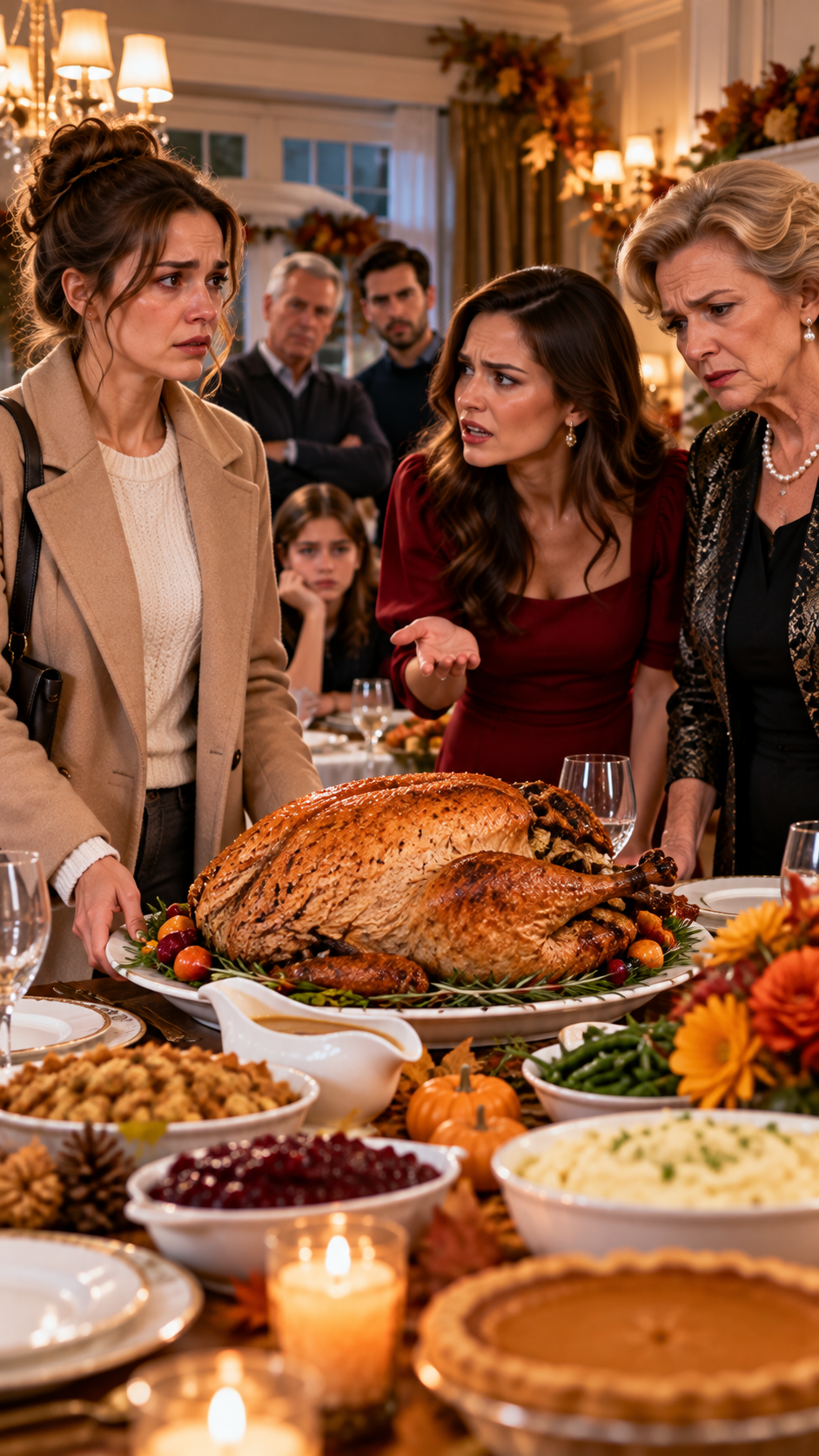
“That turkey looks dry.”
Renee delivered the verdict before I had even taken off my coat. I was standing in my in-laws’ kitchen, both hands wrapped around the handles of a roasting platter that weighed nearly as much as my four-year-old son. The heat from the bird had fogged my glasses, and the smell of rosemary, butter, and roasted skin followed me into the room. I had driven across town with the platter balanced on folded towels, taking every corner slowly because I was terrified the turkey would slide. Now my sister-in-law was looking at it as though I had brought her something I had scraped off the bottom of an oven.
I stared at her for a moment, waiting for the familiar smile that sometimes softened her comments after she noticed their effect. It never came. Renee Hendrick, a successful attorney with immaculate nails and a talent for making criticism sound like ordinary conversation, simply tilted her head. Her eyes moved from the golden skin to the platter beneath it. She had not touched the bird, smelled it, or asked how long it had taken to prepare. She had not even said hello.
“It hasn’t been carved yet,” I answered. “Perhaps we should see what it’s like inside before deciding.”
Renee gave a small shrug, as though I had missed the point of an obvious joke, and turned back toward the dining room. I remained where I was, my arms beginning to ache beneath the weight. Somewhere behind me, a cupboard slammed. In the next room, people were laughing over a bottle of wine. Nobody came to take the platter from me.
My name is Margo. I was thirty-four that Thanksgiving, an occupational therapist with a husband named Graham and a four-year-old son, Theo. We lived in a comfortable house in North York, where the trees along our street turned copper and yellow every autumn. Our life was not extravagant, but it was good in the ways that mattered to me. Theo was curious, affectionate, and forever asking questions that required more patience than any adult possessed before coffee. Graham could make him laugh even when he was tired. I loved my work, loved my son, and believed that the small, ordinary routines of our family were worth protecting.
The Hendricks’ house was another matter. Graham’s parents, Walter and Brenda, lived in a handsome brick home with a wide front porch, polished hardwood floors, and a dining room reserved for occasions important enough to justify bringing out the good china. Their house always looked prepared for a photograph. The cushions stood straight, the silverware shone, and even the flowers seemed to have been arranged according to an invisible set of rules. Visiting there made me feel as though I should check my clothes for lint before sitting down.
Renee was five years older than Graham and had been treated as the family’s natural authority for as long as I had known her. She was clever, articulate, and professionally accomplished. Those were qualities I respected. What I struggled with was the way she used them to make other people feel slightly foolish. She rarely raised her voice. She did not need to. A glance at a badly folded napkin or a pause before answering a question could communicate her disapproval more efficiently than an argument.
Brenda had her own version of the same habit. She could inspect a room, a meal, or a person and identify its shortcomings before acknowledging anything good. Walter generally stayed out of these exchanges. He was not openly hostile to me, but he had perfected the art of remaining absorbed in whatever happened to be in front of him whenever his wife or daughter said something unkind. His silence often left me feeling that I had imagined the insult.
For almost seven years, I had tried to find a way into that family. I remembered birthdays, bought thoughtful gifts, brought wine to dinners, and volunteered to prepare food whenever a holiday required more hands in the kitchen. I listened carefully when Walter talked about his childhood, and I tried to learn the recipes Brenda said her mother had made best. I told myself that people who had known one another for decades sometimes needed time to welcome someone new. I told myself that I should not take everything personally.
The difficulty was that time never seemed to improve anything. If I bought a nice bottle of wine, Brenda might remark that she preferred a different vintage. If I wore a new dress, Renee could mention that the color made me look tired. When Theo arrived at a family gathering in perfectly serviceable boots, Brenda once wondered aloud whether we were teaching him to recognize quality. The boots were clean, warm, and the right size. Theo had chosen them himself because they had little red trucks on the sides.
I would smile, answer politely, and move on. Later, I would replay the exchange in my head, searching for the moment when I might have responded differently. Perhaps I should have worn another dress. Perhaps I should have bought the more expensive boots. Perhaps I had misunderstood Brenda’s tone. It was exhausting work, and none of it changed the next visit.
Graham knew that I found his family difficult. I had told him, although usually in the careful language people use when they are trying not to make their spouse choose sides. I would mention something Renee had said while we washed dishes, or tell him how Brenda had criticized Theo’s manners in front of other relatives. He listened, frowned briefly, and offered an explanation.
“That’s just how Mom is, sweetheart. She doesn’t mean anything by it.”
Sometimes he said Renee was under pressure at work. Sometimes he suggested his mother was tired or worried about getting everything right. He was not deliberately trying to hurt me. He simply regarded each remark as an isolated incident, too small to justify a confrontation. Because he had grown up with those women, he had learned to treat their sharpness as part of the furniture.
I wanted to believe him. I loved Graham, and I did not want a collection of petty disagreements to become a permanent division between us. So I became skilled at swallowing my disappointment before it could turn into an argument. I told myself that being the bigger person meant letting things go. I did not recognize how often I was the only person being asked to let anything go.
Two years earlier, I had spent several weekends learning to make tourtière after Walter mentioned how much he missed the version his grandmother used to prepare. He spoke about it one evening after dinner, describing the pastry, the spices, and the way the kitchen smelled on cold winter afternoons. I remembered how his expression softened while he talked. For once, I had found something that connected him to a happy memory, and I wanted to give him that feeling again.
I tracked down the family recipe through one of Graham’s cousins, visited a specialty butcher, and practiced the pastry until I could roll it without tearing the edges. When I finally brought the pie to a family gathering, I felt nervous but hopeful. Walter took a bite, chewed thoughtfully, and said his grandmother had always used more clove. Brenda examined the crust and asked whether I had made it myself. When I told her I had, she looked unconvinced.
I went home that evening convinced I had failed. It took me months to learn that Walter had actually enjoyed the pie, and even longer before he would admit it to me. At the time, though, I accepted the criticism as useful information. I wondered how much more clove I should use next time. I never considered asking why a meal prepared with such care had to become a test I could pass only by meeting standards nobody had explained.
The Thanksgiving turkey was supposed to be different. The request had come from Graham the previous week, when he mentioned that his mother’s oven was malfunctioning. Brenda was hosting the usual family gathering, and the turkey was the one dish she did not trust anyone else to handle unless circumstances forced her hand.
“Would you mind cooking it at our place and bringing it over?” Graham had asked. “Mom says the oven keeps losing heat. She’s worried it won’t be ready in time.”
I agreed almost immediately. I had already ordered a twenty-two-pound turkey from a butcher three weeks earlier, intending to cook it for our own small celebration before Graham explained the problem. Preparing the bird for his parents would mean more work, but I thought it might be an opportunity to contribute something substantial. I pictured Brenda thanking me as I carried it through the door. I imagined Walter complimenting the seasoning. More than anything, I wanted to arrive with something nobody could reasonably dismiss.
The preparation began the night before. The turkey was too large to fit comfortably in our refrigerator, so I used a clean cooler in the garage for the brine, checking the temperature carefully and making certain the bird stayed cold. I set out the ingredients, cleared the kitchen counters, and arranged the roasting equipment before going to bed. When my alarm rang at five in the morning, I was already tired.
I rinsed and dried the turkey, prepared the herb butter, and worked it carefully beneath the skin. I seasoned the cavity, tucked aromatic vegetables into the roasting pan, and arranged the legs so the bird would cook evenly. The kitchen was chilly at first, but by the time the oven had been running for an hour, the windows had begun to mist. The smell of garlic, sage, and butter drifted down the hallway. Theo wandered in wearing pajamas and asked whether we were having Thanksgiving breakfast.
“Not unless you want turkey before the sun comes up,” I told him.
He considered that possibility seriously, then asked for cereal instead.
The cooking took almost five hours. I monitored the temperature, basted the skin, and checked the thickest part of the breast and thigh with a thermometer. I adjusted the roasting pan when one side began to brown more quickly than the other. By late morning, the skin had turned a deep golden color, and the juices gathered beneath the bird smelled rich and savory. When I finally checked the temperature again and confirmed it was done, I felt a wave of satisfaction so strong that I had to lean against the counter for a moment.
I let the turkey rest, tented it loosely, and prepared to transport it. Graham helped me wrap the platter in thick towels while Theo watched from the doorway, asking whether the turkey was bigger than he was. It nearly was, at least from his perspective. We loaded the platter carefully into the car, and I drove across town with both hands tight on the steering wheel. Every bump in the road made me glance toward the passenger seat.
By the time we reached the Hendricks’ house, my back ached and my coat felt too warm. I was thinking about where to set the platter, whether the turkey would still be hot when it was carved, and whether I had remembered to bring the serving fork. I was not thinking about criticism. I had done the work, followed the temperatures, and checked the meat. I believed that whatever happened next, the turkey would at least be given a fair chance.
Then Renee looked at it and called it dry.
I was still standing in the kitchen when Brenda came in about ten minutes later. She wore a cream-colored sweater and carried a dish towel over one shoulder. She approached the counter, inspected the turkey without touching it, and let out a sigh so practiced that I could not tell whether she was disappointed or merely performing disappointment for an audience.
“Well,” she said, “I suppose it will have to do.”
For a moment, I heard nothing except the low hum of the refrigerator. I watched Brenda turn toward the dining room, already finished with me and my work. My fingers tightened around the platter’s edge. I had not taken off my coat. I had not been offered a glass of water, a place to sit, or even a simple thank-you for bringing the centerpiece of the meal.
Seven years of little remarks seemed to gather in that one quiet kitchen. The pie. The boots. The dresses. The gifts. Every time I had laughed along because correcting someone would have made me appear difficult. Every time Graham had asked me to remember that his mother meant well. I looked down at the turkey, its skin still shining faintly beneath the kitchen lights, and realized that I no longer cared whether Brenda approved of it.
“If it’s only going to do,” I said, surprised by how steady my voice sounded, “perhaps I should take it back.”
Brenda stopped.
“What did you say?”
I lifted my eyes to hers. For the first time since I had married Graham, I was not searching her face for a way to make the moment comfortable.
“I said I could take it somewhere it would be appreciated.”
Her expression hardened. Behind her, I heard Graham set down the wine bottle.
“Margo,” he said, in the warning tone I knew so well.
I looked at him, then back at the woman who had spent less than ten seconds judging five hours of work.
And I made my decision.
Click here to continue reading: PART 2: I Carried the Turkey Back to My Car While My Husband Waited for Me to Apologize to His Mother
The Twenty-Two-Pound Turkey Had Taken Five Hours to Prepare, Yet My Sister-in-Law Found Fault Before Anyone Offered to Help
Part 1 of 12

