
I thought I had learned how to recognize trouble.
I was wrong.
Sometimes, trouble came to your front door wearing a friendly smile.
Sometimes, it brought cookies for your child.
And sometimes, it knew more about your family than you realized.
My name is Sarah.
I was raising my eleven-year-old son, Joel, on my own, and most days, I was too tired to worry about anything beyond getting through the next twenty-four hours.
Five years earlier, my husband had walked out of our lives.
He hadn’t packed a suitcase in front of me.
He hadn’t shouted that he was leaving.
There had been no terrible argument that might have warned me what was coming.
It was an ordinary Tuesday morning.
Nathan kissed Joel on the forehead while our son sat at the kitchen table eating breakfast.
Then he picked up his car keys.
He told me he’d be back that evening.
I believed him.
I watched him leave through the front window, then turned back to the dishes.
Joel waved at his father from his chair.
That was the last time he saw Nathan for years.
Three days later, Nathan called me.
I was standing beside the kitchen sink when my phone rang.
His name appeared on the screen, and I answered without hesitation.
I thought he was calling to explain why he hadn’t come home.
Instead, he told me he wanted a divorce.
I remember staring at the dirty plate in my hand.
For a few seconds, his words didn’t make sense.
I asked where he was.
He said he needed somewhere quiet to sort out his thoughts.
I told him we could talk when he came home.
He said there was nothing left to discuss.
I asked him what that meant for Joel.
Our son was six years old.
He still slept with a stuffed animal tucked beneath his arm, and he believed his father could fix almost anything with a screwdriver.
Nathan answered as if I had asked him about a broken appliance.
He said the boy would manage.
Then the call ended.
I stood in the kitchen long after the screen went dark.
I kept thinking there had to be something I hadn’t understood.
A mistake.
A misunderstanding.
Some detail that would make his decision less cruel.
There wasn’t one.
Within weeks, the divorce process began.
Nathan left me with debts I hadn’t known were as serious as they were.
There were unpaid loans, credit card balances, and bills arriving in envelopes that seemed to multiply overnight.
I didn’t have the luxury of falling apart.
Joel still needed breakfast.
He needed clean clothes.
He needed someone to sit beside him when he had a nightmare.
So I found another job.
During the day, I worked at a dental practice.
In the evenings, I cleaned an insurance office.
Some nights, I came home so exhausted that I barely managed to eat before falling asleep.
I became very good at pretending I wasn’t tired.
Joel became very good at noticing anyway.
One morning, he looked at my shoes while we stood by the front door.
He pointed to the worn sole.
I told him they were perfectly fine.
He looked unconvinced.
I made a joke about how the little hole let my feet breathe.
He laughed because he wanted to make me feel better.
That was the kind of boy he was.
Thoughtful.
Curious.
Always trying to help, even when nobody had asked him to.
He liked building things out of cardboard boxes, old fabric, and whatever scraps he could find around the house.
A cereal box could become a garage.
An empty paper towel tube could become a telescope.
He once spent an entire afternoon making a little house for his toy figures, carefully cutting windows into the cardboard with scissors.
I kept the crooked things he made because he always looked so proud when he finished them.
I wanted him to have a childhood.
Not a perfect one.
Just one in which he could be a child without feeling responsible for his mother’s problems.
But there was one problem I couldn’t fix with a joke or a homemade toy.
His father was gone.
At first, Joel asked about Nathan every few days.
Sometimes, he asked whether his father remembered important dates.
Sometimes, he wondered why Nathan never called.
I always found an answer.
I said he might be busy.
I said perhaps something had happened at work.
I told Joel that grown-ups sometimes needed time to work through difficult things.
I wasn’t proud of those explanations.
I simply couldn’t bear to look into my son’s face and tell him that his father knew how to contact him but hadn’t bothered.
Eventually, Joel stopped asking.
I convinced myself that he was moving forward.
I told myself that children were resilient.
Now, when I think about those years, I wonder whether he had stopped hoping because he had finally accepted the truth.
I wish I had understood that sooner.
There was one thing from my marriage I never forgot.
A watch.
It had a silver bracelet and a deep blue face.
I had saved for six months to buy it for Nathan’s anniversary present.
I gave up little things to afford it.
I delayed replacing clothes.
I counted every purchase.
I wanted to give him something he would keep for the rest of his life.
I even paid to have a message engraved on the back.
It was a promise I believed in when I wrote it.
I thought it would remind him that, no matter how difficult life became, he had a home and a family waiting for him.
After he left, I rarely thought about the watch.
Remembering it hurt too much.
I had more immediate concerns.
Rent.
Food.
School expenses.
Joel’s next pair of shoes.
I kept moving because stopping would have meant facing all the things I couldn’t change.
Then Ivy moved into our neighborhood.
She arrived about six months after Nathan left.
She was older than me, lived alone, and seemed to enjoy getting to know the people on our street.
She told me her daughter and granddaughter lived elsewhere.
I felt sorry for her.
I understood what it was like to spend too much time in an empty house.
At first, Ivy seemed like the sort of neighbor every struggling mother hoped to have.
She brought cookies for Joel.
She asked how school was going.
She offered to keep an eye on him if I needed to work late.
Once or twice, when money was especially tight, she lent me a little to cover groceries and household bills.
I was grateful.
I didn’t have a large family nearby, and most of my friends were busy with their own responsibilities.
Ivy made our lives feel a little less lonely.
That was what I believed.
There were times when her questions struck me as unusually personal.
She wanted to know whether Nathan had started paying support.
She asked if Joel still wanted to take swimming lessons.
She wondered whether I had met anyone new.
I usually laughed and told her that finding time to sleep was difficult enough.
She would smile sympathetically and move on to another subject.
Sometimes, she asked about Joel’s school.
Sometimes, she wanted to know what he did after classes or whether he had been sad lately.
She seemed especially interested in anything connected to Nathan.
I assumed she was being kind.
When someone has spent years feeling alone, kindness can make you overlook things you might otherwise question.
I never considered that Ivy could have a reason for asking.
I never wondered whether my answers were going anywhere beyond her front door.
For five years, she remained part of our ordinary lives.
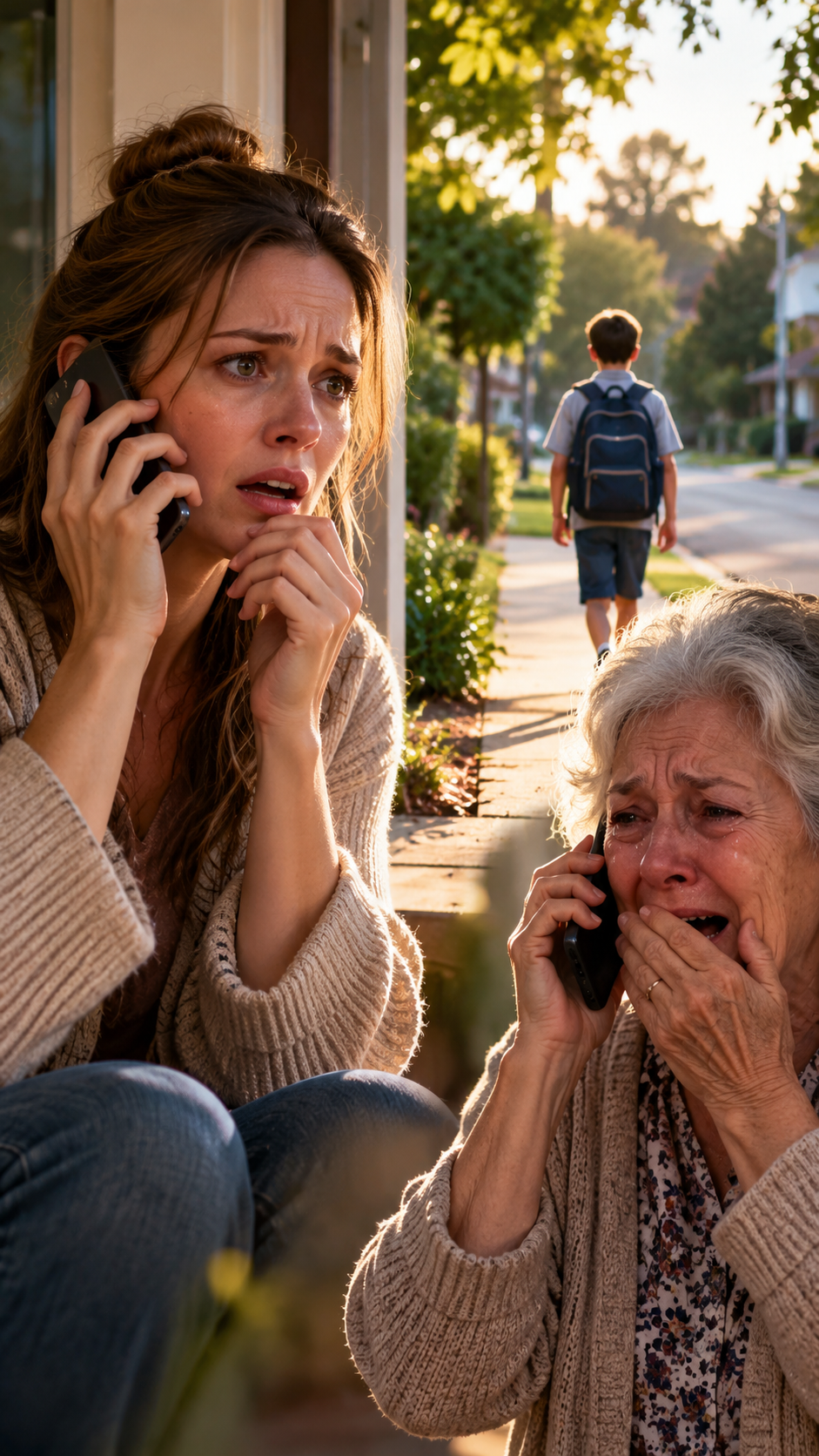
Then came the Friday afternoon when I agreed to let Joel walk home from school alone for the first time.
It was a short journey.
About ten minutes, provided he followed the familiar route and didn’t stop along the way.
He had been asking me for weeks.
He was eleven, and he wanted to prove that he could manage something on his own.
I understood that.
I also remembered being eleven myself.
I knew that growing up meant being trusted with small responsibilities before you were ready for the bigger ones.
Still, I worried.
I told him to come straight home.
I asked him to message me when he left school.
He promised he would.
At 3:11 that afternoon, my phone buzzed.
Joel had sent a short message to let me know he was on his way.
I smiled at the screen.
Then I returned to my work.
Ten minutes passed.
I wasn’t concerned.
Fifteen minutes passed.
I checked my phone.
There was no new message.
At twenty minutes, I walked over to the window.
The street looked ordinary.
A car passed.
Someone was walking a dog on the opposite pavement.
But Joel wasn’t there.
I picked up my phone to call him.
Before I could press his name, it rang.
Ivy.
I answered immediately.
She sounded so upset that I couldn’t understand her first few words.
She told me I needed to come outside.
I asked whether Joel was hurt.
She said he was there.
Then she told me to come and see what my son had done.
I felt the blood drain from my face.
I ran outside without even stopping to put on my jacket.
Ivy was standing beside the curb.
She looked furious.
Joel stood next to her, holding a yellow garbage bag in both hands.
His cheeks were red.
His eyes were wet.
He looked at me as though I were the only person who might believe him.
He spoke before I could ask a question.
He insisted he hadn’t stolen anything.
I went straight to him.
I asked what had happened.
Ivy pointed at the bag and accused him of taking her belongings.
Joel shook his head.
He explained that he had seen cardboard beside her garbage cans and thought he could use it for one of his projects.
According to him, the things had already been thrown away.
Ivy interrupted him.
She insisted that everything in the bag belonged to her.
I looked from my neighbor to my son.
I didn’t know what had happened, but I knew I needed to understand it before anyone made another accusation.
I told Ivy we could examine the contents together.
If Joel had accidentally taken something that shouldn’t have been taken, I would make sure it was returned.
She didn’t seem satisfied.
But she agreed to let me check.
I took the yellow bag from Joel.
He watched me with frightened eyes.
I began emptying it onto the pavement.
Cardboard fell out first.
Then scraps of fabric.
A few pieces of miscellaneous material followed.
I was beginning to think the argument had been a misunderstanding.
Then a man’s shirt slid out of the pile.
Something inside its sleeve struck the sidewalk.
A small metallic sound.
I looked down.
A silver watch lay beside my shoe.
The face was blue.
I stopped breathing for a moment.
I knew that watch.
I had chosen it myself.
I had saved for it.
I remembered holding it in the shop and wondering whether Nathan would like the color.
My fingers trembled as I picked it up.
I turned it over.
The engraving was still there.
The message I had paid to have placed on the back.
I read it once.
Then again.
The years between my marriage and that afternoon seemed to collapse into a single moment.
It was Nathan’s watch.
The one I had given him before he walked away from his wife and son.
And it had been hidden inside a shirt among the belongings my neighbor claimed she had thrown out.
I looked up at Ivy.
Her expression changed as soon as she saw what I was holding.
I asked her how she had come to possess my husband’s watch.
For the first time since I had known her, she looked genuinely frightened.
She demanded that I hand it over.
I held on to it.
I asked again where it had come from.
She told me it was none of my business.
I reminded her that she had just accused my child of stealing from her.
That made the watch very much my business.
Ivy reached toward me and took it from my hand.
Then she hurriedly collected the shirt, cardboard, and fabric.
She pushed everything back into the yellow bag.
I called after her.
She refused to answer.
A moment later, her front door slammed shut.
I stood beside the curb, staring at the house.
Joel was still next to me.
He asked whether he was in trouble.
I put my arms around him and told him he wasn’t.
Then he asked the question I had been dreading.
He wanted to know whether the watch belonged to his father.
I told him the truth.
It did.
He looked toward Ivy’s house.
I did too.
I had spent five years believing Nathan had disappeared from our lives.
Now, somehow, a piece of the marriage I thought was long over had turned up in my neighbor’s garbage.
And I knew one thing with absolute certainty.
I wasn’t going to ignore it.
Click here to continue reading: PART 2: My Neighbor Left Town Without Explaining the Watch, but Her Daughter’s Message Revealed That Five Years of My Life Had Been a Lie
I Thought Letting My Son Walk Home Alone Was the Hardest Part of Growing Up Until My Neighbor Accused Him of Something I Couldn’t Believe
Part 1 of 12

