Eight months after I first arrived at the cabin, I woke one morning to the sound of birds outside the bedroom window.
For a few seconds, I forgot where I was.
Then the familiar wooden ceiling came into view.
The cabin smelled faintly of pine and the coffee I had prepared the night before.
I sat up and looked around the room.
The old building no longer felt abandoned.
The repairs were complete, the roof was sound, and the porch stood straight beneath the front windows.
I had spent months making the place comfortable without trying to turn it into something it was not.
It was still a cabin in the California mountains.
That was part of what I loved about it.
I made coffee and carried my cup outside.
The roses beside the porch had taken root.
Some of their leaves were still small, but the plants looked healthy.
I touched one of the stems gently.
Margaret would have told me not to fuss over them.
Then she would have checked the soil herself.
I smiled at the thought.
The conservation agreement had moved forward after careful review.
The final terms were different from the early conversations, as real agreements often are.
I had made sure I understood what would be protected, what responsibilities I would retain, and how the arrangement would support my future.
The forest, the natural spring, and the wildlife corridor would receive lasting protection under the agreement.
The arrangement also gave me a more secure financial foundation for retirement.
The land had value, but its value was not only a number on a page.
It was the sound of wind moving through the trees.
It was the spring Margaret had once shown me.
It was the knowledge that the land would not simply become another development because someone saw a chance to make money.
I signed the final documents only after I was satisfied with the terms.
When I returned to the cabin, I placed a copy in the same secure drawer where I kept Margaret’s papers.
The blue envelope rested beside them.
I did not need to open it every day anymore.
I had begun to understand the message she had left me.
She had not simply saved money or property.
She had made sure I would have a choice.
A choice to live somewhere safe.
A choice to protect what mattered to her.
A choice to refuse offers that treated me as a burden.
And a choice to decide what kind of relationship I could have with our daughter.
The financial dispute had reached a civil settlement.
The agreement required substantial repayment, and Vanessa and Brandon had faced serious consequences from the process.
Their mansion was gone.
Their finances were no longer what they had been.
Brandon’s property company had collapsed under its debts.
The separate review of the suspicious transactions was outside my control, and I did not pretend to know what every authority might ultimately conclude.
I had done what I could do.
I had preserved the records.
I had asked for the truth to be examined.
I had followed the advice of people who understood the law and the evidence.
And I had refused to let anyone frighten me into abandoning the process.
That did not make me happy about what had happened.
It simply meant I could stop carrying the responsibility for fixing every choice other people had made.
Vanessa’s letter remained in my drawer.
I took it out again one afternoon and read it by the kitchen window.
She had asked to talk.
She had said she missed me.
Those words mattered, but they were not the same as an explanation.
I could not tell whether she was ready to face the whole truth or whether she was simply lonely after losing the life she had expected.
I had no way to know.
So I did not make assumptions.
I sat down and wrote a short reply.
I told her I had received her letter.
I told her I was willing to consider a conversation when we could speak honestly and without pressure.
I did not promise that everything would be forgiven.
I did not tell her she was no longer my daughter.
I left the door open a little, but I did not remove the hinges.
Before sending the letter, I read it once more.
Then I placed it in an envelope and took it to the mailbox at the end of the road.
On the walk back, I stopped beside the trees.
The afternoon sun reached through the branches and fell across the path.
I remembered Margaret standing there years earlier, studying the land with a small notebook in her hand.
She had been quietly building something neither Vanessa nor I fully understood.
I wished I had asked her more questions.
I wished she had not needed to prepare for the possibility that our daughter might disappoint her so deeply.
But I could not change those things now.
I could only take care of what she had left behind.
That evening, I made dinner and ate at the small table beside the window.
I no longer needed to check the value of the land every few days.
I no longer wondered whether I would be forced to leave the cabin because I could not afford to maintain it.
I had a plan for my retirement.
I had a home I could manage.
I had work to do, trees to watch, and roses to tend.
I had enough.
The word felt different now.
For years, I had thought security meant having a house paid for, money in the bank, and a family that would always stand together.
I still valued those things.
But I had learned that wealth could not make a cruel person kind.
A beautiful house could not guarantee peace.
And an inheritance could not tell me who deserved my trust.
Vanessa had received the mansion she once believed proved her importance.
I had received a deteriorating cabin that she thought proved I was worthless.
She had measured our inheritance by what she could show people.
Margaret had measured mine by what it could protect.
I understood that now.
I went to the fireplace and placed another piece of wood on the fire.
The flames caught slowly, then settled into a steady glow.
On the mantel sat a photograph of Margaret and me taken years before her illness.
Her hand rested on my arm.
We were standing outside our old home, both of us squinting into the sunlight.
I lifted the photograph and wiped a little dust from the frame.
“I found it, Margaret,” I said quietly.
“I found what you wanted me to find.”
The cabin was warm behind me.
Outside, the trees moved gently in the evening wind.
I put the photograph back in its place and turned off the kitchen light.
There would be difficult days ahead.
Vanessa and I might speak again, or we might need more time apart.
I could not promise that trust would return.
I could only decide what I was willing to build from this point forward.
Margaret had left me more than land, records, and a letter.
She had left me the chance to live without begging for respect.
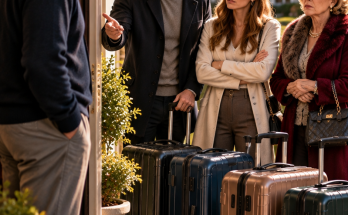
At seventy-one, I had arrived in the mountains with two suitcases and nowhere else to go.
I had thought I was losing everything.
Instead, I had found a home that had been waiting for me all along.
And for the first time since my wife died, I could look toward the years ahead without feeling that I was standing at the edge of someone else’s decision.
I was home.
Source: kaylestore.net
The End
Read more original stories on Feel Every Story.
My Daughter Took the Oceanfront House and Left Me With Two Suitcases, but I Still Couldn’t Understand Why My Wife Had Chosen That Cabin
Part 12 of 12