
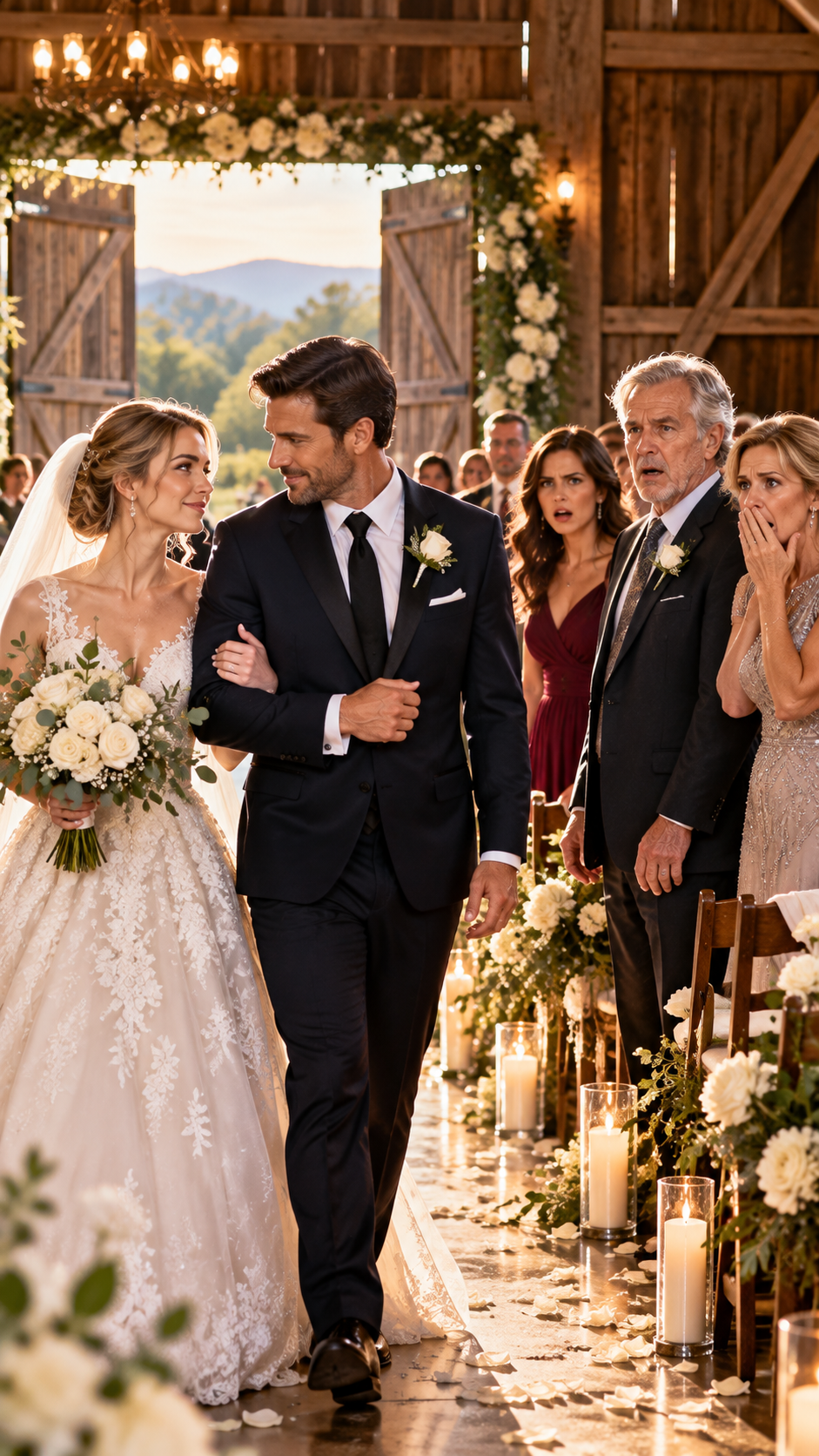
I used to think a promise from your father was something you could count on.
I was wrong.
I learned that three days before my wedding, standing in my workshop with garden shears in one hand and a half-finished arrangement of flowers in front of me.
My phone rang.
I saw Dad’s name on the screen and answered without putting the shears down.
For a moment, I thought he was calling to ask about the ceremony.
Maybe he wanted to know what time he should arrive.
Maybe he had remembered something important.
I had spent weeks trying to make everything right for Saturday, and a small part of me still wanted him to be excited.
Instead, Richard Reed told me he couldn’t walk me down the aisle.
He said it so calmly that I didn’t understand the words at first.
I looked at the fourteen copper vases lined up on my worktable.
Each one held a careful mixture of lavender, rosemary, and white dahlias.
I had arranged them myself.
The workshop smelled like fresh greenery and damp soil, and the afternoon light came through the high windows in pale strips.
Everything was where it belonged.
Except my father.
“What happened?” I asked.
He took a breath, but there was no hesitation in his answer.
“Lauren is having a hard time right now, Amelia.”
I waited for him to explain what that had to do with my wedding.
He continued before I could ask.
“She doesn’t think she can handle seeing me walk you down the aisle.”
My fingers tightened around the shears.
Lauren was my older sister.
She was also the person my parents had spent most of their lives trying to keep happy.
When she was upset, everyone adjusted.
When she made a mistake, someone found a reason it wasn’t entirely her fault.
When she wanted something, the rest of us were expected to understand why it mattered so much to her.
I had grown up believing that was simply how families worked.
Now I was getting married, and apparently the same rules still applied.
“Why would that upset her?” I asked.
Dad sighed.
“Things are difficult between Lauren and her husband.”
I knew their marriage had been falling apart.
I knew there had been arguments and long stretches when they barely spoke.
I also knew Lauren was worried about what would happen to her children if the separation became permanent.
Sophie and Noah were still young enough to believe that Christmas could fix almost anything.
They were the reason my parents were so careful around Lauren.
She had made it clear that if Dad chose to walk me down the aisle, she might keep the children away from the family at Christmas.
That threat had apparently been enough.
“She’s not the one getting married this weekend,” I said.
My voice sounded steadier than I felt.
“I am.”
Dad went quiet.
I could hear a faint noise on his end of the call, something like a door closing.
He might have been standing in his kitchen.
I pictured him looking out the window, trying to find a way to make this conversation easier for himself.
He had always been good at that.
He could make a decision that hurt someone and then speak as though the real problem was the discomfort of discussing it.
“I don’t want you to misunderstand me,” he said.
I almost laughed.
There was something strange about hearing those words from a man who had just told his daughter he would not be present for one of the most important moments of her life.
“Then explain it to me.”
“I just think you need to consider what Lauren is going through.”
“I have considered it.”
“She’s very vulnerable right now.”
“And I’m getting married.”
He didn’t answer.
I looked down at the flowers again.
One of the white dahlias had a damaged petal, so I reached for it with my free hand and removed it carefully.
I couldn’t explain why that tiny task mattered.
Perhaps I needed something I could fix.
Something that wouldn’t turn around and tell me I was asking for too much.
Dad finally spoke.
“Please don’t make me sound like a terrible father over this.”
That was when I understood.
He wasn’t asking whether I was hurt.
He was asking me not to describe what he had done in a way that made him uncomfortable.
I swallowed.
“You’ve chosen Lauren.”
“That’s not fair.”
“Isn’t it?”
“I’m trying to keep things from getting worse.”
“For her.”
He didn’t deny it.
I had spent years making excuses for him.
I told myself he was tired, or busy, or caught between two daughters who wanted different things.
I had told myself that being the quieter daughter meant I was the easier one to disappoint.
Looking back, I hate how easily I accepted that explanation.
I thought being understanding made me mature.
Sometimes it only made me convenient.
“I’m sorry, Amelia,” Dad said.
I closed my eyes.
For a second, I wanted to accept the apology.
I wanted to tell him I understood and that everything would be fine.
I wanted to return to my flowers, finish the arrangements, and pretend this conversation had been a misunderstanding that would somehow correct itself.
But he hadn’t misunderstood anything.
He had made his decision.
“I’m not sure you’re sorry about what you’re doing,” I told him.
He said nothing.
“I think you’re sorry that I won’t make this easy for you.”
The silence afterward was worse than an argument.
I could hear my own breathing.
I could feel the metal handles of the shears pressing into my palm.
Dad eventually said he had hoped I would be more reasonable.
That word hurt more than I expected.
Reasonable.
It was the word my family used when they wanted me to accept something I would never have asked anyone else to accept.
I had been reasonable when Lauren canceled plans because she was upset.
I had been reasonable when birthdays became complicated because my sister was having a difficult week.
I had been reasonable when my parents forgot something important to me and expected me to understand.
Now I was supposed to be reasonable about my own wedding.
“All right,” I said.
I didn’t mean that I agreed.
I meant that I couldn’t keep having the same conversation with a man who had already decided what mattered.
We ended the call.
I stood beside the worktable for a while, holding the shears.
The workshop looked exactly as it had before my phone rang.
The copper vases were still lined up.
The flowers were still fresh.
The oak shelves along the wall still held the jars, twine, and tools I used every day.
Nothing had changed.
Except the person who had promised to walk beside me had decided I wasn’t worth the trouble.
I set the shears down.
Then I picked them up again because I couldn’t remember why I had put them down.
That was how shocked I was.
I kept working for another few minutes.
I adjusted a stem in one vase, moved a branch of rosemary, and checked the spacing between two arrangements.
My hands knew what to do even when my mind didn’t.
Then I looked at the empty place beside the workbench where Dad had once stood while I showed him a finished project.
He had come to the workshop before.
He had admired the shelves and asked about the business.
He had even helped carry a heavy table inside once.
I had thought those small moments meant we were closer than we really were.
Maybe I had mistaken the occasional appearance of a father for the steady presence of one.
My phone rang again.
Mom.
I stared at her name for a moment before answering.
Part of me hoped she had called because Dad had told her what happened and she wanted to comfort me.
I should have known better.
“Your father explained the situation,” Diane said.
She sounded as if we were discussing a seating arrangement.
“Did he?”
“Amelia, I don’t want this to become a bigger problem than it needs to be.”
I leaned against the worktable.
“What problem?”
“Lauren is struggling. We all know that.”
I waited.
Mom continued explaining how difficult the separation had been for my sister, how worried Lauren was about the children, and how important it was for the family to remain calm.
I listened to every word.
She didn’t ask how I felt.
She didn’t ask whether I had already imagined walking into the barn with Dad beside me.
She didn’t ask what it was like to hear him withdraw a promise three days before I was supposed to marry Ethan.
Instead, she told me that walking down the aisle alone could be a positive experience.
“You can show everyone how independent you are,” she said.
I looked toward the workshop door.
The afternoon sunlight had moved across the floor.
I had no idea how long we had been talking.
“Mom, I wanted my father to walk with me.”
“You have Ethan.”
I closed my eyes.
“That doesn’t mean I don’t care about Dad.”
“You’re going to have a husband. You should focus on that.”
I could hardly believe what I was hearing.
“And I’m not allowed to be upset about my father?”
Mom exhaled sharply.
“That’s not what I’m saying.”
It was exactly what she was saying.
She simply didn’t want to hear herself say it.
I asked her whether she thought Dad had made the right choice.
She avoided answering.
She talked about Lauren’s emotional state, about the children, and about how much pressure everyone was under.
Then she reminded me that nearly two hundred people would be attending the wedding.
“We don’t need a scene,” she said.
I looked at the flowers on the table.
Fourteen copper vases.
Fourteen arrangements.
I had planned every detail because I wanted the day to feel warm and welcoming.
Now my mother was worried about appearances before the ceremony had even begun.
“I wasn’t planning to make a scene.”
“Good. Then there’s no reason for this to become an issue.”
I pressed my lips together.
For years, I had believed my mother was the person who could understand both sides of an argument.
I was beginning to see that she understood the side that caused her the least trouble.
“Walk in by yourself,” she said. “Hold your head up, smile, and don’t turn this into something embarrassing.”
I didn’t answer immediately.
I wanted to ask whether she would have given Lauren the same advice.
I wanted to know whether my sister would ever be expected to swallow a disappointment without everyone rushing to protect her.
But I already knew the answer.
Mom said my name again.
I told her I had to go.
Then I ended the call.
This time, I put the phone facedown on the worktable.
I didn’t cry immediately.
I moved the damaged dahlia into a separate container.
I washed a little soil from my fingers.
I straightened a roll of ribbon that hadn’t needed straightening.
Then I walked out the back door of the workshop and sat on the low step behind it.
The air was cool.
I could smell the herbs growing in pots near the wall.
Somewhere beyond the garden, a car passed on the road.
I stared at my hands.
They were steady now.
That almost made it worse.
I had imagined that if something truly hurt me, I would know what to do.
Instead, I sat alone behind my own workshop, trying to understand how a wedding could become a family negotiation in the space of two phone calls.
I had three days left.
Three days to decide whether I would keep pretending that being hurt was the same thing as causing trouble.
And for the first time in my life, I wasn’t sure I wanted to be the reasonable one.
Source: 1millionstories.net
Click here to continue reading: PART 2: My Mother Called It Independence, but the Man Who Found Me Behind the Workshop Understood Why I Could Not Pretend I Was Fine
Three Days Before the Wedding, My Father Made a Choice That Left Me Holding Garden Shears and Questioning Everything I Believed About Family
Part 1 of 12

