
I used to believe that if I loved my son enough, he would eventually come back.
I was wrong about that.
For thirteen years, I waited for a phone call that never came, a letter that never arrived, or even a simple message telling me he was still alive and doing well.
Then, three days after I sold my company for $4.2 million, someone knocked on my front door.
It was Andrew.
My son.
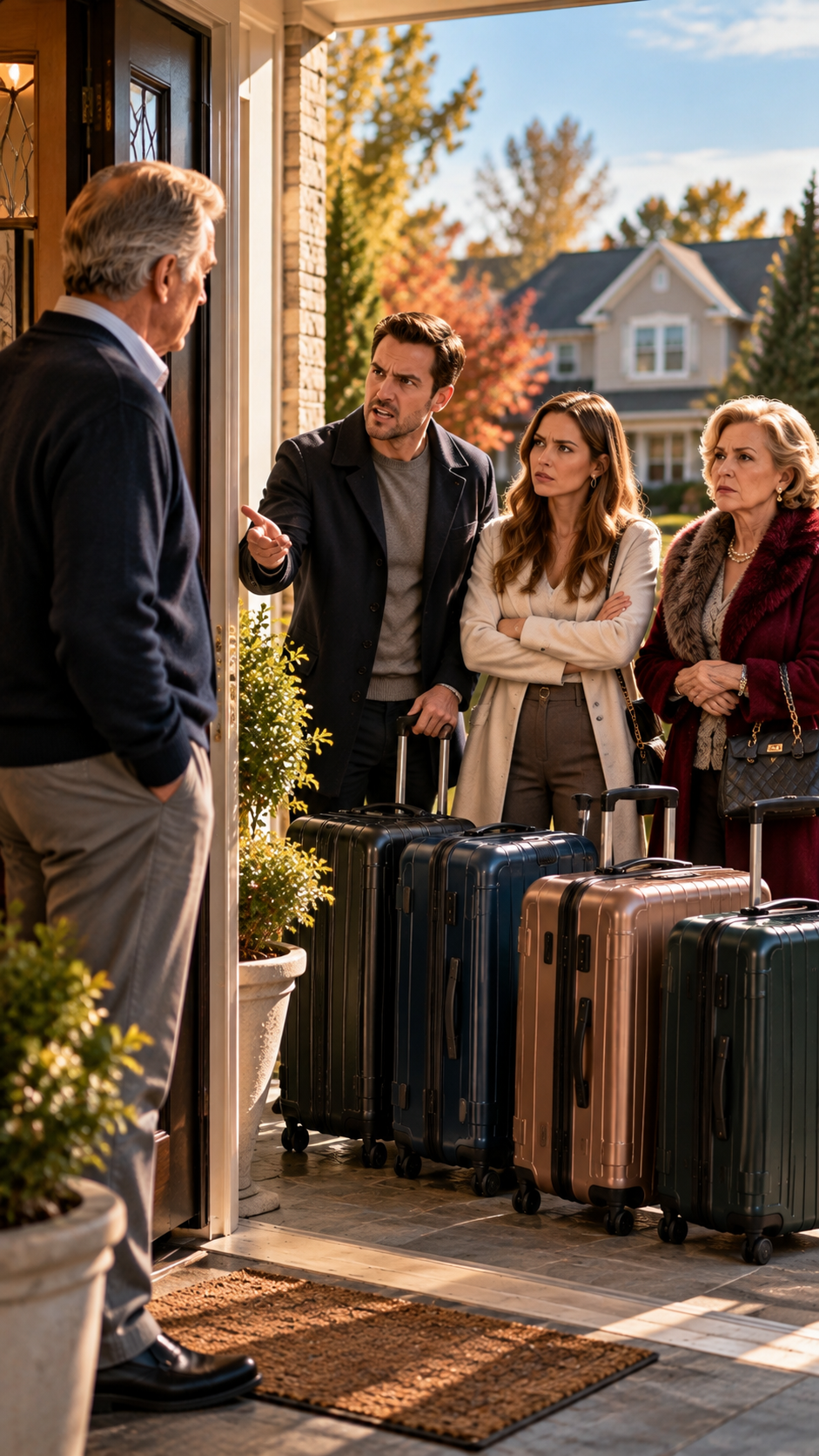
He stood on the porch with his wife, Jessica, her mother, Patricia, and four large suitcases.
I remember looking at those suitcases before I looked at their faces.
They had brought enough luggage to suggest they weren’t planning a short visit.
Andrew didn’t hug me.
He didn’t ask how I had been.
He barely looked at me before announcing what he had come for.
“We need to talk about our share. And we’ll need separate bedrooms.”
For a moment, I thought I had misunderstood him.
I was seventy-one years old, a widower, and a man who had spent more than a decade trying to understand why his only son had decided to erase him from his life.
Now Andrew was standing at my door as if he had merely been away for a weekend.
And he was already assigning rooms.
I looked at Jessica.
She seemed entirely comfortable with the arrangement.
Patricia, her mother, was studying the entrance hall with the expression of someone inspecting a property she might soon own.
Nobody appeared embarrassed.
Nobody seemed aware of how strange this meeting was.
I stepped back from the door, though I didn’t invite them in.
“Before we discuss bedrooms, can you tell me how you’ve been?”
Andrew gave a short, impatient laugh.
“Dad, let’s not make this complicated.”
That answer told me more than he probably intended.
My name is William Carter.
I had lived in that Connecticut house for decades, long enough for every floorboard to make a familiar sound and every room to hold a memory of my wife, Margaret.
She had been gone for years.
The house had become quieter after her death, but I had learned to live with the silence.
I still kept her photograph above the fireplace.
I still made two cups of coffee some mornings before remembering that only one person was left to drink them.
And I still checked the mailbox more often than necessary, even though I knew Andrew wasn’t going to write.
For thirteen years, I had tried to accept that my son wanted nothing to do with me.
Now he was here.
Not because he missed me, as I briefly and foolishly hoped.
Because he believed I had money to give him.
Jessica finally broke the silence.
“William, are you going to let us stand outside all morning?”
She said it as if I were the one behaving badly.
I moved aside just enough for them to enter the hall.
Patricia came in first.
She glanced at the staircase, then at the living room, and finally at the framed photographs along the wall.
“This house needs some work,” she said.
“We can talk about improvements later.”
Later.
She said the word as though she already expected to be involved in decisions about my home.
Andrew pulled one suitcase across the floor.
The wheels rattled over the wooden boards, making a sound that seemed far too loud in the quiet house.
“Jessica and I will take the main bedroom upstairs,” he said. “Patricia needs something on the ground floor.”
I watched him leave the suitcase beside the stairs.
He had not asked whether I had a spare room.
He had not asked whether I wanted company.
He had simply decided.
“How long are you planning to stay?” I asked.
Andrew turned toward me.
“Dad, we’re family. We shouldn’t have to negotiate every little thing.”
I almost smiled.
Family.
That word had been absent from his vocabulary for thirteen years.
When I had needed him, I had been told to stay away.
When Margaret was dying, he had not come.
When we buried her, he had not stood beside me.
But now, apparently, we were close enough for him to decide where I should sleep in my own house.
I kept my voice calm.
“That’s an interesting way to describe our relationship.”
His expression hardened.
“Don’t start blaming me for everything.”
I hadn’t raised my voice.
I hadn’t even accused him of anything.
Still, he was already defending himself.
Jessica folded her arms.
“We didn’t come here to argue about old problems.”
“No,” I said. “You came here to discuss your share.”
Andrew looked directly at me.
“You know what we mean.”
I did.
Three days earlier, the investment group that had purchased my manufacturing business had completed the sale arrangements.
The business had taken decades to build.
I had started small, worked long hours, and spent years earning the trust of customers who needed specialized equipment they could depend on.
There had been difficult years.
There had been nights when I wondered whether the company would survive another month.
But it had survived.
Eventually, it became a respected supplier in Connecticut.
The sale price was $4.2 million.
That number had appeared in conversations I hadn’t expected, and apparently in conversations I hadn’t been invited to.
I had hoped to spend my retirement quietly.
I wanted to visit a few places Margaret and I had once discussed, support young people entering technical careers, and stop worrying about payroll every Friday.
I had not imagined that the sale would bring my son back to my door.
Andrew took a step closer.
“You sold the company, Dad. We know.”
There it was.
No greeting.
No apology.
Just the money.
I looked at the four suitcases again.
“Who told you about the sale?”
Jessica answered before Andrew could.
“People talk. It’s not a secret.”
Perhaps it wasn’t.
But the speed of their arrival made it difficult to believe this was a coincidence.
Patricia had moved toward the living room.
She was looking at the furniture, the windows, and the fireplace.
“There’s plenty of room here,” she observed. “You don’t need all of it to yourself.”
I looked at her.
“This is my home.”
“Of course,” she replied, with a smile that suggested she considered the matter temporary.
Andrew cleared his throat.
“We’ve had some expenses. Things haven’t been easy.”
That was the first time he had mentioned his life.
Even then, he said nothing about his children.
I had two grandchildren I had never held.
They had been born during those thirteen years, and I knew them mostly through fragments of information that reached me indirectly.
I didn’t know what they liked to eat.
I didn’t know whether they had their mother’s eyes or Andrew’s stubborn expression.
I didn’t know what they called their grandfather.
I had missed birthdays, school milestones, and every ordinary moment that makes a family familiar.
Andrew had made sure of that.
Years earlier, when I refused to give him $200,000 for a business scheme, he had decided I was no longer worth speaking to.
Jessica had called me selfish.
Patricia had accused me of deliberately ruining their future.
Andrew had delivered the final punishment himself.
He told me not to expect to meet any children he might have.
I had taken him seriously.
I had respected the distance he demanded, even when respecting it felt like tearing something out of my own chest.
Now he was standing in my hallway, speaking as if those years had never happened.
“What exactly do you think you’re entitled to?” I asked.
His answer came quickly.
“An inheritance. Something to help us get back on our feet.”
I looked at him for a long moment.
“You’re asking me for an inheritance while I’m standing right here.”
He shifted his weight.
“That’s not what I meant.”
“Then explain what you meant.”
Jessica opened her mouth, but Andrew raised a hand to stop her.
“We’re not going to have this conversation in the doorway.”
For the first time, I agreed with him.
There were things we needed to discuss.
Just not the things he expected.
I turned toward the dining room, where Margaret and I had spent countless evenings talking about our son.
For years, I had wondered whether Andrew would someday understand what he had done.
I had also wondered whether I would have the strength to face him if he returned.
I never imagined he would arrive with luggage and a list of demands.
I turned back to him.
“Before anybody unpacks, there’s something you should know.”
Jessica let out a tired sigh.
“Please don’t give us another speech.”
“I won’t.”
I paused.
“I’ve already made decisions about my estate.”
That changed Andrew’s face.
His impatience disappeared.
He looked at me properly for the first time since arriving.
“What kind of decisions?”
I didn’t answer immediately.
There was no point trying to explain everything while they stood around my hallway, surrounded by suitcases and assumptions.
My attorney needed to be present.
Rebecca Collins had represented me for twenty years. She had handled business agreements, property matters, and the practical details that came with building a company.
She also knew what had happened between Andrew and me.
More importantly, she knew I had not spent the last thirteen years sitting around waiting for my son to change his mind.
I had built a life without him.
I intended to keep it.
“Come back tomorrow morning,” I said. “Nine o’clock. My attorney will explain the arrangements.”
Patricia looked relieved.
“Good. Finally, we’re getting somewhere.”
Andrew glanced toward the staircase.
“What about the rooms?”
“The rooms will still be here tomorrow.”
He seemed to interpret that as permission to return with his suitcases.
I let him believe whatever he wanted.
They carried the luggage back outside, one bag at a time.
Jessica said nothing as she passed me.
Patricia offered a brief smile.
Andrew was the last to leave.
For a second, I thought he might turn around and say something that sounded like a son speaking to his father.
Instead, he picked up the final suitcase.
“See you in the morning.”
Then he walked away.
I closed the door.
The house became quiet again.
I stood in the entrance hall and looked at the empty space where the suitcases had been.
I felt no relief.
Not yet.
I walked to the telephone and called Rebecca.
She answered on the second ring.
“William?”
“It’s happened,” I told her.
“What has?”
“Andrew has come back.”
There was a pause.
Then she asked the question I had been expecting.
“Does he want to make things right?”
I looked toward Margaret’s photograph above the fireplace.
“No. He wants his share.”
Rebecca exhaled slowly.
“Then we should be prepared.”
I looked at the clock.
Tomorrow morning was going to be difficult.
But for the first time in thirteen years, I wasn’t going to face my son alone.
Source: kaylestore.net
Click here to continue reading: PART 2: My Son Arrived With a Calculator and a List of Demands, but My Attorney Had Prepared for a Very Different Conversation
My Son Stayed Away for Thirteen Years, Then Returned Three Days After My Company Sold for Millions
Part 1 of 12

