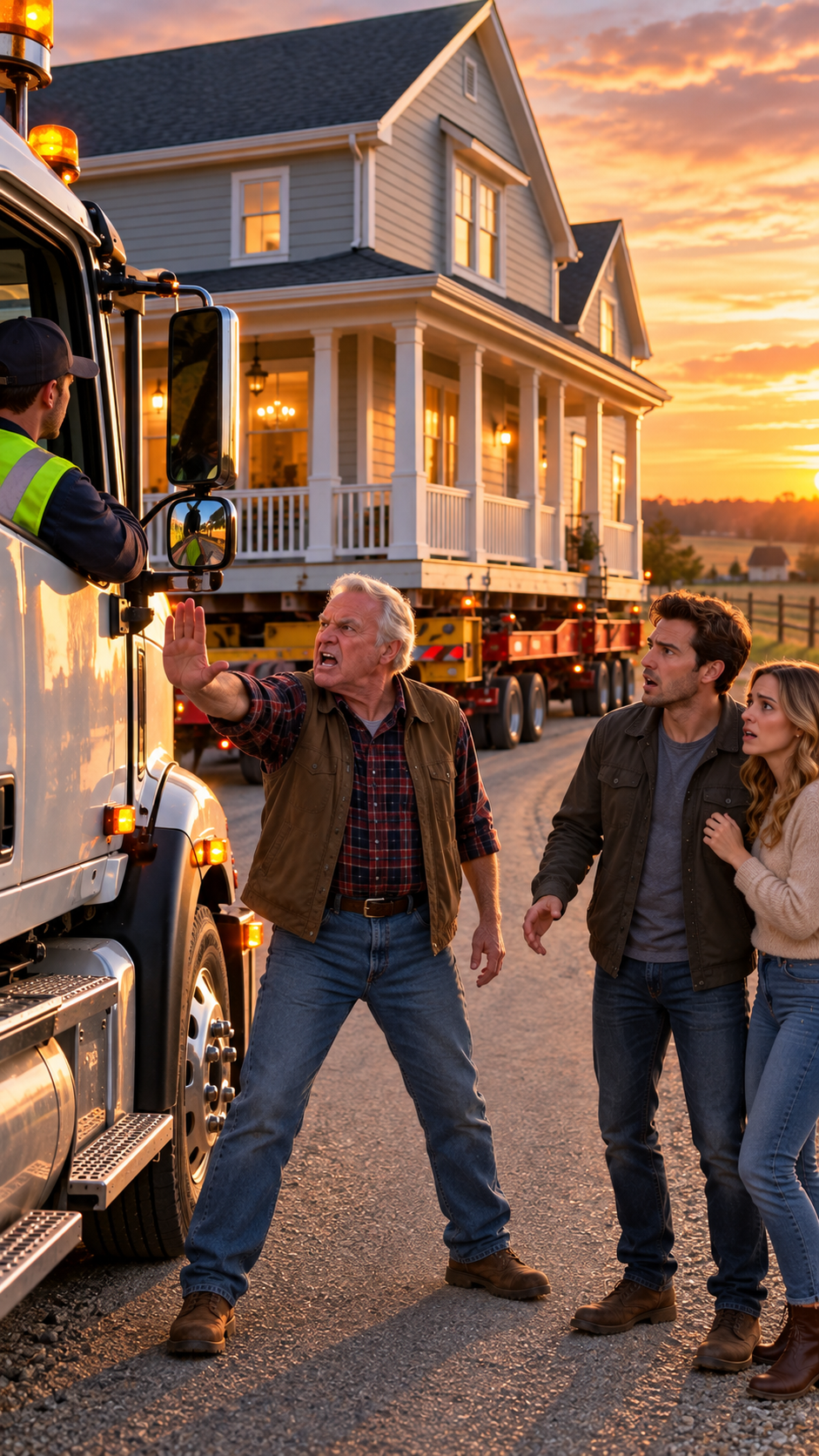
I used to believe that if you worked hard, paid what you owed, and treated family with respect, nobody could take away the life you had built.
I was wrong.
The day my father-in-law told us our house belonged to him, I was standing in our kitchen with a coffee mug in my hand.
The mug had a small chip near the handle.
I had meant to replace it for years, but somehow it had become part of the kitchen.
Just like everything else in that house.
Gordon Rasmussen sat across from me at the table, drinking his coffee as though he were discussing the weather.
He had come by that morning without much warning.
My husband, Jake, was home, and our two children were getting ready for the day.
Hailey was looking for her shoes.
Cole was asking whether he could ride his bicycle after school.
It was an ordinary morning.
Then Gordon put his cup down.
“I’ve been thinking about what will happen to my property when I get older.”
Jake looked up from the table.
I remember the way he held his spoon still above his bowl.
“What about it, Dad?”
Gordon wiped his mouth with a napkin.
“The house will stay with the land.”
For a moment, I thought I had misunderstood him.
Our house stood on two acres that belonged to Gordon.
But the house itself was ours.
Jake and I had paid for it, furnished it, repaired it, and spent eleven years making it a home.
We had two children who had grown up inside those walls.
There was no reason to think Gordon was talking about taking it.
Or so I believed.
Jake set his spoon down.
“Dad, we paid to build that house.”
Gordon barely moved his shoulders.
“You built it on my property.”
I waited for him to explain what he meant.
He didn’t.
Instead, he reached for his coffee again.
“Anything attached to my land belongs to me.”
The words came out so casually that they frightened me more than an argument would have.
I put my mug on the counter.
“Are you saying the house is yours?”
Gordon looked directly at me.
“That’s what I’m saying.”
I remember hearing Hailey run down the hallway.
Her shoes slapped against the floor, followed by Cole calling after her.
Neither child knew anything had changed.
I wished I could say I stayed calm.
I didn’t.
I felt as if someone had walked into our home and quietly announced that our entire life had been a misunderstanding.
Jake leaned forward.
“We’ve paid you every month for eleven years.”
Gordon nodded.
“You paid to use the land.”
“And the house?”
“You were allowed to live there.”
That was when I understood.
He wasn’t confused about what we had paid.
He knew exactly what the arrangement had been.
He simply believed it gave him the right to claim everything.
For eleven years, Jake and I had sent him five hundred dollars every month.
We had never skipped a payment.
Not when our car needed repairs.
Not when medical bills arrived.
Not when our working hours were cut and we had to count every dollar before buying groceries.
Five hundred dollars.
Month after month.
We had treated the arrangement as a family agreement.
Gordon had treated it as something else.
I looked at Jake, hoping he would find the right words to make his father reconsider.
Instead, he stared at the table.
He was angry, but I knew that wasn’t the only thing he felt.
Gordon was his father.
That mattered to him, even then.
It mattered enough to make everything harder.
“Dad, you know we paid for that home ourselves.”
Gordon folded his napkin.
“I never said you didn’t.”
“Then how can you say it belongs to you?”
“Because it stands on my land.”
He spoke as though repeating the same sentence made the argument stronger.
I wanted to shout.
I wanted to remind him about every payment, every repair, and every time we had helped him when he needed something.
Instead, I stood beside the counter and said nothing.
Looking back, I hate how quickly I became quiet.
I had spent years believing that keeping peace in a family was a good thing.
That morning, I began to understand how expensive that belief could become.
Our house was only twelve hundred square feet.
It wasn’t impressive.
There was no grand staircase or expensive kitchen.
The living room was small enough that the children could shout from one end and be heard clearly at the other.
The hallway floor creaked near the bedrooms.
The pantry doorframe carried little pencil marks showing how much Hailey and Cole had grown.
Those marks were more important to me than anything expensive we owned.
Hailey’s first height mark was near the bottom.
Cole’s latest mark was almost level with my shoulder.
We had made those marks while laughing about how quickly children grew.
Now I found myself wondering whether Gordon thought even those memories belonged to him.
Jake pushed his chair back.
“We need to talk about this properly.”
Gordon stood.
“I’ve told you how it is.”
Then he picked up his coat.
There was no apology.
No offer to discuss it later.
He left through the front door as if he had finished an ordinary conversation.
I watched his truck disappear down the driveway.
For several seconds, neither Jake nor I spoke.
Then Cole came into the kitchen.
“Can I ride my bike today?”
Jake looked at him.
I watched my husband take a breath before answering.
“Sure, buddy.”
Cole smiled and hurried away.
I turned toward the sink because I didn’t want him to see my face.
We had built that house for our children.
We had chosen the rooms with them in mind.
We had paid every bill we were asked to pay.
And now the man who owned the land believed he owned the place where our children slept.
That evening, after Hailey and Cole were in bed, Jake and I sat at the kitchen table.
The same table where his father had made his announcement.
A stack of bills lay between us.
I moved them aside and took out a notebook.
“Let’s write down everything we’ve paid.”
Jake rubbed his forehead.
“We already know what we’ve paid.”
“I want to see it.”
So we started counting.
Five hundred dollars a month.
Twelve months a year.
Eleven years.
Sixty-six thousand dollars.
I wrote the total in the middle of the page.
Then I stared at it.
Sixty-six thousand dollars was not a small amount to us.
It represented years of working, saving, and deciding which things could wait.
It represented money we could have used for other parts of our children’s future.
Jake looked at the number.
“He can’t just pretend none of that happened.”
I wanted to believe him.
But I also knew that being right and being protected were not always the same thing.
We had no written agreement clearly spelling out what would happen to the house.
We had trusted Gordon because he was family.
We had assumed that a handshake and eleven years of payments meant something more than a convenient arrangement.
We had never imagined we would need to prove our intentions to him.
The next morning, Jake called an attorney.
We explained the situation as carefully as we could.
We told the attorney that we had paid for the house ourselves, that Gordon owned the land, and that we had paid him five hundred dollars each month.
We explained that the arrangement had continued for eleven years.
The attorney listened.
Then he asked us for the written agreement.
Jake and I looked at each other.
There wasn’t one.
The attorney explained that the situation could be complicated.
Without clear documents protecting our ownership and rights, the dispute might become a costly legal fight.
He couldn’t promise us a quick answer.
He couldn’t promise that we would avoid court.
When the call ended, Jake sat very still.
I looked at the notebook on the table.
The number sixty-six thousand suddenly seemed much smaller than the problem in front of us.
We had spent years paying for the land beneath our home.
But we had never made certain that the law would protect the home itself.
And now we were facing the possibility of losing it.
Source: kaylestore.net
Click here to continue reading: PART 2: We Had Spent Eleven Years Trusting One Man, and Now We Had to Decide What Our Family Could Afford to Lose
My Father-in-Law Had One Sentence That Made Eleven Years of Payments Feel Like They Had Never Mattered
Part 1 of 12