I used to believe that losing a child was the worst thing a mother could survive.
I was wrong.
There were things people could say afterward that made the loss feel even more unbearable.
I learned that beside two small coffins, with my four-year-old daughter holding on to my dress.
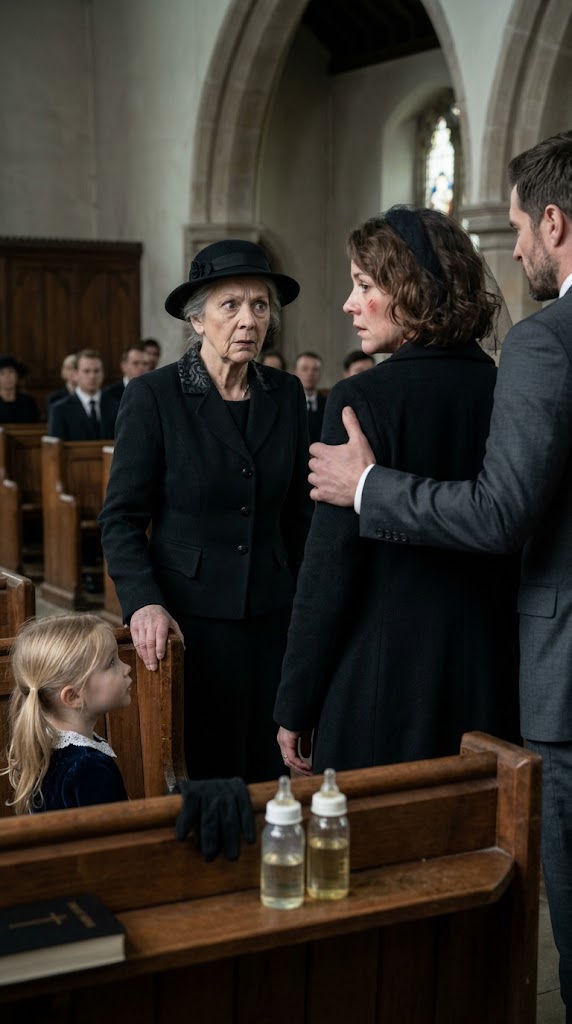
My mother-in-law, Miriam, stood in front of me.
She looked directly into my face and told me that God had taken my boys because He knew what kind of mother I was.
For a second, I couldn’t understand the words.
I heard her voice.
I saw her mouth moving.
But my mind refused to put the two together.
Behind her were arrangements of white roses tied with pale blue ribbons.
Small stuffed bears had been placed among the flowers.
I kept looking at those bears because I couldn’t look at the coffins for very long.
They were meant for my sons.
Owen and Luke.
Five months old.
My babies.
My daughter, Emma, leaned against my leg.
Her tights had slipped down at one knee, and she was rubbing the soft edge of her dress between her fingers.
She had been doing that all morning.
Whenever she became frightened or confused, she rubbed the same piece of fabric.
I knew that about her.
I knew how she liked her milk, which songs made her laugh, and how she sometimes woke in the night just to check that I was nearby.
I knew the ordinary things about my children.
I had never imagined I would have to stand at their funeral and defend my right to be their mother.
“Mommy, why are the grown-ups whispering?”
I bent toward her.
“They’re sad, sweetheart.”
She looked across the room.
Then she looked up at me again.
I wished that answer had been enough.
Across the chapel, my husband, Trevor, was speaking to a man from work.
Someone had put a hand on his shoulder.
Trevor looked exhausted, with dark circles beneath his eyes and a face that seemed older than it had eleven days earlier.
I was exhausted too.
Neither of us had slept properly since the boys died.
Eleven days.
That was all the time separating the family we had been from the family standing in that room.
Before those eleven days, we had three children.
Emma was our oldest.
Owen and Luke were our twin boys.
Owen liked to curl his fingers around mine during feeding.
His whole hand would close around one finger as if he were trying to keep me there.
Luke was different.
He could cry through an entire afternoon, but if Emma sang the beginning of “You Are My Sunshine,” he would grow quiet.
She only knew the first two lines.
She sang them again whenever he started fussing.
Sometimes she sang them to Owen too, just in case.
I had thought there would be years of those little moments.
I had thought I would forget some of them as the children grew.
Instead, I was afraid of forgetting anything.
The boys’ names had been written on small cards beside the flowers.
I read those names over and over.
Owen.
Luke.
I knew the letters.
I knew the names.
I still couldn’t understand why they had been placed in a room where everyone was dressed in black.
Miriam stepped closer to me.
She had been watching me for several minutes.
I knew that look.
She used it whenever she believed I had failed some test she had never explained.
“I warned Trevor that those children needed a mother who knew how to look after them.”
I stared at her.
My sister, Rachel, was standing near the chapel entrance, talking quietly with the funeral director.
I wanted to call her.
I wanted someone to come between Miriam and me before she said anything else.
“Please don’t do this,” I told her.
Miriam ignored me.
“You were always worn out. You were forever saying how difficult everything was.”
I remembered the conversation she meant.
It had happened at her kitchen table months earlier.
I had been tired from caring for Emma and the twins.
I had admitted that sometimes I cried in the shower because it was the only place where nobody was calling for me.
It had embarrassed me to say it.
I had trusted her enough to believe she would understand.
She had remembered every word.
Now she was bringing them back while my sons lay in front of us.
I felt something inside me harden.
“That’s enough, Miriam.”
She tilted her head.
I could see that she wasn’t finished.
“You should have listened when people tried to help you.”
I took a breath.
“Move away from me.”
She struck me across the face.
The sound seemed much louder than it should have in that quiet room.
My head turned.
For a moment, I couldn’t move.
Then Emma screamed.
I turned toward my daughter, and Miriam grabbed my hair.
Pain spread across my scalp as she pulled.
I tried to get away from her.
The funeral director reached us before I could understand what was happening.
He caught Miriam’s wrist and ordered her to release me.
She resisted for a moment.
Then her fingers loosened.
Rachel rushed over and gathered Emma into her arms.
Trevor appeared beside me.
His hand closed around my upper arm.
“Clara, settle down.”
I looked at him.
I honestly thought I had misheard him.
His mother had slapped me.
She had pulled my hair in front of our children’s funeral guests.
Our daughter was crying so hard she could barely breathe.
And Trevor wanted me to settle down.
“Mom, please sit over there,” he told Miriam.
He spoke as if she had become upset during an ordinary family disagreement.
He didn’t ask whether I was hurt.
He didn’t ask Emma what had frightened her.
He just stood there, trying to make the room quiet again.
I pulled my arm away from him.
People were watching us.
A woman offered me a chair.
Someone near the back said they should call for assistance.
The funeral director was still standing between Miriam and me.
I heard every word, but none of it seemed close to me.
I could only see Emma’s frightened face over Rachel’s shoulder.
I had failed to protect my boys from whatever had happened to them.
Now I couldn’t even keep their grandmother from hurting their mother at their funeral.
The thought made me feel sick.
Then Emma slipped out of Rachel’s arms.
She didn’t run toward me.
She walked a few steps toward Pastor Daniel, who was standing beside the first row of chairs.
He had baptized her when she was a baby.
Every Sunday, he let her choose which basket she wanted to carry during the children’s collection.
She trusted him.
He lowered himself until he was looking directly at her.
“What is it, Emma?”
She rubbed the hem of her dress.
Then she glanced at Miriam.
“Can I tell you something Grandma said I must keep secret?”
The room seemed to change.
Pastor Daniel didn’t look frightened, but his expression became serious.
He kept his voice gentle.
“Yes, sweetheart. You can tell me.”
Emma looked down at her hands.
“It’s about the babies’ bottles.”
Miriam moved so quickly that her chair scraped against the floor.
“She doesn’t know what she’s talking about.”
The funeral director stepped in front of her again.
Pastor Daniel didn’t ask Emma to repeat herself in front of everyone.
He looked toward Rachel.
“Let’s go somewhere quiet.”
Rachel took Emma’s hand.
The three of them walked toward the small sitting room beside the chapel.
I started after them.
I needed to know what my daughter was trying to say.
Behind me, Miriam spoke again.
“Clara, that little girl invents things.”
I stopped.
Not because I believed her.
Because I remembered something.
The night before my sons died, Miriam had offered to take over their feeding so I could sleep.
She had told me to go upstairs.
For once, she hadn’t criticized the way I held a bottle or the way I prepared the formula.
She had simply said she would handle it.
I had been grateful.
I had thought she was finally trying to help me.
Now, standing beside my children’s coffins, I couldn’t stop thinking about the bottles.
Source: 1millionstories.net
Click here to continue reading: PART 2: My Daughter Had Been Carrying a Secret About Her Brothers, and I Finally Understood Why Grandma Was Afraid of Her Words
My Mother-in-Law Chose the Worst Possible Moment to Tell Me What She Thought I Deserved
Part 1 of 15