
I followed them into the sitting room.
I couldn't help it.
I needed to hear what Emma had seen, even though I was afraid of what her answer might do to the little bit of hope I had left.
Rachel looked back at me from the doorway.
Her expression told me to wait.
I stopped.
Pastor Daniel closed the door most of the way, leaving it slightly open.
Nobody was trying to hide Emma from me.
They were trying to give her room to speak without a dozen adults staring at her.
I understood that.
I also hated it.
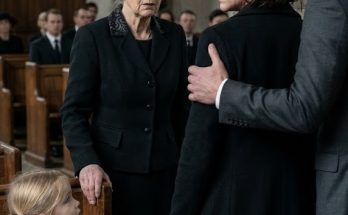
My daughter was four years old.
She should have been thinking about toys, picture books, and whether she could have another biscuit before dinner.
She should not have been asked to explain anything connected to her brothers' deaths.
I stood in the corridor with my hands pressed together.
From where I was, I could see a narrow strip of the room.
Rachel sat beside Emma.
Pastor Daniel pulled another chair closer but didn't crowd her.
He spoke quietly.
I couldn't hear every word.
I caught Emma's name.
Then I heard him tell her that she could take her time.
Miriam was still somewhere behind me.
I didn't turn around.
I knew she would be watching.
I knew she would be waiting for someone to dismiss Emma's words as a child's imagination.
That was what she had always done whenever Emma said something inconvenient.
She called her dramatic.
She said she was copying the adults.
She said children misunderstood things.
Until that afternoon, I had rarely challenged her.
I had told myself that Miriam was simply difficult.
I had told myself that keeping the peace was easier than arguing with her.
Looking back, I can see how often I mistook silence for peace.
The door opened a little wider.
Rachel came into the corridor.
Her face was pale.
“What did she say?” I asked.
Rachel glanced toward the chapel before answering.
“She said she saw Miriam put something into one of the bottles.”
I felt the wall behind me with my hand.
“Something?”
“She didn't recognize it as the formula you normally used.”
I tried to make sense of that.
There were bottles.
There was formula.
There were the ordinary things I had handled every day while feeding two babies.
I knew how to prepare their feeds.
I knew where I kept the supplies.
I knew the containers I used.
But Emma was four.
She might not have known what everything was called.
She might have seen something innocent and misunderstood it.
I knew all the reasons to be cautious.
I also knew why Miriam had rushed to stop her.
“What exactly did she say?”
Rachel shook her head.
“Daniel is being careful not to lead her.”
I nodded, though I wanted to push past her and ask Emma myself.
I wanted to hear the words in my daughter's voice.
I wanted to know whether she had seen something that mattered or whether grief was making me search for answers anywhere I could find them.
Rachel touched my shoulder.
“Clara, let them handle this properly.”
I hated that she was right.
I had spent the last eleven days wanting someone to explain why my sons were gone.
Now my daughter had offered the first detail that might help explain what happened, and I couldn't simply demand that she tell me everything.
I had to wait.
That was all I could do.
Wait.
A few minutes later, Pastor Daniel came out.
He asked me to sit down.
I couldn't.
“What did she tell you?”
He looked at me with the same careful expression Detective Alvarez would later use.
“Emma said she saw your mother-in-law put something into a bottle.”
I almost corrected him.
Miriam wasn't my mother.
She was my husband's mother.
It was a pointless distinction, and I knew it.
I was frightened enough to reach for anything that made the conversation feel less real.
“Did she say what it was?”
“No.”
“Did she say why?”
“She said Grandma told her it was a secret.”
I pressed my fingertips against my lips.
A secret.
The word seemed too ordinary for what it meant now.
Children were told to keep secrets about birthday presents.
They were told not to spoil surprises.
They weren't supposed to be made responsible for holding something frightening inside because an adult had told them not to speak.
Pastor Daniel sat down beside me.
“I want you to understand something. Emma has told us what she remembers seeing. We don't yet know what it means.”
“I know.”
My answer came too quickly.
He waited.
I looked at him.
“I need to know whether it has anything to do with my boys.”
“So do the investigators,” he said. “That's why we need to be careful.”
I looked toward the closed door.
“Can I talk to her?”
“Of course. But don't ask her to repeat the details. Let the specialist speak with her when the time comes.”
I nodded again.
I was beginning to understand that wanting the truth and knowing how to find it were two different things.
Rachel brought Emma out.
My daughter came straight to me and wrapped both arms around my waist.
I bent down and held her.
Her face was damp from crying.
I kissed the top of her head.
She smelled like the children's shampoo I had used that morning before we left for the funeral.
For a moment, I could almost pretend we were home getting ready for an ordinary day.
Then I remembered the coffins.
Emma looked up at me.
“Mommy?”
“I'm here.”
“Are you mad?”
The question hurt more than I expected.
“No, sweetheart.”
“Even though I told?”
I held her a little closer.
“I'm not mad at you.”
She looked toward the chapel.
“Grandma was mad.”
“I know.”
“Did I do something bad?”
I swallowed.
“No, Emma. You didn't do anything wrong by telling someone what you saw.”
She seemed to think about that.
I didn't ask her what else she remembered.
I didn't ask what was in the bottle.
I wanted to.
God, I wanted to.
But I could see how frightened she was, and I knew that making her repeat herself wouldn't help either of us.
Instead, I held her hand and walked with Rachel toward the exit.
Miriam was still inside.
I didn't say goodbye to her.
I didn't look for Trevor.
I couldn't stand in that chapel another minute.
Outside, the air felt colder than it had when we arrived.
Rachel opened her car and helped Emma into the back seat.
I sat beside my daughter.
She held a stuffed rabbit by one ear.
It wasn't one of the bears from the funeral flowers.
It was an old toy she had brought from home, its fur worn smooth where she liked to hold it.
Rachel started the engine.
Nobody spoke for the first few minutes.
I watched the buildings pass outside the window.
People were going about their lives.
Someone was carrying shopping bags.
A man stood beside a parked car, talking on his phone.
A woman pushed a stroller along the pavement.
I wondered how many of them had ever received news that divided their lives into before and after.
Then I wondered how many mothers had sat in a car beside a surviving child and tried to work out how to keep that child safe from the pain of the world.
I didn't have an answer.
I only knew that Emma was beside me, and she needed me to be her mother.
Not a grieving woman who needed her to explain what had happened.
Not someone who treated her as the key to solving a mystery.
Her mother.
That was the one thing I could still do.
Rachel drove us to her house.
It was the only place I could imagine staying.
I couldn't return to my own home.
Not yet.
The thought of walking into the nursery made my chest tighten.
I could picture the two little beds.
I could picture the bottles.
I could picture the things I had prepared for the boys before they were born, believing I was making a safe place for them to grow.
I couldn't face any of it.
At Rachel's house, she helped Emma out of the car and brought her inside.
I followed them into the kitchen.
The room was familiar.
Rachel had a bowl of fruit on the counter and a stack of unopened mail beside the kettle.
Ordinary things.
Things that belonged to a world where people still had to eat, pay bills, and decide what to make for dinner.
I sat down.
Emma climbed into the chair beside me.
She put her rabbit on the table and began rubbing its ear between her fingers.
I reached across and held her hand.
She didn't pull away.
For a little while, we stayed like that.
Then there was a knock at the front door.
Rachel went to answer it.
I heard a woman's voice identifying herself as a nurse.
A moment later, Rachel returned with the nurse and a uniformed officer.
The officer introduced himself and explained that he needed to take a statement about what had happened at the funeral.
I had almost forgotten that Miriam had struck me.
Almost.
The pain in my cheek was still there, and my scalp hurt where she had pulled my hair.
But those injuries seemed small beside everything else.
I answered the officer's questions as clearly as I could.
I told him what Miriam had said.
I told him she had hit me.
I explained that she had grabbed my hair when I tried to move away.
I told him about the funeral director stepping between us.
I told him that Rachel had taken Emma away from the confrontation.
When he finished, the nurse examined my cheek and checked the tender area beneath my hair.
She asked whether I felt dizzy.
I said no.
She asked whether anything else hurt.
I said my heart hurt, though I knew that wasn't what she meant.
She gave me a moment before continuing.
I appreciated that.
People had been asking questions all day.
Some wanted to know whether I was eating.
Some wanted to know whether I had slept.
Others wanted to tell me that everything happened for a reason.
I had stopped knowing how to respond to any of them.
The officer eventually left.
The nurse finished her examination.
Rachel brought me a glass of water.
I held it without drinking.
Emma was on the floor now, sitting beside her aunt and arranging wooden animals in a line.
Every so often, she looked toward the kitchen.
Each time, I lifted my hand so she could see me.
Each time, she returned to her animals.
It was such a small thing.
It was also the only thing that made me feel useful.
Later, Rachel sat across from me.
“Do you think Miriam could have done something to the boys?”
I stared at the water.
“I don't know.”
It was the only honest answer I had.
I didn't know what Emma had seen.
I didn't know what Miriam had put into the bottle.
I didn't know whether it had been connected to my sons' deaths.
I wasn't going to turn a frightened child's memory into a conclusion simply because I needed one.
But I couldn't pretend the memory meant nothing either.
I looked toward Emma.
She was making the wooden animals walk around the table leg.
She had no idea how much her small voice had changed the course of that day.
I wished she had never needed to speak about it.
I wished I could have protected her from knowing anything that would make her afraid of her own grandmother.
Most of all, I wished Owen and Luke were still alive.
There was no investigation, no explanation, and no answer that could make those wishes disappear.
But for the first time since their deaths, there was something the adults needed to examine.
And I could no longer pretend that the night before they died had been an ordinary night.
Source: 1millionstories.net
Click here to continue reading: PART 3: The Detective Told Me Not to Guess, but Every Memory of That Night Was Beginning to Look Different
My Mother-in-Law Chose the Worst Possible Moment to Tell Me What She Thought I Deserved
Part 2 of 15

One Comment on “PART 2 – My Daughter Had Been Carrying a Secret About Her Brothers, and I Finally Understood Why Grandma Was Afraid of Her Words”