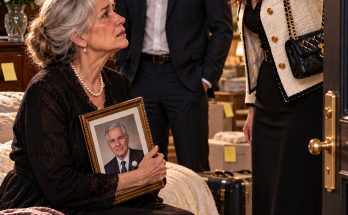
Over the next few days, I noticed a change in Grandma.
It wasn't dramatic.
She still called to ask whether I had eaten.
She still worried about small things.
She still remembered birthdays and kept cookies ready for unexpected visitors.
But she had stopped rushing to reassure everyone that everything was fine.
When Dad called, she told him honestly if she was tired.
When a neighbor asked whether she needed help carrying something, she accepted without insisting she could manage alone.
And when Paige sent a message asking how she was feeling, Grandma answered without pretending that the restaurant incident had already become a distant memory.
Those were small changes.
They mattered.
I had spent years thinking Grandma's kindness was something that needed protecting from the world.
I was beginning to see that part of protecting her meant respecting her decisions, even when those decisions involved telling people she loved that they had disappointed her.
One afternoon, I visited her after work.
She was sorting through a small stack of household receipts at the kitchen table.
A pair of reading glasses rested beside her notebook.
I asked what she was doing.
"Getting organized."
She held up a receipt from the grocery store.
"I seem to have collected enough paper to open my own office."
I laughed and sat down.
She continued sorting the papers into small piles.
Then she mentioned something that made me look up.
"I've decided I'm not accepting any more surprise restaurant invitations."
I waited for her to explain.
"If somebody wants to take me out, we'll discuss the arrangements first."
"That sounds sensible."
"I want to know where we're going, how I'm getting home, and who's paying."
She looked at me over her glasses.
"Before I put on my pearls."
I laughed.
She laughed, too.
It was the first time we had joked about the evening without her expression changing afterward.
I was glad.
Not because the incident had become funny.
Because Grandma was beginning to reclaim the parts of herself that had been overshadowed by embarrassment.
She wasn't going to stop going out.
She wasn't going to stop enjoying time with family.
She simply wanted to know what she was agreeing to before she agreed to it.
That was reasonable.
It was something she should never have needed to learn at eighty-one.
But she had learned it.
And she seemed comfortable with the decision.
I asked whether she was worried Paige and Trevor might be offended by her new rule.
She shook her head.
"They can be offended if they like."
I stared at her.
Then she smiled.
"I love them, Anna. But I don't have to make every decision based on whether somebody else might be unhappy."
I thought about how many times I had done exactly that.
I had agreed to things I didn't want to do because I didn't want to create tension.
I had stayed quiet when a conversation needed honesty.
I had stepped in to solve problems because it seemed easier than allowing the people responsible to face them.
Grandma wasn't the only one who needed to learn something from Friday.
I did, too.
The following day, Dad called me.
He told me he had been thinking about the restaurant incident and the way he had handled family disagreements over the years.
He admitted that he had often used money to make uncomfortable situations disappear.
If Paige or Trevor had a problem, he offered help.
If somebody was upset with them, he tried to smooth things over.
He had believed that a quick solution was a good solution.
Now he understood that sometimes a quick solution only protected people from learning anything.
I listened.
I didn't tell him he had been a terrible father.
That wasn't true.
He had supported us in many ways.
He had worked hard to keep the family together.
But his desire to avoid conflict had sometimes allowed the wrong people to escape responsibility.
"I'm glad you're thinking about it," I said.
"I should have thought about it sooner."
I didn't disagree.
He asked whether Grandma seemed better.
I told him she was doing well, but that she was still processing what had happened.
He said he understood.
Then he asked whether I thought he should visit her.
I told him that was something he should discuss with her directly.
"Don't assume she's ready just because she's willing to talk."
He was quiet for a moment.
"You're right."
That evening, I called Grandma.
She told me Dad had asked whether he could come by for tea later in the week.
She had agreed.
She said she wanted to talk with him about something that had bothered her for a long time.
I asked what it was.
She didn't give me the details.
"I'll tell you when I'm ready."
I respected that.
It wasn't my conversation to manage.
For so long, I had been the person who carried information between family members.
I explained one person's feelings to another.
I tried to make difficult conversations easier.
I sometimes believed I was helping.
But there was a difference between helping somebody find their voice and speaking so often that they never needed to use it themselves.
I wanted Grandma to have the chance to say whatever she needed to say directly.
A few days later, I stopped by her house again.
She was sitting in her favorite chair, looking through an old photograph album.
I joined her.
There were pictures of family birthdays, holidays, and afternoons at the beach.
Grandpa appeared in several of them.
He was smiling in one photograph, holding a paper bag of sandwiches while Grandma stood beside him in a sun hat.
She touched the edge of the picture.
"We never needed much to have a good day."
I smiled.
"You've told me that before."
"I know."
She looked at the photograph for a while.
Then she closed the album.
"I don't want what happened at that restaurant to make me afraid of enjoying myself."
I turned toward her.
"It won't."
She nodded.
"I'm going to keep seeing people. I'm going to keep going places. But I'm going to make sure the arrangements are clear."
I thought that was a good decision.
She didn't need to become suspicious of everyone.
She didn't need to withdraw from the world.
She needed to know that she could set boundaries without feeling guilty.
Grandma had spent decades being the person who made things easier for everyone else.
Now she was learning that she could ask others to do their part.
Before I left, she reminded me that she wanted to go to the coast with me the following week.
I told her I was looking forward to it.
"Nothing too expensive," she said.
"Nothing too expensive."
"And no surprises."
I raised my hand as though taking an oath.
"No surprises."
She laughed.
I left her house feeling lighter than I had in days.
The family still had work to do.
Paige and Trevor had apologized, but trust would take longer.
Dad was reconsidering habits he had followed for years.
And I was learning that keeping peace did not mean taking responsibility for everyone else's decisions.
For the first time, those changes felt like something we could build on.
Not a perfect family.
A more honest one.
Source: lessoninlife.net
Click here to continue reading: PART 8: A Week After the $412 Dinner, I Took Grandma Back to the Coast, Where a Sandwich and a Bottle of Lemonade Meant More Than an Expensive Table
The Blue Dress, the Empty Chairs, and the Four Hundred Dollars Nobody Had Warned My Grandmother She Would Owe
Part 7 of 12