I used to think that if you loved your children enough, they would never make you feel like a stranger.
I was sixty-eight when I learned how wrong I could be.
It happened in the house where I had raised my son, buried my husband in my memories, and spent nearly four decades believing that kindness would always find its way back to me.
My name is Margaret Bennett.
And the first person who made me feel unwelcome in my own home was my daughter-in-law.
But I didn’t understand how far things had gone until the first evening she moved in.
That morning, I had still believed I was doing the right thing.
My son Edward called at 10:42 on a Tuesday.
I remembered the time because I was standing in the kitchen, looking at the clock above the refrigerator, wondering whether I had enough beef to make stew for dinner.
His voice sounded different.
Not angry.
Not impatient.
Tired in a way I had rarely heard before.
“Mom, have you got a minute?”
I put the knife down.
“Of course, sweetheart. What’s happened?”
He told me his company had eliminated his department.
Just like that, he had lost his job.
The rent on the apartment he shared with his wife and two children had become more than they could manage, and he didn’t know how long it would take him to find another position.
He tried to explain everything at once.
The bills.
The interviews.
The embarrassment.
I listened without interrupting.
Then he went quiet.
“Mom, I don’t know what we’re going to do.”
I knew that silence.
I had heard it when he was a boy and thought he had disappointed his father.
I had heard it when his first serious relationship ended.
And now I heard it again from a grown man who was frightened that he couldn’t provide for his family.
I didn’t ask how much money he had left.
I didn’t ask why he hadn’t planned for an emergency.
I didn’t remind him that adults sometimes had to face the consequences of their choices.
I was his mother.
And he needed help.
“You can all come here,” I told him. “Stay with me while you get things sorted out.”
He exhaled so loudly that I moved the phone away from my ear.
“Really, Mom?”
“Really.”
He thanked me several times.
I told him there was no need to thank me.
At the time, I meant it.
My house had enough rooms, and I was alone most of the day anyway.
My husband, Anthony, had been gone for several years, leaving behind a collection of books, a blue coffee mug, and more memories than I knew what to do with.
The house was quiet.
Sometimes too quiet.
The thought of hearing my grandchildren running down the stairs again made me smile.
Dylan was twelve.
Sarah was nine.
They had spent countless weekends with me when they were younger, usually leaving behind toys, crumbs, and questions I couldn’t always answer.
I missed those days.
I imagined Sarah helping me in the kitchen and Dylan asking whether he could stay up late.
I imagined Edward sitting at the dining table, talking to me the way he used to before work, bills, and marriage seemed to take up every corner of his life.
I imagined a family helping one another through a difficult season.
I did not imagine having to defend my right to sit at my own dinner table.
That afternoon, I prepared for their arrival.
I changed the sheets in the guest room and placed fresh towels in the upstairs bathroom.
I cleared a drawer for Sarah’s clothes and made room in the closet for Dylan’s jackets.
Then I went to the grocery store.
I bought Dylan’s favorite crackers.
I picked up the strawberry yogurt Sarah always asked for.
And I bought the ingredients for Edward’s favorite beef stew.
Rosemary.
Carrots.
Potatoes.
Fresh bread.
Small things.
But when you are a mother, small things can feel like the only way to tell someone that they still have a place in your life.
My husband had understood that better than anyone.
Anthony and I bought the house thirty-eight years earlier, when we were both young teachers.
We had very little money.
We counted every dollar, postponed vacations, and worked extra hours whenever we could.
Anthony repaired the kitchen cabinets himself.
He planted a maple tree beside the front porch.
He built a wooden bench beneath the dining room window because he said every house needed somewhere to sit and watch the world pass.
When we finally paid off the mortgage, he framed the confirmation and hung it in his workshop.
He was so proud of that piece of paper.
I used to tease him about it.
“You’d think we’d won the lottery.”
He would smile.
“We did. We own our home.”
After he died, I kept the framed confirmation.
The house was still mine, legally and practically.
The deed carried my name alone.
I paid the bills.
I arranged the repairs.
I decided what stayed and what changed.
But I never thought of the house as just a property.
It was the life Anthony and I had built together.
And I wanted my son to feel welcome there.
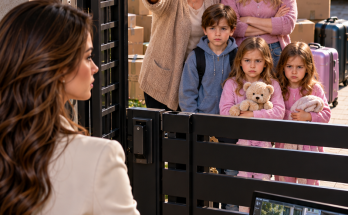
By noon the next day, Edward’s car pulled into my driveway.
I was waiting near the front door.
Dylan climbed out first, carrying a backpack that looked too heavy for him.
Sarah followed, holding a stuffed animal against her chest.
I hugged them both.
“Grandma, your house smells like bread.”
“That means you’ve arrived at the right place.”
They laughed.
For a moment, I felt certain everything would be all right.
Then Linda got out of the passenger seat.
She looked at the front of the house before she looked at me.
Her expression was difficult to describe.
Not exactly displeased.
More like someone inspecting a place she had already decided was beneath her expectations.
She carried one suitcase and left the rest for Edward.
“Hello, Margaret.”
“Hello, Linda. Come inside.”
She walked through the doorway and stopped in the hallway.
Her eyes moved from the staircase to the living room, then toward the kitchen.
She opened a cupboard.
She looked inside the downstairs bathroom.
She examined the furniture.
I told myself she was probably nervous.
Moving into another person’s home was not easy.
Neither was losing an apartment or watching your husband struggle to find work.
I wanted to be understanding.
I wanted to give everyone time.
Then Linda walked upstairs and opened the door to the guest room.
She stood in the middle of it, studying the bed and the small dresser beside the window.
“This room is smaller than I expected.”
I followed her inside.
“It’s the guest room. The children can use the room across the hall.”
She glanced toward the bathroom.
“And that lighting is terrible.”
I almost laughed, but her face told me she wasn’t joking.
“I can replace the bulb if it’s too dim.”
She didn’t answer.
Instead, she walked down the hallway and pushed open my bedroom door.
I had been in that room every night since Anthony died.
His side of the closet was still empty.
His books remained on the bedside table, and the photograph of us on our wedding day stood beside my lamp.
Linda looked around as if she were deciding where to put her furniture.
Then she turned toward me.
“Edward and I should take this room.”
For a second, I thought I had misunderstood her.
“My bedroom?”
“There are four of us and only one of you. It makes more sense.”
I stared at her.
I had offered her a place to stay.
I had bought food for her children.
I had spent hours preparing rooms so they could settle in comfortably.
And before she had even unpacked, she was telling me which room I should surrender.
“Linda, this is my bedroom.”
She gave a small shrug.
“We’ll discuss it later.”
“No. We won’t.”
She smiled in a way that made me feel foolish for having to repeat myself.
Then she walked downstairs and began talking about moving the living room furniture.
I stood in the hallway for a moment after she left.
I could hear Edward carrying boxes.
I could hear Sarah asking where she should put her schoolbag.
I could hear Dylan opening and closing drawers.
Everyone was moving into my house.
And somehow, I was already being pushed aside.
I swallowed my hurt.
I told myself the first day was always difficult.
I told myself that Linda was under pressure.
Most of all, I told myself that I should be grateful to have my family close.
That evening, I finished making the stew.
I set out the good china Anthony and I had received as a wedding gift.
Dylan helped me place the glasses on the table.
Sarah arranged two candles in the middle.
Edward came into the kitchen and lifted the lid from the pot.
“Mom, that smells incredible.”
I smiled.
“Then you’d better eat before it gets cold.”
For a few minutes, I felt like myself again.
The children talked about school.
Edward told me about a job application he had submitted.
I asked questions and listened carefully.
Linda ate without saying much.
I thought perhaps the difficult part was over.
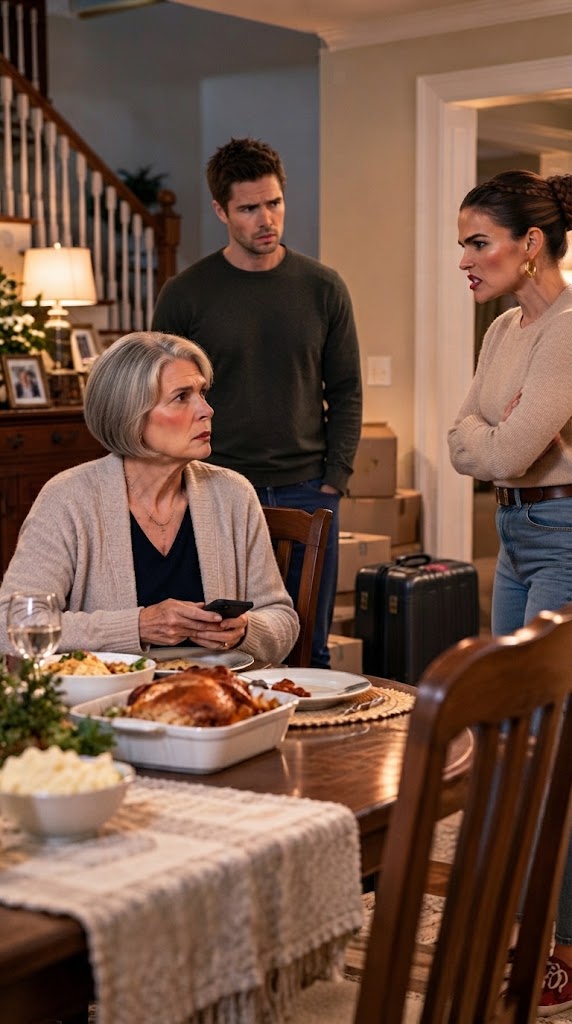
Then she put down her spoon.
“I think we need to establish some rules.”
Edward stopped talking.
Sarah looked at her father.
I folded my napkin and waited.
Linda placed both hands beside her plate.
“I’m going to be running this household from now on.”
I looked at her.
I honestly thought she had chosen the wrong words.
“I’m sorry?”
“Edward and I need to organize things properly. Everyone will have to adjust.”
I glanced at my son.
He was staring at his plate.
“Linda, you are welcome to stay here while Edward finds work. But this is still my home.”
She leaned back in her chair.
“You can’t expect four people to move into your house and have everything stay exactly the same.”
“I don’t expect that. I expect us to treat one another with respect.”
She looked toward the kitchen door.
It opened onto the backyard, where Anthony’s maple tree stood near the fence.
Then she pointed.
“If you don’t like how we’re doing things, take your plate outside and eat there.”
Nobody moved.
The clock ticked on the wall.
I could hear the faint sound of a car passing outside.
Linda looked at me as though she had just given an ordinary instruction.
Then she added that I could eat with my friend if I wanted company.
I felt my face grow warm.
I turned toward Edward.
He was my son.
He had grown up at this table.
He had eaten the meals I cooked when money was tight and the meals I prepared when he came home from college.
I waited for him to tell his wife that she had gone too far.
He didn’t.
He moved a piece of bread around his plate.
“Mom, please. Let’s not argue over dinner.”
That hurt more than Linda’s words.
I had expected cruelty from someone who had already shown me how little she respected my boundaries.
I had not expected my own son to treat my humiliation as an inconvenience.
I looked at Anthony’s photograph on the mantelpiece.
He had spent years making this house a place where our family could gather.
I remembered him standing in the kitchen after a long day at school, rolling up his sleeves to help me wash the dishes.
He never needed to announce that he belonged there.
He had earned his place through love and work.
And I had earned mine, too.
For years, I had let Linda make cutting remarks because I didn’t want to upset Edward.
I had stayed quiet during holidays.
I had accepted apologies that never quite sounded like apologies.
I had convinced myself that keeping the peace was the same as protecting my family.
That evening, I finally understood the difference.
I put down my napkin.
Then I stood up.
Linda watched me with a satisfied expression, as if she believed I was going to obey.
I walked into the kitchen.
Behind me, nobody spoke.
The old wall telephone hung beside the pantry.
I had kept the same number for years.
I reached for the receiver and opened the small drawer beneath it, where I kept a card with an important telephone number written in blue ink.
My hand was steady.
That surprised me.
Linda called from the dining room.
“Who are you calling? Your friend?”
I didn’t answer her.
At 6:48 p.m., I dialed Gabriella Moreno.
She had handled Anthony’s estate and helped me keep my property documents in order.
More importantly, she had warned me years earlier that kindness and legal permission were two different things.
I had hoped I would never need to remember that conversation.
Gabriella answered on the second ring.
“Margaret? Is everything all right?”
I looked through the doorway.
Edward had finally lifted his head.
Linda’s smile was still there.
For one last second, I thought about hanging up.
Then I remembered the words she had spoken at my table.
I remembered my son’s silence.
And I made my decision.
“Gabriella,” I said quietly. “It’s time.”
Source: lessoninlife.net
Click here to continue reading: PART 2: My Son Recognized the Attorney’s Name Before His Wife Understood Why I Had Called Anyone at All
I Thought I Was Giving My Son a Safe Place to Start Over, Until His Wife Looked Around My Home and Began Making Other Plans
Part 1 of 12