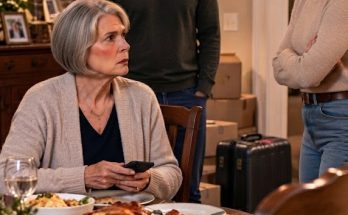
The first Sunday after they moved out, I woke before sunrise.
For a few seconds, I forgot they were gone.
I listened for footsteps upstairs.
Nothing.
I listened for Sarah calling from the bathroom or Dylan opening the refrigerator.
Nothing again.
Then I remembered the boxes beside the front door.
The car pulling away.
Edward's hand slipping from mine.
I was alone in the house.
I made coffee and carried my cup to the porch.
The maple tree stood quietly beside the driveway, its branches moving in the morning breeze.
Anthony had planted it when we first bought the house.
Back then, it had been little more than a thin trunk with a handful of leaves.
Now it shaded half the front yard.
I sometimes wondered whether Anthony had imagined us growing old beneath it.
I hoped he had.
I sat on the porch until my coffee cooled.
Then I went inside and began my usual Sunday routine.
I washed the breakfast dishes.
I watered the plants.
I checked the mail.
Nothing special.
But every ordinary task reminded me that I could move through my own home without worrying about another argument.
That should have felt entirely good.
It didn't.
I missed the children.
I missed hearing Edward laugh when something on television surprised him.
I even missed knowing that somebody else was in the next room.
Loneliness had returned, but it was different from the loneliness I had felt after Anthony died.
That earlier loneliness came from losing someone I loved.
This one came from realizing that I had nearly lost myself trying to keep someone else close.
I wasn't sure which feeling was harder to carry.
Around noon, I prepared a simple lunch.
I set one plate on the table.
I almost reached for a second out of habit, then stopped.
The empty chair across from me looked unfamiliar.
I ate slowly and left the television off.
After lunch, I went into the workshop.
Anthony's framed mortgage confirmation was still hanging on the wall.
I took it down carefully and wiped the glass with a soft cloth.
The paper inside had begun to yellow around the edges.
The date was still clear.
We had worked for years to reach that moment.
I remembered Anthony standing beside me, holding the confirmation as if it were a prize.
He had looked happier than he did on our wedding day.
Perhaps because that piece of paper represented something we had accomplished together.
We had built a life.
We had raised a son.
We had made a home.
And we had never treated any of those things as automatic rights over another person's future.
I returned the frame to its place.
Then I sat at Anthony's old workbench.
For the first time, I allowed myself to admit something I had been avoiding.
I was afraid Edward might never understand why I had made him leave.
I was afraid that, in his mind, I would always be the mother who chose a house over her son.
I knew that wasn't true.
But knowing something privately didn't guarantee that someone else would understand it.
I wanted him to call.
I wanted him to ask how I was.
I wanted to hear his voice without feeling that I needed to defend every decision I had made.
Still, I didn't pick up the telephone.
I had spent enough years making the first move whenever a relationship became uncomfortable.
This time, I wanted to give him room to think.
And I needed that room, too.
A few days later, Gabriella called to check whether everything had been settled as planned.
She asked whether I had experienced any further problems with the property.
I told her the family had moved out, and there had been no new issues.
She reminded me to keep my documents secure and retain the records connected to the earlier valuation request.
I thanked her.
Then I asked whether there was anything else I needed to do.
She said the immediate matter had been handled according to the arrangement we had made, and I should contact her if anything changed.
After we finished speaking, I placed her number back in the drawer beside the kitchen telephone.
The little card had become more than a contact.
It reminded me that asking for help was not a betrayal of my family.
Sometimes it was the only way to protect the possibility of having a healthier relationship with them.
The following week, I received a message from Edward.
He asked whether he could visit on Sunday.
I read it twice.
Then I replied that he was welcome to come in the afternoon.
I didn't ask whether Linda would accompany him.
He hadn't mentioned her.
I didn't ask whether he wanted to discuss the house.
I decided to let him tell me what he wanted to say.
On Sunday, I made coffee and set two cups on the kitchen counter.
I found myself checking the clock more often than necessary.
At two, I looked through the front window.
At half past two, I heard a car pull into the driveway.
Edward came to the door carrying a paper bag.
He looked tired, but he was smiling.
“Hi, Mom.”
“Hello, sweetheart.”
He held up the bag.
“I brought some pastries.”
I stepped aside to let him in.
For a moment, neither of us knew what to do.
Then he hugged me.
I held him briefly before letting go.
We went into the kitchen.
He placed the bag on the counter, and I poured the coffee.
We sat at the dining table.
The same table.
The same chairs.
The same framed photograph of Anthony on the mantelpiece.
Edward looked around the room.
“I forgot how quiet it gets here.”
I smiled faintly.
“I'm getting used to it again.”
He looked at his cup.
“I'm sorry, Mom.”
I waited.
He told me he had spent a lot of time thinking about the first dinner.
He said he kept remembering how I had looked at him when Linda told me to leave the table.
He had been so focused on avoiding an argument that he hadn't considered what his silence meant to me.
“I thought I was keeping things calm,” he said.
“But you were asking me to accept being hurt so you wouldn't have to be uncomfortable.”
He nodded.
“Yes.”
It was the first time he had repeated the truth without trying to soften it.
I felt something inside me relax.
Not everything.
But something.
He told me he had started to understand that he couldn't let fear decide how he treated people.
He had been afraid of losing his marriage.
Afraid of failing as a father.
Afraid of being unable to provide for his children.
And he had been so busy worrying about those things that he had stopped noticing what was happening to me.
“I don't want to keep doing that,” he said.
I looked at my son.
“Then you have to learn to speak before things reach the point where someone has to make a decision for you.”
He nodded.
We drank our coffee.
We talked about his contract work and the interviews he had attended.
He told me the children were adjusting to their new surroundings.
I asked whether Sarah had found a place for her ceramic bird.
He smiled.
“She put it on the shelf beside her bed.”
I was glad.
For the first time since moving day, I felt that the family had begun to settle into a different kind of life.
It wasn't the life I had imagined when Edward first called.
But perhaps it could become something better than the arrangement we had lost.
Before he left, Edward stood beside the dining table and looked at Anthony's photograph.
“Dad would have been disappointed in me.”
I followed his gaze.
“Your father loved you.”
“I know.”
“He would have wanted you to learn from what happened.”
Edward nodded slowly.
Then he turned toward me.
“I want to do better.”
I believed he meant it.
I also knew that a promise made over coffee was only a beginning.
So I told him I would be glad to see him again.
Then I watched him walk down the porch steps.
This time, when his car pulled away, I didn't feel abandoned.
I felt hopeful.
Carefully hopeful.
And for now, that was enough.
Source: lessoninlife.net
Click here to continue reading: PART 10: My Son Finally Found Steady Work, but the Most Important Change Was Not His Paycheck or the Apartment His Family Had Chosen
I Thought I Was Giving My Son a Safe Place to Start Over, Until His Wife Looked Around My Home and Began Making Other Plans
Part 9 of 12