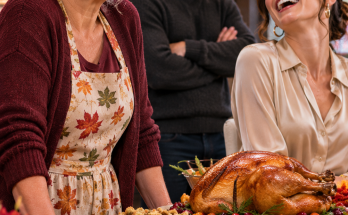
The following Sunday, Derek invited me to dinner.
I almost asked what food I should bring.
The question came naturally.
It was the first thing I usually asked.
Then I stopped myself.
I didn't need to bring anything.
I didn't need to prepare a dish.
I didn't need to arrive early and start working in the kitchen.
I could simply visit my son.
I could sit down.
I could enjoy dinner.
I could be a guest.
I called him.
"What time would you like me to come?"
"Five thirty," he said.
Then he added, "And Mom, you don't have to cook."
I smiled.
"All right."
I hung up.
I felt relieved.
I also felt nervous.
I had spent so many years being the person who handled the food that I wasn't sure how to behave when someone else did it.
When I arrived, Cassandra opened the door.
She smiled.
"Hi, Diane."
"Hello, Cassandra."
She stepped aside.
I walked into the house.
The dining room looked familiar.
The table was set.
The children were running around.
But the kitchen was different.
Cassandra was preparing vegetables.
Derek was tending the oven.
The children were setting the table.
Nobody was waiting for me to start cooking.
I stood in the doorway for a moment.
Then Cassandra turned toward me.
"Would you like some coffee?"
I smiled.
"That would be lovely."
She poured me a cup.
I sat down at the table.
I watched the children.
They were arguing about where the napkins should go.
Derek came into the room.
"Mom, how was Portugal?"
I smiled.
"It was wonderful."
He sat beside me.
I told him about the bakery.
I told him about the painting lessons.
I told him about the little house.
He listened.
He asked questions.
For the first time in a long time, I felt that he was interested in my life.
Not in what I could do for him.
Not in what I could prepare.
Just in me.
Dinner was simple.
Roast chicken.
Potatoes.
Green beans.
Bakery pie.
We ate together.
The children talked about school.
Cassandra asked about the painting lessons.
Derek asked whether I had enjoyed traveling alone.
I told them about the first morning in Óbidos.
I told them about the coffee.
I told them about the courtyard.
I told them about the watercolor that had looked like a blue towel in a bowl of soup.
Everyone laughed.
I laughed too.
After dinner, Derek loaded the dishwasher.
Cassandra brought me another cup of coffee.
I sat with the grandchildren.
They asked about Portugal.
They wanted to know whether there were castles.
They wanted to know whether I had seen the ocean.
They wanted to know whether I had eaten anything strange.
I told them about the little shops.
I told them about the streets.
I told them about the pastries.
They listened with wide eyes.
I showed them a few photographs.
They were especially interested in the little ceramic houses I had bought.
I told them that I had brought them gifts.
They were excited.
I watched them open the packages.
I felt happy.
I had missed them.
I had missed the familiar sound of their voices.
I had missed their questions.
I had missed the way they laughed.
But I also knew that I didn't need to spend every holiday in the kitchen to be their grandmother.
I could be present without being responsible for everything.
That evening, I drove home.
I thought about Thanksgiving.
I thought about Cassandra's joke.
I thought about Derek looking down at his plate.
I still remembered how hurt I had felt.
But I also remembered the dinner I had just shared with them.
It wasn't perfect.
We still had things to work through.
But something had changed.
I had changed.
And perhaps they had begun to change too.
A month later, I hung one of my watercolors in the hallway.
It showed a crooked street in Óbidos.
There were blue shutters.
Flowers beside a doorway.
A little patch of sunlight on the wall.
The perspective was imperfect.
The colors were uneven.
But I loved it.
I stood in front of the painting for a long time.
I remembered the little house.
The courtyard.
The bakery.
The quiet mornings.
I remembered the woman who had arrived in Portugal feeling nervous and unsure.
I remembered the woman who had left feeling peaceful.
I had learned something important during those eight weeks.
I still loved cooking for my family.
I still enjoyed seeing everyone gathered around a table.
I still wanted to help when someone genuinely needed me.
But I no longer believed that love required me to give up my own life.
Derek began calling more often.
Sometimes he asked about my day.
Sometimes he asked about my paintings.
Sometimes he simply wanted to talk.
Joanna continued sending suggestions for future trips.
The grandchildren proudly displayed the little Portuguese tiles I had brought home.
I had more places to visit.
More books to read.
More paintings to attempt.
I also had a family I loved deeply.
And I was beginning to understand that those things could exist together.
I didn't have to choose between being a mother and being myself.
I didn't have to spend every holiday in the kitchen.
I didn't have to say yes to every request.
I could love my family.
I could help them.
I could cook for them.
But I could also sit down.
I could travel.
I could paint.
I could enjoy my retirement.
The next Christmas was still months away.
I hadn't decided whether I would cook the turkey.
I might.
Or I might arrive with something small and festive.
I might sit at the table and let someone else handle the potatoes.
I hadn't decided.
And for the first time in my life, I didn't feel guilty about that.
Source: lessoninlife.net
Click here to continue reading: PART 9: The First Time My Son Asked Me to Cook Christmas Dinner Again, I Realized Our Family Had Finally Started to Change
I Thought Being a Good Mother Meant Always Saying Yes, Until One Thanksgiving Dinner Made Me Question Everything I Had Given
Part 8 of 13