The list stayed on the kitchen table for three days.
I had written it in a small notebook, beside the watercolor paper I brought home from Portugal. The pages smelled faintly of paint and the cedar drawer where I kept my brushes.
I did not make a schedule.
I did not ask anyone whether the places were sensible, affordable, or worth the trouble.
I simply let myself want them.
On the fourth morning, I opened the notebook again.
Óbidos was still at the top, though I had already been there. I had written it down because I wanted to remember that I could return to a place without needing a reason beyond wanting to.
Below it were towns I had seen in photographs, coastlines I had never walked, and a few places I could not pronounce correctly.
I smiled at that.
For years, I had believed a life was measured by how much you did for other people.
Now I was learning that it could also be measured by what you allowed yourself to experience.
I took the notebook to the table and added one more line.
A weekend with no plans.
That one felt almost as difficult as the rest.
I had spent so long arranging every hour around someone else’s needs that an empty day seemed wasteful.
But I left the line there.
A few days later, Joanna called while I was making tea.
“Are you busy Sunday?”
“I don’t think so.”
“Would you like to come over?”
“I would.”
She paused.
“Just come as yourself, Mom. You don’t have to bring anything.”
I looked at the loaf of bread cooling on the counter.
“I can bring bread.”
“You can,” she said. “But you don’t have to.”
I laughed, because she knew me too well.
On Sunday, I brought the bread anyway.
It was a small loaf, still warm, wrapped in a clean kitchen towel. I did not bring a casserole, a dessert, or enough food to feed twelve people.
Joanna opened the door and took the loaf from my hands.
“Thank you,” she said.
Then she hugged me.
Inside, her children were arguing over a board game. One of them had left a sock under the coffee table. A cartoon played quietly in the background.
The house was ordinary and loud.
I sat down on the sofa and let the noise happen around me.
Joanna brought me a cup of tea.
“You look rested,” she said.
“I feel rested.”
“Good.”
She sat beside me, her shoulder touching mine.
For a while, neither of us said anything.
Then she asked, “Are you still thinking about traveling?”
“Yes.”
“Where next?”
“I’m not sure yet.”
“That’s allowed.”
I looked at her.
She smiled.
“You know you don’t have to have the whole thing planned before you start.”
I had spent most of my life planning.
Meals, birthdays, holidays, bills, school pickups, medical appointments, repairs. If something went wrong, I was usually the person who knew where the spare key was or which drawer held the receipt.
I had thought being prepared was the same as being safe.
Now I understood that sometimes it was only another way to keep myself busy.
“I’m trying to get better at not knowing,” I said.
Joanna leaned her head against mine.
“I think you’re doing fine.”
That evening, I drove home with the empty towel folded on the passenger seat.
The road was quiet.
I noticed the last light on the trees and the way the sky changed from gold to gray. I did not turn on the radio.
When I reached my house, I left the car in the driveway for a moment.
The porch light was on.
The house was waiting for me, but it was not asking anything.
I went inside and put the kettle on.
The next week, Derek called.
He asked if I wanted to have dinner with him and the children on Saturday.
“Cassandra is making pasta,” he said. “The kids want you to come.”
“I’d like that.”
There was a short silence.
“Mom?”
“Yes?”
“I’m glad you’re coming.”
I held the phone a little closer.
“Thank you for asking me.”
He cleared his throat.
“I know I didn’t do that enough before.”
I could have told him that he had not done it at all.
I could have listed the holidays, the errands, the meals, and the times I had been treated as though my presence came with a set of chores.
But he already knew.
The important part was what he did with that knowledge.
“I’m glad you’re trying now,” I said.
“I am.”
We ended the call without making promises.
That felt better than a promise neither of us knew how to keep.
On Saturday, I arrived at Derek’s house at six.
I carried no food.
The children met me at the door, both talking at once. One wanted to show me a drawing. The other wanted to tell me about a school project.
I listened to both stories.
Cassandra stood in the kitchen, stirring a pot.
“Hi, Diane,” she said.
“Hello, Cassandra.”
She looked at my hands.
“You didn’t bring anything?”
“No. Derek said you were making dinner.”
“Yes,” she said. “I am.”
There was no sharpness in her voice.
I took off my coat and hung it by the door.
The table was already set. There were five plates, a bowl of salad, and a basket of bread. Derek was helping one of the children find a fork.
Cassandra carried the pasta to the table.
“Would you like to sit here?” she asked, pointing to a chair beside the window.
“Yes, thank you.”
I sat down.
No one asked me to get up for more napkins.
No one handed me a dish to wash.
When the children spilled water, Derek wiped it up. Cassandra brought a towel. I stayed in my chair.
It was such a small thing.
I noticed it anyway.
After dinner, one of the children asked if I would help with a puzzle.
“I can help for a little while,” I said.
We spread the pieces across the coffee table.
Derek brought coffee. Cassandra sat at the other end of the sofa with her feet tucked beneath her.
For a moment, the room felt like a room where people were simply spending time together.
Not a place where I had to earn my seat.
When it was time to leave, Cassandra walked me to the door.
“Thank you for coming,” she said.
“Thank you for dinner.”
She looked down at the mat.
“I’m still sorry about Thanksgiving.”
I waited.
“I know saying that doesn’t change what happened,” she continued. “I just want you to know I haven’t forgotten it.”
“I haven’t forgotten it either.”
She nodded.
“I understand.”
I could tell she wanted to say more.
I could also tell she was trying not to turn the moment into a request for reassurance.
That mattered.
“I appreciate you saying it,” I told her.
She opened the door.
“Drive safely.”
“I will.”
I walked to my car.
The air was cold, and the porch light made the driveway look pale. Through the window, I could see Derek carrying the children’s plates toward the kitchen.
Cassandra was gathering the cups.
They were cleaning up their own dinner.
I sat behind the wheel for a moment before starting the engine.
I did not feel triumphant.
I did not feel as though I had won something.
I felt relieved that the evening had been ordinary.
On the drive home, I thought about the woman I had been on Thanksgiving.
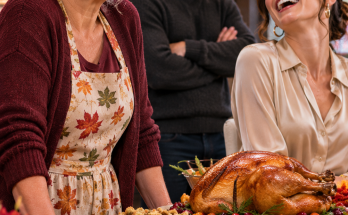
I could still see her in the kitchen, wearing the apron her mother had embroidered, surrounded by food she had spent hours preparing.
She had believed that if she worked hard enough, everyone would feel loved.
She had believed that being useful would protect her from being overlooked.
I wished I could have reached back through time and sat beside her.
I would not have told her to throw the food away.
I would not have told her to leave her family.
I would have told her to sit down.
I would have told her that she was allowed to be hungry, tired, angry, and disappointed.
I would have told her that love was not a payment she had to earn.
When I got home, I put the kettle on again.
The notebook was still on the table.
I opened it to the list of places I wanted to see and added a small mark beside Óbidos.
Not because I was finished with it.
Because I had been there.
I turned to the next page and wrote the name of a coastal town I had been reading about.
Then I closed the notebook.
The next morning, I went to the grocery store.
I bought eggs, milk, apples, and a small bunch of flowers. I did not buy enough food for a gathering. I did not check whether anyone else needed anything.
At home, I put the flowers in a glass jar.
Their stems were uneven, and one of the blossoms had already begun to open.
I set the jar beside the sink.
Then I made breakfast.
I ate it sitting down.
Afterward, I washed my plate and left the rest of the morning open.
I had no errands to run for Derek.
No household bill to cover for Cassandra.
No holiday meal to prepare for people who had not asked me to come.
There were still things I would do for my family.
There were still people I loved.
But I was learning that love did not require me to disappear inside it.
I could be a mother without being the person who solved every problem.
I could be a grandmother without turning every visit into a service.
I could be generous without giving away the hours I needed for myself.
I could say yes when I meant yes.
I could say no without writing an apology afterward.
That was the decision I had made in Portugal.
Not to stop loving my family.
Not to punish them.
To stop treating my own life as the thing that could always wait.
A few weeks later, I took the notebook to a café and ordered coffee.
I sat by the window and watched people pass.
A woman walked a small dog. A man carried a paper bag of groceries. Two children ran ahead of their father, laughing at something I could not hear.
The world kept moving without needing anything from me.
I opened the notebook and looked at the list.
I chose one place.
Then I wrote a date beside it.
It was not a grand plan.
It was enough.
I finished my coffee, closed the notebook, and stepped outside.
The day was cool and bright.
I walked slowly toward my car, taking the long way through the parking lot because I had nowhere else I needed to be.
For the first time in a long time, that felt like a life.
Source: lessoninlife.net
The End
Read more original stories on Feel Every Story.
I Thought Being a Good Mother Meant Always Saying Yes, Until One Thanksgiving Dinner Made Me Question Everything I Had Given
Part 13 of 13