
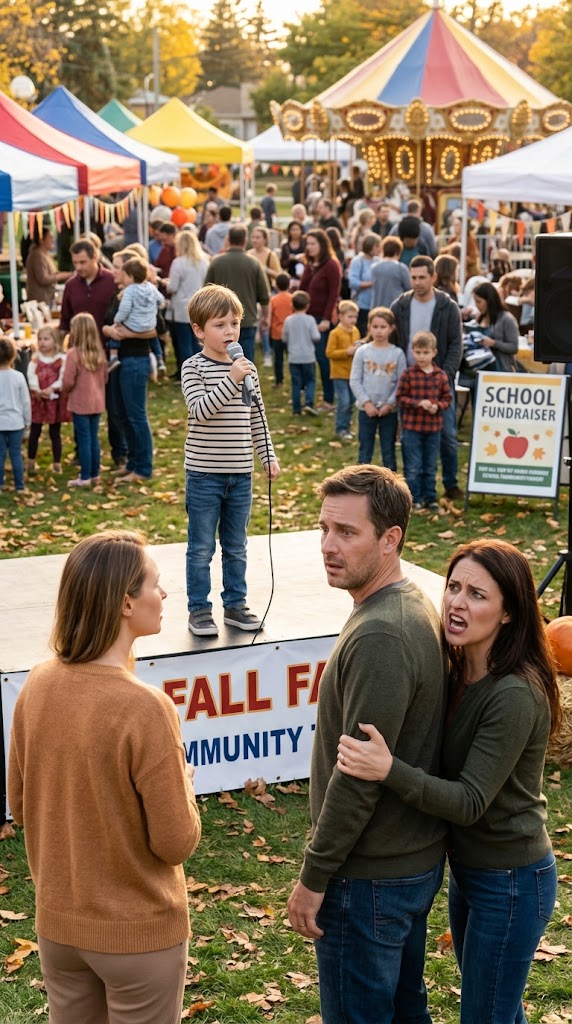
“Mom, do you think you look embarrassing?”
Becca stopped cutting the orange fabric. The scissors remained open in her hand, one blade resting against the wooden kitchen table, while her ten-year-old son stood opposite her, worrying a loose thread on his sweatshirt. Outside, rain tapped against the window above the sink. The house smelled of cinnamon, laundry detergent, and the pumpkin bread cooling on the counter.
She studied his face, searching for the familiar mischievous expression that usually accompanied his strangest questions. It never appeared.
“What made you ask me that, sweetheart?”
Dustin glanced toward the hallway, although there was nobody there to overhear them. “Nothing. I was just wondering.”
Becca placed the scissors down. She had learned during the years since her divorce that children sometimes approached difficult subjects sideways, testing the ground before deciding whether it was safe to tell the truth. If she pushed too quickly, Dustin would retreat behind a shrug and a quiet assurance that everything was fine.
She pulled out the chair beside her. “Come sit with me.”
He climbed onto it, leaving his feet swinging above the kitchen floor. Between them lay the beginnings of two pumpkin costumes, a pile of felt leaves, and a cardboard box filled with decorations for his school’s upcoming fall fair.
“Is somebody making you feel bad about how I dress?” she asked.
His eyes lifted to hers, then dropped again.
“Annabelle said you dress like you’ve stopped caring.”
The sentence landed more heavily than Becca expected. She had heard criticism before, from people who mistook plain clothes for a lack of ambition and from strangers who believed a woman’s appearance was public property. But hearing those words repeated by her son changed their weight entirely.
“Annabelle said that to you?”
Dustin nodded. He pulled a thread until it stretched from the cuff of his sleeve, then wound it around his finger.
“She said you always wear the same kinds of things. And last weekend, she asked Dad how he managed to stay married to you for so long.”
For a moment, Becca heard only the rain and the refrigerator humming behind her. She was thirty-five, worked full-time, managed most of the household responsibilities, and spent whatever energy remained helping her son navigate the ordinary difficulties of growing up. Choosing expensive clothes had never been high on her list of priorities. Neither had impressing the woman dating her former husband.
Still, she could not stop thinking about Dustin sitting at his father’s house, listening to an adult dissect his mother’s appearance as though she were an object laid out for inspection.
“What did your dad say when she asked him that?”
Dustin’s shoulders rose slightly.
“He laughed.”
Becca looked down at the orange fabric. She had intended to sew small green leaves around the neckline of Dustin’s costume, but suddenly the needle and thread seemed very far away.
“Did you think it was funny?”
“No.”
The answer came so quickly that she almost wished he had hesitated. At least hesitation might have meant he was unsure. Instead, her son had apparently known exactly what he felt and had spent the rest of the visit keeping it to himself.
She moved her chair closer.
“You never have to laugh at something just because other people are laughing, Dustin. And nobody should make you feel like you have to defend either of your parents.”
“Then why does Dad let her say those things?”
Becca opened her mouth, but the explanation she wanted to give was not one a ten-year-old should have to hear. She could have told him that adults sometimes avoided uncomfortable conversations. She could have explained that Nigel had always preferred a peaceful room to an honest argument, even when maintaining that peace meant allowing someone else to suffer.
Instead, she reached for his hand.
“I don’t know why your dad handled it that way. But I am going to talk to him.”
“Will he be mad?”
“Not at you. This is an adult problem, and it’s our responsibility to sort it out.”
Dustin nodded, but the worry in his expression did not disappear. Becca recognized it from the first months after the divorce, when he had asked whether he should bring his favorite toys to both houses or whether liking his father’s new furniture meant he was betraying her. She had spent a long time reassuring him that love was not a competition.
She had not realized he was still learning that lesson in a different form.
After he went upstairs to finish his homework, Becca stood alone in the kitchen. The two unfinished costumes lay side by side, one sized for a child and the other for an adult. Their seams were imperfect. One shoulder on hers was already slightly crooked, and Dustin had insisted on adding a ridiculous green stem to the top of his.
They were supposed to be funny. That was the point.
She picked up her phone and called Nigel.
He answered after several rings. There was television noise in the background, followed by the sound of a door closing.
“Hey, Becca. Everything okay?”
“I need to talk to you about something Dustin told me.”
His tone changed immediately. “What happened?”
“Annabelle has been making comments about my clothes when he’s at your house. She asked you how you managed to stay married to me, and you laughed.”
The silence that followed was short but revealing. Nigel did not ask whether Dustin had misunderstood. He did not sound surprised. Instead, he released a weary breath, as though she had called to reopen an argument he had already decided was unnecessary.
“Becca, Annabelle has a strange sense of humor.”
“That doesn’t make it harmless.”
“She wasn’t trying to hurt anybody.”
“Dustin was hurt. He’s been carrying it around long enough to come home and ask me whether I look embarrassing.”
Nigel said nothing.
Becca walked to the window. Across the street, a neighbor was dragging a rubbish bin up a wet driveway. Everything outside looked ordinary, which made the conversation feel even more absurd. Somewhere in another house, a child was probably worrying about a spelling test or whether his friends would come over on Saturday. Her son was worrying about whether his mother deserved to be mocked.
“He shouldn’t have to dread coming to dinner at your house,” she continued. “And he shouldn’t have to listen to anyone make me the punch line.”
“I’ll talk to her.”
“Please don’t just tell me that so we can hang up.”
“I said I’ll speak to her, Becca. I promise.”
She wanted to believe him. They had worked hard to keep their divorce from becoming a battlefield. Their marriage had ended, but they still had a child who loved both of them, and Becca had always believed that cooperation mattered more than winning arguments about the past.
“Good,” she said. “Because this isn’t about whether she likes my clothes. It’s about what Dustin is hearing.”
They ended the call without exchanging their usual polite goodbyes.
Becca returned to the table and picked up the needle. She threaded it carefully, pulled the orange fabric beneath the presser foot of her sewing machine, and tried to concentrate on the costume. A crooked seam could be repaired. A loose button could be replaced. The harder question was how to persuade a grown man to recognize the damage caused by a laugh he had barely thought about.
Three days later, she received a partial answer.
She was standing outside Dustin’s school when Annabelle approached with a pair of blue sneakers in one hand. Nigel had apparently found them under the back seat of his car. Annabelle wore a fitted cream coat and immaculate boots that seemed strangely impractical for the muddy playground, and her hair remained perfectly arranged despite the damp wind.
“Becca! I was hoping I’d catch you.”
Becca took the sneakers. “Thanks. He was looking for these.”
“Of course.” Annabelle glanced toward the school doors, where parents were gathering beneath the awning. “Nigel mentioned you’re helping organize the fall fair.”
“Dustin’s class is running a pumpkin booth.”
“Oh, that sounds adorable. I thought I might help out. I could order some decorations and make the whole thing look a little more polished.”
Before Becca could answer, Dustin appeared with his backpack bouncing against his shoulders.
“Annabelle! You’re coming to the fair?”
“If your mom doesn’t mind.”
Dustin looked at Becca with sudden excitement. The school event had occupied his thoughts for weeks. He had already designed a sign, chosen the cupcake decorations, and persuaded his teacher to let the children display their handmade paper pumpkins.
“Could we all work on it together?” he asked.
Becca hesitated. The memory of the kitchen conversation remained fresh, and Nigel’s promise had not yet produced any visible change. But she could see how much the invitation meant to Dustin. Refusing would force him to choose between a boundary she needed to establish and an opportunity he wanted to enjoy.
“All right,” she said. “We can share the work. The children have already made decorations, and those need to stay part of the display.”
“Absolutely,” Annabelle replied.
Her gaze traveled briefly over Becca’s faded blue cardigan.
“I’ll make sure everything looks presentable.”
The remark was quiet enough that Dustin might not have noticed it. Becca did.
She looked at Annabelle for a moment, waiting to see whether she would acknowledge what she had said. Instead, the younger woman smiled brightly and began asking Dustin about the cupcakes.
Becca told herself that she had agreed to help because of her son, not because she trusted Annabelle. She could remain civil, protect the children’s work, and refuse to let a school fundraiser become another argument between adults.
It sounded simple when she put it that way.
At the volunteer meeting that afternoon, Annabelle arrived carrying photographs of expensive decorations she had ordered online. There were copper-colored lanterns, artificial maple branches, velvet ribbons, and a large orange banner with gold lettering. The other parents admired the pictures, and Annabelle explained where everything would go as though the arrangement had already been decided.
“You’re organizing the whole booth?” one mother asked.
“Pretty much,” Annabelle replied. “I want it to look special.”
Becca, who had spent the previous evening cutting cardboard pumpkins with three children from Dustin’s class, set her notebook on the table.
“We’re sharing the work. The students made most of the paper decorations, and I’m baking cupcakes with Dustin.”
Annabelle gave a little laugh.
“Of course you’re handling the food. That’s very much your style, Becca.”
The mother beside them looked down at her own notes. Someone at the far end of the table began discussing the raffle tickets.
Becca felt the familiar temptation to pretend she had not heard. She could ignore the remark and keep the meeting moving. She could spare everyone the awkwardness of confrontation.
Then she noticed Dustin’s teacher arranging the children’s paper pumpkins into neat rows on a shelf behind them. The students had spent an entire afternoon making those decorations. Several had drawn crooked faces on them, and one had attached a tiny paper hat to a pumpkin because he wanted it to look like his grandfather.
Annabelle pointed toward the shelf.
“These don’t really match the decorations I’ve ordered. We should probably leave them off the main table.”
“They’re part of the children’s display,” Becca said.
“They look a little cheap next to everything else.”
“They’re made from construction paper. The children made them themselves.”
Annabelle folded her arms. “I just think the booth would look better if we had a consistent theme.”
“And I think the children should be able to recognize their own work when they walk up to it.”
For the first time, Annabelle’s smile faltered. She glanced at the other parents, perhaps expecting someone to support her, but nobody volunteered to turn a discussion about paper pumpkins into a judgment of Becca’s taste.
“All right,” she said finally. “We’ll see how it looks on the day.”
Becca wrote down the remaining tasks and continued the meeting. Her hands stayed steady, but she noticed that Annabelle had stopped addressing her directly.
That evening, Dustin sat on the kitchen counter while Becca measured flour into a mixing bowl. He had recovered some of his usual cheerfulness and was explaining why every cupcake needed exactly seven chocolate chips.
“Four would be enough,” Becca told him.
“Four looks unfinished.”
“Five?”
“No.”
“Six?”
He considered the suggestion with the solemnity of a scientist evaluating an experiment. “Maybe six and a half, but seven is better.”
She laughed, and he grinned as he tipped the chocolate chips into his palm.
When the batter was ready, Dustin borrowed her phone to photograph their progress. He took pictures of the flour scattered across the counter, the first tray of cupcakes, and Becca attempting to scrape a stubborn lump of frosting from the mixing spoon. He also photographed the sewing machine and the two pumpkin costumes hanging over the backs of their chairs.
“Don’t use the one where I dropped the frosting,” Becca said.
“I haven’t decided.”
“Dustin.”
“It’s an important part of the artistic process.”
She reached for the phone, but he held it above his head, laughing. For a few minutes, the kitchen belonged entirely to them: the warm oven, the mess of baking supplies, the orange costumes, and the private jokes that had accumulated over ten years of being mother and son.
Later, they tried on the costumes. Dustin’s fit neatly around his shoulders, but Becca’s was lopsided enough that the green felt stem tilted toward one ear.
She turned toward the mirror and grimaced.
“We look ridiculous.”
“Exactly,” Dustin said. “That’s why they’re good.”
She smiled, but Annabelle’s earlier remarks crept into her thoughts. She adjusted the crooked shoulder, then lowered her hands.
“Are you sure you want me to wear mine at the fair?”
Dustin’s expression changed. The playful grin disappeared, replaced by a seriousness that made him look older than ten.
“Why wouldn’t I?”
“I just mean, if you think it’s too silly—”
“Mom, we made them together.”
He said it as though she had asked whether he wanted to attend his own birthday party.
Becca looked at him in the mirror. She could have brushed the concern aside, told him that other people’s opinions didn’t matter, and returned to the business of finishing the costumes. Instead, she recognized that his question had never really been about clothes.
“Then we’re wearing them together,” she said.
Dustin wrapped his arms around her waist. His cheek pressed against the rough orange fabric, and she rested her chin briefly on his head.
“It’s my favorite thing we’ve made,” he murmured.
She kissed his forehead. For a moment, the worry seemed to leave him.
Then he pulled back.
“Mom, why don’t you tell Annabelle to stop?”
Becca’s hands remained on his shoulders.
“I spoke to your dad about it.”
“But she still does it.”
There was no accusation in his voice. That made the question harder to answer.
“You’re right,” Becca said. “I need to handle it differently.”
“Will Dad get mad at me?”
“No, sweetheart. This isn’t your fault. You don’t have to fix anything between the adults.”
He nodded, but he did not look convinced. His eyes wandered toward the phone lying on the counter, its screen displaying the photographs he had taken that evening.
Becca assumed he was thinking about the fair, the cupcakes, and the presentation his teacher had invited him to prepare. She had no reason to imagine that those ordinary photographs might become important beyond the classroom.
She helped him take off his costume and hung both outfits in the hallway closet. Before bed, Dustin asked if he could keep working on his slideshow after school the following day.
“Of course,” she told him. “Just make sure your teacher gets to review it before the fair.”
“I will.”
He hugged her, then disappeared upstairs.
Becca stayed in the hallway a little longer, looking at the two pumpkin costumes hanging side by side. She had spent the past several years trying to give her son a childhood that felt secure despite the separation between his parents. She had never expected to agree with Nigel about everything, but she had believed they shared one essential responsibility: neither of them should make Dustin feel that loving one parent required him to diminish the other.
Now she was beginning to understand that remaining polite was not the same as protecting their child.
On Sunday morning, she would discover just how much that distinction mattered.
Click here to continue reading: PART 2: The Decorations Disappeared Before the Fair, and Becca Began to Suspect That Annabelle Wanted More Than a Beautiful Display
One Cruel Remark About Her Clothes Revealed What Her Ten-Year-Old Son Had Been Carrying Between Two Homes
Part 1 of 12

