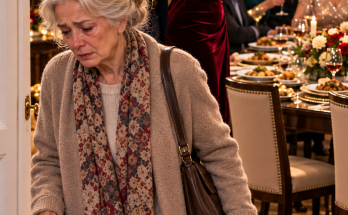
Mrs. Rivera moved through my kitchen with the calm efficiency of someone who had spent a lifetime helping people manage difficult days.
She asked where I had put my maternity clothes.
I pointed toward the bag.
She crouched to gather the things that had fallen out.
I wanted to help her, but another contraction was beginning, and she told me to stay where I was.
"Just breathe, Anna. I'll take care of this."
I watched her pick up a folded blanket.
Then she found the tiny white sock.
It was still lying beside Mark's shoe.
She held it between her fingers, checked that it was clean, and placed it back inside the bag.
She did not comment on how it had ended up on the floor.
She did not need to.
I looked toward the kitchen.
Mark was still there.
He had not offered to help Mrs. Rivera. He had not asked how far apart my contractions were. He had not even come over to see whether I could stand comfortably.
He continued looking at his phone.
I had imagined many different versions of the day our daughter would be born.
In some, Mark and I would leave the house together, nervous and excited. We would talk about the name we had chosen and wonder what the next few days would be like.
In others, I would be frightened, and he would reassure me.
I had never pictured a neighbor packing my hospital bag while my husband stood nearby, waiting for me to admit that I had been wrong.
Mrs. Rivera zipped the bag as carefully as she could.
Then she reached for my arm.
I took it.
We walked slowly toward the door.
Every step reminded me that the baby was coming whether Mark was ready or not.
I had spent weeks preparing for this birth. I had attended appointments, followed instructions, and made sure everything I could control was ready.
Now the only thing I wanted from my husband was something simple.
I wanted him to stand beside me.
He did not.
As we reached the entrance, Mark finally spoke.
"Don't expect things to go back to normal when you return."
I stopped.
Mrs. Rivera stopped with me.
For a moment, I felt the familiar urge to explain myself. It rose automatically, almost like a reflex.
I wanted to tell him that I had never intended to exclude him.
I wanted to remind him that I had agreed to discuss the document with Dana, not reject it.
I wanted to ask why he was doing this on the day our daughter was coming into the world.
But I was tired.
And I was in pain.
And I had spent enough of my life trying to find the right words to make another person behave as though I mattered.
Mrs. Rivera's hand tightened around mine.
It was a small gesture.
She did not speak for me.
She did not tell Mark what kind of husband he was.
She simply held my hand and waited for me to continue walking.
So I did.
I crossed the doorway without answering him.
I remember that part clearly.
Not because it was dramatic.
Because it was the first time in a long time that I left an argument without trying to win it.
Outside, the air felt different.
I lowered myself into the passenger seat while Mrs. Rivera secured the hospital bag.
She checked that I was comfortable before starting the car.
"Have you spoken to the maternity unit?"
I told her I had called earlier.
She nodded and made sure we had the directions.
There was no unnecessary conversation.
She focused on getting me where I needed to go.
I sat with one hand resting against my stomach.
Our daughter moved beneath my palm.
I tried to imagine what she would look like.
I wondered whether she would have dark hair or light hair, whether her eyes would resemble mine, and whether she would be a quiet baby or one who announced every opinion.
The thoughts came and went between contractions.
Then another thought arrived.
What would I tell her about this day when she was old enough to understand?
I did not want to make her responsible for the problems between her parents.
I did not want her to grow up hearing that her father had failed me before she was born.
But I also knew that pretending everything was fine would not protect her.
I had been pretending for myself for years.
I had told myself that difficult periods were temporary. I had believed that if I remained patient, Mark would eventually recognize how much I was trying to hold together.
Perhaps he would.
Perhaps he would not.
I could not solve that question from the passenger seat of Mrs. Rivera's car.
I could only get to the hospital.
When we arrived, Mrs. Rivera parked and came around to help me.
Inside, the staff took over.
There were questions, checks, instructions, and people who knew what to do next. I answered as clearly as I could while trying to concentrate on the contractions.
Eventually, a nurse asked who would be staying with me.
The question caught me off guard.
I had assumed the answer would be obvious.
My husband.
For a moment, I did not know what to say.
I looked at Mrs. Rivera.
She was standing beside me, still wearing her slippers, her handbag hanging from one shoulder.
"I'll stay with her," she said.
She spoke as if it were the most natural decision in the world.
I looked at her, and my eyes filled.
I had known this woman as a neighbor. We exchanged greetings, talked about ordinary things, and occasionally helped each other with small tasks.
She was not family by blood.
She had not made promises to me at a wedding.
She had not stood before our friends and relatives and said she would be there through the difficult days.
Yet she was there.
I nodded because I could not find the words to thank her.
The nurse helped me settle in.
Mrs. Rivera stayed close.
As the hours passed, I stopped thinking about Mark for long stretches at a time. The physical work of labor demanded my attention, and there was no room to keep replaying the argument.
When I did think of him, it was usually because I wondered whether he would call.
My phone remained nearby.
I checked it more often than I wanted to admit.
No message came.
I told myself he might be angry enough to need time.
I told myself he might be waiting for me to contact him.
I told myself he was probably trying to decide what to do.
The truth was that I did not know what he was doing.
I knew only that I was in the hospital, preparing to give birth to our daughter, and he had not contacted me.
There was a difference between those facts and the explanations I kept creating for them.
I was beginning to understand that difference.
At some point, Mrs. Rivera asked whether I wanted her to call anyone.
I shook my head.
I did not want another conversation about my marriage.
I wanted to get through the birth.
She adjusted the blanket and stayed beside me.
Her presence was quiet.
It did not solve anything.
It made the next hour easier.
That was enough.
I thought about my grandfather, William Hart.
He had died four months earlier, and his absence had become part of the background of everything that was happening in my life.
I had loved him.
I missed him in ways I had not always known how to express.
His death had left practical matters to settle, but grief had never felt practical to me. It came at inconvenient times, sometimes when I was busy, sometimes when I thought I was doing well.
The inheritance connected to his estate had become another source of pressure in my marriage.
I had not told Mark the full amount.
I had not even finished understanding all the arrangements myself.
I knew the inheritance was substantial, and Dana was reviewing the trust records with the trustee.
That was what I knew.
That was what I had chosen to keep private until I was ready to discuss it.
Mark knew there was an inheritance.
He knew enough to ask questions.
He did not know its approximate value.
I had not hidden the existence of the matter. I had simply wanted the time and privacy to deal with it properly.
At first, I had not considered that decision controversial.
Then the questions began.
His mother wanted to know when the estate would be settled.
Mark wanted to know what would happen next.
Their interest seemed to grow whenever I mentioned speaking to Dana.
I tried to answer without giving away details I was not prepared to discuss.
I told myself that they were curious because money affected families.
I did not want to assume the worst.
I did not want to turn grief into another argument.
But I began to notice that some conversations became tense whenever I said I needed to consult my attorney.
That was why the document beside my dinner plate had bothered me.
It was not only the document itself.
It was the insistence that I should sign it before having it reviewed.
I had asked for time.
Mark had treated the request as a personal rejection.
Now, lying in the hospital, I wondered whether I had been too cautious or whether I had been right to pause.
I could not answer that question yet.
I knew only that I had made the decision I believed was responsible.
I would not sign something simply to end an argument.
Not even if the argument was with my husband.
Especially not then.
As the morning continued, the contractions became harder to ignore.
I put my phone aside.
For the first time that day, I stopped waiting for a message from Mark.
I focused on the child I was about to meet.
I had wanted her for so long.
I had spent years believing motherhood might not be part of my life, and now she was coming.
There would be time later to decide what my marriage meant.
There would be time to speak to Dana.
There would be time to ask Mark why he had behaved as he had.
But there was no reason to spend the moment before my daughter's arrival trying to persuade him to care.
I was done asking him to come.
Mrs. Rivera was already there.
And my daughter was on her way.
Source: 1millionstories.net
Click here to continue reading: PART 3: My Daughter Arrived as the Sun Rose, and the First Photograph I Sent Her Father Received No Reply While His Mother Asked About Money
My Husband Refused to Drive Me to the Hospital, and the Small Baby Sock Beside His Shoe Told Me More Than His Words Ever Could
Part 2 of 8