The first dinner invitation came three weeks after our meeting at the café.
Logan sent a message asking if I would come over on Sunday evening.
Chelsea would cook.
They wanted to have dinner at home, with no guests and no special occasion.
I read the message twice.
Then I set the phone down.
My first feeling was hope.
My second was fear.
I was afraid that accepting would make them think everything had been settled.
I was afraid that refusing would make them believe I did not want to see them.
For a long time, I had allowed that kind of fear to make decisions for me.
This time, I called Logan.
"I received your message."
"Yes. We were hoping you could come."
"I would like to see you both. But I want to be clear about something."
"Okay."
"I am coming for dinner. I am not agreeing to move back."
"I understand, Dad."
"And if I come, I expect to sit at the table with you."
There was no hesitation.
"Of course you will."
I held the phone a little more tightly.
"That should never have been a question."
"I know."
I agreed to come at six.
On Sunday afternoon, I stood in front of my closet longer than necessary.
I considered the gray sweater I had worn so often at their house.
Then I chose a clean blue shirt and a comfortable jacket.
I did not dress to prove that I belonged.
I dressed because I wanted to look nice for dinner.
There was a difference.
Before leaving, I checked the small folder of personal documents in my desk drawer.
I had kept the copies of the notices and the loan agreement together.
They were not something I intended to carry to dinner.
I simply liked knowing they were where they belonged.
The agreements would remain in place.
The dinner did not change them.
I drove to Logan's house just before six.
For a moment, I sat outside with the engine off.
The house looked the same as it had when I left.
The porch light was on.
The front curtains were open.
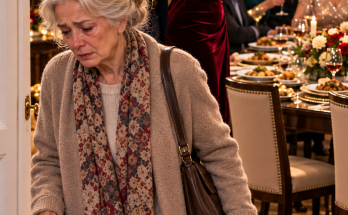
Through the window, I could see the dining table.
There were three place settings.
Not two.
I got out of the car and walked to the door.
Logan opened it before I knocked.
"Hey, Dad."
"Hello, son."
He stepped aside to let me in.
Chelsea came from the kitchen.
"Albert. I'm glad you came."
"Thank you for inviting me."
She reached toward my jacket, then stopped.
"Would you like me to take that?"
"Thank you."
I handed it to her.
The house smelled of roasted vegetables and baked chicken.
I could hear the oven fan and the quiet sound of a radio in the kitchen.
Nothing about the evening was grand.
There were no flowers arranged across the table.
There were no guests to impress.
It was an ordinary family dinner.
That was precisely why it mattered.
Chelsea brought the food to the table.
Logan pulled out a chair for me.
I sat down.
For a second, I looked at the place setting in front of me.
A plate.
A fork.
A folded napkin.
A glass of water.
Such ordinary things.
I had spent years believing that I did not need much.
I had told myself that I was happy to eat later, to stay upstairs, to let the younger people have their evening.
But what I had wanted was never complicated.
I had wanted to be included without having to earn it.
We began eating.
Chelsea asked about my apartment.
I told her I liked the neighborhood and had found a good place to buy groceries.
Logan asked about the plant.
I told him it was doing well.
He smiled.
"I never knew you liked plants."
"Your mother did. I suppose some habits stay with you."
For a moment, none of us spoke.
Then Chelsea asked about Margaret.
She wanted to know whether I still had the photographs from the old house.
"I do," I said. "I framed one of her in the garden."
"I remember that picture."
She looked down at her plate.
"I should have asked you about things like that instead of making assumptions about you."
I considered her words.
"Yes. You should have."
She accepted the answer.
She did not try to turn it into a joke or rush to defend herself.
We continued eating.
At one point, Logan asked whether I wanted more vegetables.
I said yes.
He passed the bowl.
It was such a small exchange that another person might not have noticed it.
I did.
I noticed that nobody asked me to finish quickly.
Nobody hinted that I should go upstairs.
Nobody looked toward the front window to see whether someone important might arrive.
I was simply there.
After dinner, Chelsea brought out a small plate of dessert.
Logan began clearing the table.
I stood to help.
"You don't have to do that," Chelsea said.
"I know."
I carried two plates to the kitchen anyway.
I wanted to help because I chose to, not because I was afraid that failing to help would make me unwelcome.
As we stood near the sink, Chelsea spoke quietly.
"I know one dinner doesn't fix anything."
"No, it doesn't."
"But I wanted you to know we are trying."
I looked at her.
"Then keep trying when it is inconvenient too."
She nodded.
"I will."
I did not ask her to promise more.
I did not tell her that everything was forgiven.
Some things would take time.
When I left that evening, Logan walked me to the door.
"Can we do this again?" he asked.
"Yes."
"Maybe next Sunday?"
"Let's talk during the week and decide."
He nodded.
I put on my jacket.
At the threshold, I turned back toward the living room.
For years, that house had been the place where I lived but did not always feel welcome.
Now I was leaving it again.
The difference was that I was leaving by choice.
I had my own apartment.
I had my own keys.
I had my own quiet evenings and my own decisions.
I loved my son.
I was willing to build something better with him.
But I was no longer willing to make myself smaller so that everyone else could remain comfortable.
On the drive back to Irving, I thought about the kitchen counter where I had left my key before dawn.
I had left it there because I could no longer live as if access to a home depended on how useful I was.
At the time, I had been frightened.
I had wondered whether I was throwing away my place in my son's life.
I had not known whether Logan would call.
I had not known whether Chelsea would apologize.
I had not known whether the business would survive without the support of my investments.
I had known only that I could not continue.
That had been enough.
The following morning, I woke in my own bed and made coffee.
I watered the plant.
Then I sat at the table and opened the folder of personal documents.
The family loan remained outstanding under the written agreement.
The bank's collateral requirements remained in force.
The household investment account was no longer available for Logan and Chelsea to use.
Those arrangements were not signs that I had stopped loving my son.
They were the boundaries that allowed me to love him without losing myself.
I closed the folder and put it away.
Then I took out the photograph of Margaret and Logan from the old family picnic.
I had not framed that one yet.
I placed it beside the photograph of Margaret in the garden and studied it for a while.
Logan had been young in that picture.
His hair was untidy.
His smile was wide and unguarded.
I remembered the boy who used to bring me broken toys and ask whether I could fix them.
I remembered teaching him to ride a bicycle.
I remembered the first time he had called me from college because he did not know how to handle a problem.
I had helped him whenever I could.
I still wanted to help him.
But I understood now that helping someone grow was different from preventing them from ever having to stand on their own.
My son had responsibilities.
He had a business.
He had a marriage.
He had decisions to make and consequences to face.
I could love him through all of it.
I could not live it for him.
A few days later, Logan called to tell me the bank had given him a clear path toward replacing the collateral.
It would require changes and careful planning.
He sounded relieved.
"That's good news," I said.
"Yes. It means we can move forward without relying on your investments."
"That is what the arrangement was supposed to accomplish."
"I know."
He paused.
"I wanted to tell you because I don't want you to think I'm waiting for you to change your mind."
I appreciated that more than he knew.
"Thank you for telling me."
"We'll manage."
"I hope you do."
We talked about other things before ending the call.
He asked whether I had been sleeping well.
I told him I had.
He asked if I needed anything from the house.
I said I had everything I needed.
This time, the answer was true.
That evening, I made stuffed mushrooms.
I had not planned to.
I had found Margaret's handwritten recipe while sorting through a box of papers, and the sight of her familiar notes had made me want to cook.
I washed the mushrooms, chopped the filling, and followed the instructions she had written years earlier.
The kitchen smelled warm and familiar.
I set a plate on the table and sat down to eat.
I thought about the night I had prepared the same dish for Logan's coworkers.
I remembered standing in the kitchen, proud that I could still make something my son loved.
I remembered Chelsea telling me to stay upstairs.
I remembered Logan looking away.
For a long time, I had thought that memory would always hurt in exactly the same way.
It still hurt.
But it no longer decided what I believed about myself.
I had not been foolish for wanting to share dinner with my son.
I had not been weak for helping him.
I had not been wrong to expect respect in the house where I lived.
The mistake had been believing that I needed to keep giving in order to deserve those things.
I finished my meal and washed the plate.
Then I turned off the kitchen light.
My apartment was quiet.
The framed photograph stood on the shelf.
The plant rested beside the window.
My phone lay on the table, and I knew Logan might call again.
I would answer if I wanted to.
I would visit if it felt right.
I would help when help was appropriate and freely chosen.
But I would not hand over my peace in exchange for a place at the table.
I was sixty-eight years old.
I had loved and lost my wife.
I had raised a son.
I had worked for decades, saved carefully, and built a life that belonged to me.
None of that disappeared because my family had forgotten how to treat me.
And none of it needed to be proved by the balance in an investment account.
I had left my key on the kitchen counter before dawn because I finally understood that I could not force people to value me by staying where I was unwanted.
I had thought leaving might cost me my family.
Instead, it gave me the chance to see what remained when money, convenience, and obligation no longer held us together.
What remained was not perfect.
It was not finished.
It was a father and a son learning to speak honestly.
It was a daughter-in-law beginning to understand the harm she had caused.
It was a family discovering that love could not be measured by what one person was willing to pay.
And it was me, at last, living in a place where I did not have to ask permission to belong.
Source: 1millionstories.net
The End
Read more original stories on Feel Every Story.
My Son Let Me Become a Stranger in His House, and I Finally Understood What My Place in His Family Really Was
Part 12 of 12