By the next morning, I had read Brianna's post enough times to know its wording by heart.
She had written about loyalty.
She had written about people who made promises and abandoned others when the consequences became inconvenient.
She had not mentioned my name.
She didn't need to.
Anyone who knew about the cabin could guess who she meant.
The comments were worse than the post itself.
Some people told her to stay strong.
Others said family should never turn its back on family.
One person wrote that money had a way of revealing people's true character.
I closed the page.
I wanted to explain that I had not withdrawn help at the last minute.
I had stopped someone from selling a property that did not belong to him.
Those were not the same thing.
But I knew that a public argument would not make the truth easier to establish.
The title company had the documents.
Sloane had the ownership records.
I had submitted my written denial.
I decided to keep my attention on those facts.
My phone rang while I was reviewing the messages from Sloane.
It was my mother.
I watched her name on the screen for several seconds before answering.
"Elena, why are you doing this to us?"
Her voice was quiet.
I moved the phone away from my ear, then brought it back.
"Mom, I didn't authorize the sale."
"We thought we had a solution."
"Who is we?"
She didn't answer directly.
"Victor said the money would help everyone. We could finally stop worrying about bills."
I looked at the desk.
There was a photograph of the cabin beside my laptop, and I had turned it facedown earlier that morning.
I turned it over again.
"What did you think would happen to me when the buyers took possession?"
"We thought you would understand."
"Understand what?"
My mother sighed.
"I can't keep living like this, Elena. Everything has been difficult for so long."
I believed her when she said that.
I knew she had struggled financially.
I knew she was tired of the arguments that came with Victor's business problems.
I knew she wanted a way out.
But I also knew that she had signed the agreement that protected the cabin.
She had agreed that Victor could not sell it.
"Did you see the power of attorney?" I asked.
There was a pause.
"Your stepfather handled the paperwork."
"That isn't what I asked."
"I don't know what you expect me to say."
I held the phone more tightly.
"I expect you to tell me the truth."
She went silent.
I could hear a faint sound in the background, perhaps a cabinet closing or someone moving through the kitchen.
Then she spoke again.
"Please don't make this worse than it already is."
I felt something sink inside me.
For years, that sentence had been enough to stop me from asking another question.
It had made me feel selfish for wanting clear answers.
It had made me feel cruel for insisting that a promise should mean what it said.
This time, I didn't apologize.
"I'm not the one who submitted a document with my signature on it."
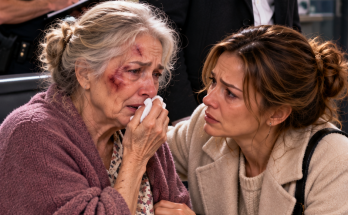
My mother began to cry.
I closed my eyes.
I hated hearing her cry.
I also knew that her tears did not answer my question.
"I love you," she said.
"I love you too."
"Then why can't you help us?"
"I did help you. I let you live in Dad's cabin for three years."
She didn't respond.
"I never agreed to sell it."
The silence that followed felt different from the others.
There was no immediate excuse.
No reminder that Victor was trying.
No request that I make things easier.
For a moment, I thought she might finally tell me something I didn't know.
Instead, she said she couldn't talk anymore and ended the call.
I sat at my desk.
I did not feel victorious.
I felt tired.
It would have been easier if I could have decided that my mother had never cared about me.
It would have been easier if every memory of her had suddenly become false.
But life doesn't work that way.
Someone can love you and still fail to protect you.
Someone can be frightened and still make a choice that harms you.
Someone can ask for your understanding while refusing to offer you the truth.
I was beginning to understand that I could not repair this by making myself smaller.
Later that afternoon, Sloane called with an update.
"The title company has confirmed the closing is on hold," she said. "They have your written statement and the ownership documents."
"Is that enough to keep the property from transferring?"
"It prevents the transaction from proceeding on the authority they've been given. The disputed document will need to be addressed before anything can move forward."
I leaned back in my chair.
"What's the next step?"
"We continue documenting everything. Keep copies of every message and do not sign anything Victor sends you without reviewing it first."
"I won't."
"And Elena?"
"Yes?"
"Do not let anyone convince you that asking for the proper process is the same as harming your family."
I looked at the photograph of my father.
For once, I had no answer ready.
"Thank you," I said.
After the call, I organized the records into a folder on my laptop.
The ownership documents went first.
Then the occupancy agreement.
Then my written statement.
Then the title company's confirmation.
I saved the disputed power of attorney separately.
I didn't want to lose track of it among the other files.
It was a strange feeling, arranging the evidence against someone I had allowed into my family home.
I had never expected to need those documents for this reason.
I had signed the occupancy agreement because I wanted to help.
I had kept paying the expenses because I didn't want my mother to struggle.
I had ignored the growing uncertainty because I thought giving them time would eventually solve the problem.
Now I could see that time had not solved it.
Time had allowed the arrangement to become comfortable for them.
And somewhere along the way, my generosity had become something they expected.
That evening, Victor sent me a message.
He wrote that the buyers were upset and that I had put everyone in a difficult position.
He said the sale had been meant to help the family.
He did not mention the signature.
He did not mention the agreement.
He did not explain how he had obtained the authority he claimed to possess.
I read the message twice.
Then I saved it with the others.
I didn't respond.
A few minutes later, Brianna posted again.
This time, she wrote about people who cared more about possessions than relationships.
I felt the familiar urge to defend myself.
I wanted to tell her that the cabin had belonged to my father before it belonged to me.
I wanted to tell her that I had opened its doors to her family when they had nowhere else to go.
I wanted to ask why her birthday trip seemed to matter more than the agreement her father had signed.
But I did none of those things.
I had no evidence that she knew every detail of the transaction.
I knew only that she was publicly describing the situation in a way that made me look responsible for the trouble.
I closed the app.
The cabin was still standing.
The sale had not closed.
My father's chair was gone from the listing photographs, but the house itself remained where he had built it.
I thought about the porch boards we had replaced when I was thirteen.
My father had made me measure them twice because he wanted the repair to last.
He hadn't asked me to trust that the boards were straight.
He had shown me how to check.
For three years, I had trusted my family to respect the boundaries we had put in writing.
Now I was checking.
That didn't make me cruel.
It made me responsible for what my father had left me.
I knew the dispute was far from over.
The disputed power of attorney still needed to be addressed.
I still didn't know what my mother had known, or when she had learned it.
And I didn't know whether Victor had acted alone or whether someone else had helped him move the transaction forward.
Those questions remained unanswered.
But one thing had changed.
I was no longer willing to confuse silence with peace.
The cabin had been entrusted to me.
I had given my mother and stepfather a place to stay because they needed help, not because I had forgotten who owned it.
They had been allowed to live there under clear conditions.
Those conditions had not changed simply because someone had found a buyer.
For the first time since that Tuesday morning, I stopped asking myself how I could make everyone less angry.
I began asking what I needed to do to protect what was mine.
Source: 1millionstories.net
Click here to continue reading: PART 5: I Kept Every Document, Every Message, and Every Promise in Writing, Because Family Had Finally Made Memory Feel Unreliable
My Stepfather Said the Cabin Was Already Sold, but He Had No Idea What I Was About to Find
Part 4 of 12