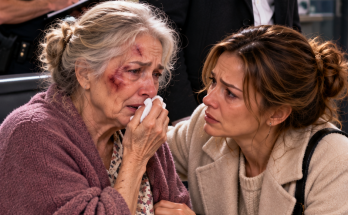
My mother called the next afternoon.
I almost let it go to voicemail.
Not because I didn't want to hear her voice.
Because I was afraid of what I would do with whatever she said.
I answered.
“Hello, Mom.”
She was quiet for a moment.
“Are you at home?”
“Yes.”
“Can we talk?”
I moved away from my desk and sat down.
“We're talking now.”
“I mean properly.”
I looked at the clock.
“I have time.”
Her breathing came through the phone in short, uneven sounds.
“I don't know how everything became this terrible.”
I closed my eyes.
That was not the question I had been asking.
“Mom, Victor tried to sell my cabin.”
“He said he thought he could.”
“He submitted a power of attorney with my name on it.”
“I know.”
The words stopped me.
“You know?”
“I saw the paperwork.”
“When?”
She hesitated.
“Before you called me.”
I gripped the edge of the table.
“Did you know he was going to submit it?”
“No.”
“Did you know he had a document claiming I gave him authority?”
“I saw it when he showed me the papers.”
“When did he show you?”
“I don't remember the exact day.”
I wanted to ask her to try.
Instead, I took a breath.
“Did you believe I had signed it?”
She didn't answer immediately.
“I thought there must have been some arrangement I didn't understand.”
“An arrangement with me?”
“You and Victor had talked about the cabin before.”
“We talked about the occupancy agreement. I told him he couldn't sell it.”
“I know what you told him.”
“Then what arrangement did you think existed?”
She made a small sound that might have been a sigh.
“I don't know, Elena.”
I stared at the wall.
That answer was honest in one sense.
It was also not enough.
“Did you ask me whether I had signed the document?”
“No.”
“Why not?”
“Because everything happened so quickly.”
I looked down at the printed copy of the deed.
A sale of a house was not a misplaced grocery list.
There had been time to ask questions.
There had been time to call me.
There had been time to look at the agreement we had all signed.
“You could have called me,” I said.
“I know.”
“You could have sent me a picture of the document.”
“I know.”
“You could have asked me one question before assuming I had agreed.”
My mother began to cry.
I sat still and listened.
There was a time when her crying would have made me rush to comfort her.
I would have told her everything was going to be okay.
I would have tried to solve the problem before she had to feel it.
This time, I waited.
“I never wanted you to lose the cabin,” she said.
“Then why didn't you help me protect it?”
“I didn't think it would come to this.”
I rubbed my forehead.
“You keep telling me what you thought would happen. I'm asking what you knew.”
She went quiet.
I could hear a television playing somewhere in the background.
Then she said, “Victor told me the buyer was serious.”
“That doesn't answer my question.”
“He said the money could help us start over somewhere else.”
I felt something cold settle in my chest.
“Somewhere else?”
“He thought we could find a smaller place.”
“Using money from selling my property?”
“He said it would all be worked out.”
I looked at the occupancy agreement again.
Three years earlier, my mother had asked me for help.
I had offered the cabin because it was empty and because I believed a family should help when it could.
I had not offered it as an investment.
I had not offered it as collateral.
I had not offered it for sale.
“Mom, you knew that cabin belonged to me.”
“Yes.”
“You knew Dad left it to me.”
“Yes.”
“You knew I let you live there because you needed a place to stay.”
“Yes.”
“And you knew the agreement didn't let either of you sell it.”
“Yes.”
Each answer came more quietly than the one before.
I waited for her to explain why she had gone along with it.
She didn't.
“Did Victor tell you he had forged my signature?” I asked.
“No.”
“Did you ask him where the power of attorney came from?”
She took a long breath.
“He said it was something he had arranged.”
“That isn't the same as an answer.”
“I know.”
I pressed my fingertips against my eyes.
I wanted her to tell me that she had challenged him.
I wanted her to tell me she had refused to believe the document until she heard from me.
I wanted to hear that she had defended me when I wasn't there.
Instead, she said, “I thought if I stayed out of it, it would be easier.”
“For whom?”
“For everyone.”
I looked toward the window.
Outside, a delivery driver carried a box to the house across the street.
Ordinary life continued around me.
“I need you to understand something,” I said. “Staying out of it didn't protect everyone. It left me alone to deal with something I never agreed to.”
“I didn't know what to do.”
“You could have asked me.”
She started crying again.
I let her cry.
After a while, she said, “Are you going to have Victor arrested?”
“I haven't made any decisions about that. Sloane is handling the legal process.”
“Could you just stop it from going any further?”
“The transaction is already paused.”
“Then perhaps we can all calm down.”
I felt the old pressure return.
The familiar request to lower my voice, soften my position, and make the discomfort disappear.
“Calming down won't make the document valid,” I said.
“I know.”
“And it won't change the agreement.”
“I know.”
“Then we need to let the process continue.”
She was silent for a long time.
Finally, she asked, “Do you still want me to be your mother?”
The question hurt more than I expected.
“Yes,” I said. “But I need you to be honest with me.”
“I am trying.”
“Then answer the questions I ask.”
She didn't say anything.
I didn't push her to fill the silence.
We ended the call without resolving anything.
I sat at the table for several minutes after the screen went dark.
Her words stayed with me.
She had seen the paperwork.
She had known Victor intended to sell the cabin.
She had understood that the property belonged to me.
And she had chosen not to ask me whether I had authorized the sale.
I wrote down the date and time of the call.
I recorded what she had told me as accurately as I could remember it.
I sent the notes to Sloane, making clear that they were my recollection of a conversation, not proof of anything beyond what my mother had said.
Sloane replied that she would keep the information with the other records.
She did not tell me what conclusion to draw.
Neither did I.
That evening, I found an old photograph of my father in a drawer.
He was standing beside the cabin porch, wearing work gloves and holding a screwdriver.
His expression was serious because he was concentrating on something outside the frame.
I remembered the day.
The porch railing had been loose.
He had fixed it before dinner.
I sat with the photograph in my hand.
I wished he were there.
Not because he would have known every answer.
Because he would have looked at the problem without asking me to pretend it wasn't a problem.
I put the photograph back in the drawer.
Then I returned to the table and placed the occupancy agreement inside the folder.
I still loved my mother.
I could say that without hesitation.
But love did not require me to accept an explanation that never answered the question.
And it did not require me to give away something my father had left me simply to make the family quiet again.
Source: 1millionstories.net
Click here to continue reading: PART 11: The Records Told Me What We Knew, but They Could Not Tell Me Why My Family Chose Silence
My Stepfather Said the Cabin Was Already Sold, but He Had No Idea What I Was About to Find
Part 10 of 12