I used to believe that knowing someone for fifteen years meant I knew what they were capable of.
I was wrong.
At 2:34 in the morning, my phone rang while I was crossing an almost empty parking lot outside Fort Belvoir.
I had just finished a twenty-four-hour strategic planning assignment.
My uniform felt heavy, my eyes burned from exhaustion, and all I wanted was to get home, shower, and sleep.
Then I saw who was calling.
Mom.
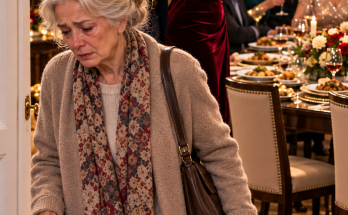
My mother, Corinne Ashford, was seventy-one years old.
She lived alone in Fairfax County, Virginia, and had a routine so dependable that I could practically set my watch by it.
Every morning, she tended her roses.
Every afternoon she found something useful to do, usually at the library, where she volunteered to record audiobooks for people who could not see.
She was independent, careful, and stubborn about handling her own problems.
She did not call me in the middle of the night unless something was seriously wrong.
I answered before the second ring.
"Mom? What's going on?"
At first, she didn't respond.
I heard her breathing through the phone.
It was uneven and shallow, like she was trying to speak but couldn't make herself do it.
I stopped walking.
"Mom, talk to me."
She made a small sound that I had never heard from her before.
Then she said my husband's name.
"Nolan came here tonight."
My grip tightened around the phone.
Nolan Vickers had been my husband for fifteen years.
He was the kind of man people trusted without feeling the need to ask why.
He worked as a wealth management consultant.
He remembered birthdays, carried shopping bags for older neighbors, and showed up at charity events dressed appropriately and ready to help.
He could make a stranger feel like an old friend in less than five minutes.
For most of our marriage, I had considered that one of his best qualities.
Then my mother spoke again.
"He hurt me, Blair."
I couldn't move.
She began crying, and the words came out between breaths.
"He called the police. He told them I attacked him."
My keys slipped from my hand and struck the pavement.
The sound was small, but in that empty parking lot, it seemed impossibly loud.
"What do you mean he hurt you?"
I already knew what she meant.
I just didn't want to accept it.
"Where are you right now?"
"At the county station."
Her voice shook so badly that I had to concentrate to understand her.
"Nolan said he was protecting himself."
For a few seconds, I forgot that I was standing outside a military installation in the middle of the night.
I forgot how tired I was.
I forgot the assignment I had just completed.
All I could think about was my mother sitting somewhere in a police station, frightened enough to believe she needed to apologize to me.
"Listen to me, Mom. Ask them to get you medical attention."
"I'm all right."
"No, you're going to let someone examine you."
She didn't argue.
That frightened me more than if she had.
I told her not to sign anything until I arrived.
I didn't know exactly what paperwork might be placed in front of her, but I knew she was upset, and I didn't want anyone rushing her into a decision while she was struggling to understand what had happened.
Then she apologized.
"I'm sorry, Blair."
I closed my eyes.
"For what?"
"For bringing this into your marriage."
There are things you remember because they changed your life.
And there are things you remember because, years later, you still wish you had answered differently.
This was one of the second kind.
My mother had been hurt badly enough to call me in the middle of the night, yet she was worried that her pain might inconvenience me.
Then she said something that stayed with me.
"I was only trying to protect you."
I asked what she meant, but she started crying again.
I couldn't get anything else from her before the call ended.
I stood there for another moment, staring at my phone.
Then I picked up my keys.
I was a lieutenant colonel in the United States Army.
My work required me to assess difficult situations, separate facts from assumptions, and make decisions when other people were too overwhelmed to do so.
I had spent years learning not to let panic take control.
But none of that training prepared me for the possibility that my husband had attacked my mother.
I drove to the Fairfax County precinct as quickly as I could without putting anyone else at risk.
During the drive, I kept replaying her words.
Nolan came here tonight.
He hurt me.
He said I attacked him.
I tried to find an explanation that made sense.
Perhaps there had been an argument.
Perhaps someone had misunderstood what happened.
Perhaps my mother had fallen, and Nolan had panicked.
I was still trying to make his behavior fit the man I thought I knew.
That was my first mistake.
I arrived about twenty minutes later.
The first person I saw was Nolan.
He was standing outside the station, drinking coffee and talking to a patrol officer.
He looked comfortable.
That was the detail I noticed before anything else.
He wasn't pacing.
He wasn't crying.
He wasn't even looking particularly worried.
His clothes were neat, his face appeared uninjured, and he spoke to the officer with the easy confidence I had seen him use at countless social gatherings.
For one foolish second, I felt relieved.
Then I remembered why I had come.
An ambulance was pulling in nearby.
I watched the paramedics prepare to take my mother for medical care, and whatever relief I had felt disappeared.
Nolan turned when he noticed me.
His expression changed immediately.
Concern replaced the casual look on his face.
He started toward me, but I walked past him.
I needed to see my mother.
I found her in an interview room with an emergency medical technician.
Her glasses were broken.
Her blouse was torn.
One side of her face was swollen.
I had seen soldiers return from difficult assignments carrying injuries they tried to minimize, and I knew what it looked like when someone was attempting to appear stronger than they felt.
My mother was doing exactly that.
She sat with her hands together, keeping them still by pressing one thumb against the other.
When she saw me, she tried to smile.
That nearly broke me.
I went straight to her and crouched beside her chair.
"You're going to the hospital."
She started to protest.
I shook my head.
"We're not debating this."
I told the EMT that I wanted her examined completely.
I wanted the injuries documented, and I wanted her to receive whatever treatment the doctors believed she needed.
My mother didn't argue again.
She only looked at me with tired eyes.
I squeezed her hand.
I wanted to tell her that everything would be fine.
I wanted to promise that I would fix whatever had happened.
Instead, I told her the one thing I could guarantee.
"I'm here now."
The paramedics took her away.
I watched the ambulance leave before turning back toward the station.
Nolan was waiting.
He had the expression of a man who had endured something unpleasant and was preparing to explain it patiently to someone who didn't understand.
I had seen that expression before.
Usually, it appeared when someone questioned one of his financial recommendations or challenged a decision he had already made.
He used it to make disagreement seem unreasonable.
This time, I wasn't interested in being reasonable.
I wanted facts.
I asked to speak with Sergeant Everett Sloan, the officer handling the matter.
Sergeant Sloan listened while I explained my relationship to both people involved.
He was careful with his words.
He did not tell me that Nolan was innocent.
He did not tell me that my mother was guilty.
He simply explained what had been reported.
According to Nolan, he had visited my mother's house at approximately nine-thirty the previous evening.
He had brought an apple pie.
He claimed the visit was an attempt to settle some recent tension between them.
At some point, he said, my mother became irrational and attacked him with a heavy iron fireplace poker.
He claimed he had pushed her away to protect himself.
I listened without interrupting.
The story sounded complete.
It had a reason for the visit, a description of the supposed attack, and an explanation for why Nolan had contacted the police.
It even made him sound patient.
He had gone to an older woman's home with a gift, tried to make peace, and then been forced to defend himself.
If I hadn't known my mother, I might have believed it.
If I hadn't seen her face, I might have believed it.
And if I hadn't spent fifteen years watching Nolan construct the version of himself he wanted other people to see, I might have believed that too.
Sergeant Sloan finished explaining the statement.
I thanked him.
Then the door opened.
Nolan walked into the room.
He looked at me as if he had been waiting for the chance to take care of everything.
"Blair, sweetheart, I'm so sorry."
I said nothing.
He lowered his eyes briefly, performing the kind of sadness that invited sympathy without requiring him to explain much.
"Your mother wasn't herself tonight."
He paused.
"I think she needs psychiatric help."
I looked at the man I had married fifteen years earlier.
I searched his face for some sign that he understood what had happened to her.
I found none.
Only concern for the story he had already told.
Source: 1millionstories.net
Click here to continue reading: PART 2: My Husband Arrived With an Apple Pie and a Perfect Explanation, Until He Started Telling Me What My Career Was Worth
My Mother Called Before Dawn, and the First Thing My Husband Wanted Was for Me to Protect His Reputation
Part 1 of 12