I used to believe that if you loved your family enough, they would always make room for you.
I was wrong.
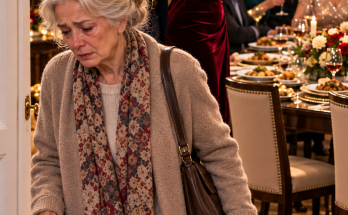
The night I understood that, I was standing beside a dining table in Dallas, Texas, holding a tray of stuffed mushrooms while my daughter-in-law looked at me as though I had wandered into the wrong house.
Her guests were seated around the table.
The conversation had been lively a moment earlier. Someone was laughing about a business deal, and the glasses on the table caught the light from the chandelier.
Then Chelsea turned toward me.
“Albert, why don't you go upstairs for the evening?”
I thought she meant she needed something from the kitchen.
“I was just bringing these out.”
She glanced at the tray.
“I know. But we'd prefer some privacy tonight.”
I looked past her at the people sitting around the table.
Two of them had already stopped talking.
I had met one of the men before. He had shaken my hand in the hallway when he arrived, then followed Logan into the dining room without giving me another thought.
Now he was looking at his plate.
I wished he would look at me instead.
It might have made the moment feel less humiliating.
Chelsea folded her arms.
“I don't want everyone to feel uncomfortable.”
I had spent most of the afternoon preparing the food.
The mushrooms were Logan's favorite appetizer when he was a boy. His mother, Margaret, used to make them whenever he brought home a good report card or finished a difficult school project.
She had been gone for six years.
I still made the recipe because it reminded me of her.
That evening, it seemed to remind nobody else of anything.
Chelsea turned toward my son.
“Logan, are you going to say something?”
I waited.
I wish I could tell you I expected a grand defense. I didn't.
I only wanted him to say that his father belonged in the house where he lived.
Logan studied the drink in his hand.
He moved the glass slightly, as though the position of the ice cubes required his attention.
Then he spoke.
“Dad, maybe tonight would be better if you gave us a little room.”
For a moment, I couldn't understand what I had heard.
Not because his words were complicated.
Because I had raised him.
I had taught him to tell the truth, to stand up for people who were being treated unfairly, and to remember who had helped him when he had nothing.
Apparently, those lessons had not survived the walk from childhood into adulthood.
I lowered the tray onto the nearest counter.
“That's fine.”
My voice sounded ordinary.
That surprised me.
I had expected anger to rise in my chest. I thought I might ask Chelsea what exactly she found so embarrassing about me.
Instead, I picked up the empty serving spoon and placed it beside the tray.
Nobody followed me.
Nobody called me back.
I walked upstairs while the dinner party continued behind me.
The sound of their conversation returned before I reached the top step.
That hurt more than the request itself.
They had not even needed time to recover from what happened.
My absence was apparently all the room required.
I closed my bedroom door.
For a long time, I sat on the edge of the bed and looked at the photographs on my dresser.
There was Margaret at the beach, her hair blowing across her face.
There was Logan at seventeen, standing beside me in the driveway after we had spent an entire Saturday repairing an old car.
In another photograph, he was younger still, missing two front teeth and grinning as though the world had been made for him.
I remembered how he used to run toward me when I came home from work.
Back then, I had never wondered whether I was welcome.
I took off my watch and placed it beside the lamp.
Then I heard someone laugh downstairs.
It was a woman's laugh, bright and effortless.
The party was going well.
I lay down without changing my clothes.
Sleep did not come.
I kept returning to one small detail: Logan had not looked at me when he asked me to leave.
He had looked at his drink.
That was the part I couldn't forgive myself for overlooking.
Because it wasn't the first time.
Not even close.
My name is Albert Higgins.
I was sixty-eight years old, retired, and had spent most of my working life as a senior accountant.
I had been a husband for forty years before Margaret died.
After she was gone, I discovered that an empty house could make even the smallest sounds unbearable.
The refrigerator starting in the kitchen.
The clock ticking in the hallway.
The porch light shining through a window when there was nobody left to wait for.
Logan had offered me a place with him and Chelsea in Dallas.
He said it was the sensible arrangement.
He said I shouldn't have to live alone.
Most importantly, he said I would always be part of their family.
I believed him.
In the beginning, I tried to make myself useful without getting in their way.
I bought groceries.
I cooked several nights a week.
When Logan needed supplies for his renovation company, I sometimes picked them up on my way home from an appointment.
I paid my share of household expenses and contributed when something needed repairing.
I didn't expect anyone to treat me like a guest of honor.
I understood that a young couple needed their own routines.
What I didn't understand was how easily a request for consideration could become a demand for invisibility.
It started with meals.
Chelsea would mention that she had invited friends over and ask whether I could eat in the kitchen.
I agreed.
Then she began suggesting that I remain upstairs when her coworkers visited.
I agreed to that, too.
Later, she asked me to use the rear entrance when I returned from running errands because guests might be in the living room.
I remember standing beside that door one afternoon with a grocery bag cutting into my fingers.
I had just purchased the coffee Chelsea liked.
I could have said something then.
I could have asked why the sight of me walking through the house had become a problem.
Instead, I carried the groceries inside and put them away.
I told myself it was easier not to argue.
Looking back, that excuse makes me ashamed.
I wasn't keeping the peace.
I was teaching them that my dignity was negotiable.
And I was doing it because I was afraid of losing the only family I had left.
There was another reason I stayed quiet.
Money.
Not because I lacked it.
Because I had it, and I had become accustomed to helping my son without making a fuss.
During my years as an accountant, I had learned to be careful with numbers. I saved consistently, invested conservatively, and avoided spending merely to impress other people.
By the time I retired, my investments had grown to a little more than eight hundred thousand dollars.
I didn't wear expensive watches.
I didn't buy a new car every few years.
My sweaters were old because they were comfortable, and I saw no reason to replace something that still did its job.
Chelsea had mistaken my habits for a lack of means.
I never corrected her.
I had never considered my account balance a family announcement.
But my money had become part of their life in ways they seldom acknowledged.
When Logan's renovation business needed additional backing for a credit line, I agreed to pledge some of my investment portfolio as collateral.
I read the paperwork before signing it.
I made sure the terms were documented.
Logan was my son, but I had spent too many years working with financial agreements to pretend that love made contracts unnecessary.
When the house needed major renovations, I lent them $186,400.
We put the arrangement in writing.
There was no confusion about what it was.
A loan.
Not a gift.
I also established an investment account to help cover household expenses.
I wanted them to have some breathing room while Logan's business grew.
I didn't need them to thank me every time a bill was paid.
I certainly didn't expect them to discuss the details with their friends.
I only wanted my contribution to be understood as what it was.
Help offered by a father who loved his son.
Not a debt of gratitude they had to repay with affection.
Not a purchase of my place in their home.
At least, that was what I told myself.
The trouble was that I had begun to confuse being needed with being loved.
Whenever Logan called because the business was short of cash, I felt useful.
Whenever Chelsea asked whether I could help with an unexpected expense, I told myself I was making their lives easier.
And whenever they asked me to step aside, I swallowed the hurt because I didn't want money to become an argument.
I thought I was protecting our relationship.
I was protecting the arrangement that allowed me to remain close to them.
There is a difference.
I learned that difference in the early hours of Tuesday morning.
I hadn't slept more than a few minutes.
The bedroom was dark except for the small light beside the bed.
I rose, walked to the dresser, and picked up Margaret's photograph.
Her smile was the same one I remembered from the last Christmas we spent together.
I wondered what she would have said about the dinner party.
Margaret had been gentle, but she was never timid when something mattered.
She would have asked Logan why he had allowed his father to be humiliated.
She would have asked Chelsea what kind of household she thought she was building.
And she would have looked at me last.
That was the look I feared most.
Not anger.
Disappointment.
I returned the photograph to the dresser.
Then I opened the closet and took out two suitcases.
I didn't make a plan for the rest of my life.
I didn't know where I would live permanently or what Logan would say when he discovered I was gone.
I knew only that I could not spend another morning pretending the previous evening had been normal.
I folded my clothes carefully.
I packed my important documents, my laptop, and the photographs I couldn't bear to leave behind.
The house remained quiet.
No footsteps came up the stairs.
No one knocked.
I stopped once beside the bedroom door and listened.
Nothing.
I had spent six years trying not to disturb the household.
That morning, I realized I had become so good at it that I could leave without disturbing anyone at all.
When the first light appeared beyond the curtains, I carried my suitcases downstairs.
The dining room was still arranged for the previous night's guests.
A few glasses remained on the table.
Someone had left a napkin beside a plate.
I looked at the chair where I had stood while Chelsea asked me to disappear.
Then I placed my house key on the kitchen counter.
I left without writing a note.
There was nothing I could put on paper that would make the truth easier to read.
I closed the door behind me.
And for the first time in six years, I walked away without asking whether my leaving would inconvenience anybody.
Source: 1millionstories.net
Click here to continue reading: PART 2: I Had Spent Years Keeping My Son’s Business Afloat, but One Quiet Meeting With an Attorney Changed What I Was Willing to Carry
My Son Let Me Become a Stranger in His House, and I Finally Understood What My Place in His Family Really Was
Part 1 of 12