I thought I knew what disrespect looked like.
Then I watched my son’s best friend walk into his funeral wearing a bright red dress, and I realized how quickly grief could turn me into someone I didn’t want to be.
My husband, Daniel, was already getting to his feet.
I caught his arm before he could take another step.
“Please. Just wait.”
He looked at me as though I’d lost my mind.
Our son was in a coffin at the front of the chapel.
And Theo, the boy who had practically grown up in our house, had arrived dressed as if he were attending an entirely different kind of occasion.
Every head turned when he entered.
A woman in the second row leaned toward her husband.
Two of Jack’s classmates exchanged looks.
Someone whispered behind me.
Theo heard them. I could tell by the way his shoulders tightened.
Still, he walked down the aisle.
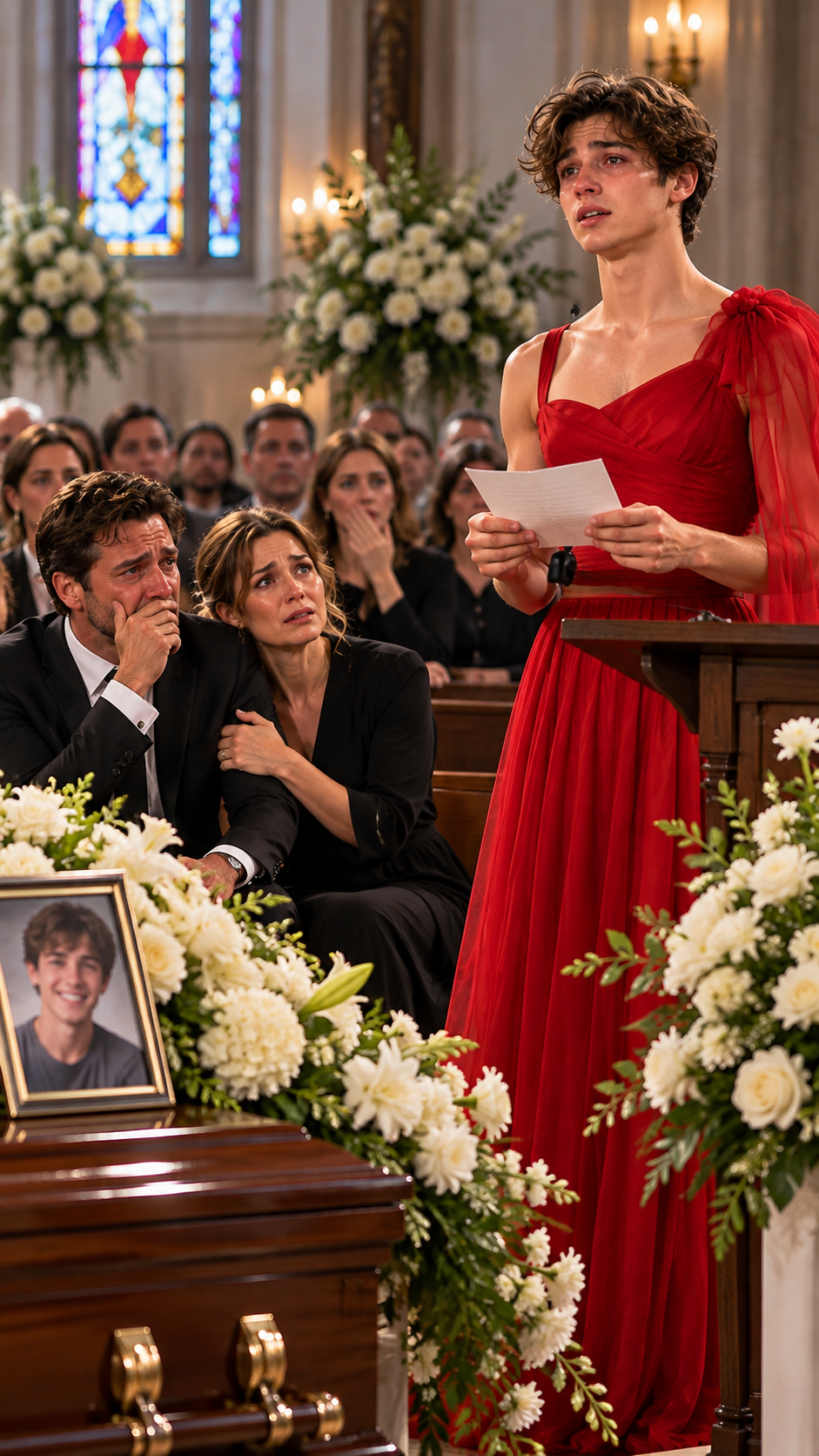
The dress reached his knees. Its red fabric stood out against the black and gray clothes everyone else had chosen.
He didn’t smile.
He didn’t look around to see who was watching.
He simply found a seat near the aisle and folded his hands in his lap.
I stared at him.
I wish I could tell you that my first thought was concern for a grieving boy who had just lost his closest friend.
It wasn’t.
I wondered what he was trying to prove.
Then I felt ashamed, because I knew Theo better than that.
Or at least, I thought I did.
My son, Jack Harris, had been dead for seventeen days.
He had turned eighteen shortly before we lost him.
Cancer had taken him fourteen months after the diagnosis, leaving Daniel and me with a house full of things our son would never use again.
His schoolbooks were still on his desk.
A half-finished list of places he wanted to visit remained beside his bed.
There was a mug in the kitchen that he’d used so often I could recognize it without looking at the cupboard.
Ordinary things.
That was what hurt the most.
The world had continued leaving ordinary things behind for a boy who would never come home to use them.
Jack had loved old horror movies, even the ones with terrible acting and endings that made no sense.
He told awful jokes and laughed at them before anyone else could.
He burned grilled cheese sandwiches with such regularity that I eventually learned to check the kitchen whenever the smoke alarm sounded.
He hated tomatoes.
Ketchup, however, was apparently acceptable on almost anything.
He could name capitals from countries I’d never heard of, yet getting him to carry his laundry downstairs had been a battle that lasted years.
He was stubborn.
Funny.
Sometimes impossible.
He was ours.
And Theo had been part of his life for so long that I could barely remember one boy without remembering the other.
They first became friends when they were seven.
Theo lived four houses away, and the boys had met through the ordinary business of childhood.
One afternoon, they were strangers.
Not long afterward, they were showing up at our door together, hungry and covered in dirt.
By the time they were ten, Theo was spending so much time at our house that we stopped treating his visits as visits.
We had a bedroom for guests.
Eventually, we stopped calling it that.
It became Theo’s room.
His parents had a difficult marriage.
They separated, tried again, separated once more, and spent years making arrangements that seemed to change whenever Theo began getting comfortable.
Holidays were especially hard.
Sometimes his mother expected him to stay with her.
Sometimes his father insisted it was his turn.
Sometimes neither seemed able to agree on what was best for their son.
Jack had never understood why the arrangements were so complicated.
He would walk into the kitchen, tell me Theo was staying with us, and wait for me to confirm what he already believed.
“Mom, Theo’s coming for Christmas.”
It was never really a question.
I always made room.
I never thought of it as a sacrifice.
He was a child who needed somewhere he could feel welcome, and we had a spare bed.
That was all.
Over time, he became more than Jack’s friend.
He became part of our family.
He knew which cupboard held the cereal and which floorboard outside Jack’s bedroom made a noise.
He could open our refrigerator without asking and tell from my expression whether I’d had a difficult day.
Daniel teased him almost as often as he teased Jack.
I bought groceries with both boys in mind.
When they argued, I told them to work it out.
When they laughed too loudly upstairs, I called up the stairs and threatened to separate them.
Neither ever took me seriously.
Those memories had once made me smile.
Now they seemed to belong to another family.
The cancer diagnosis changed everything.
At first, we believed we could manage it.
There were appointments, tests, treatment schedules, and conversations with doctors who spoke carefully while trying to give us information we weren’t ready to hear.
Daniel and I learned new medical words.
We learned how long it took to drive to the hospital at different times of day.
We learned how to keep our voices steady when Jack asked a question we didn’t know how to answer.
And we learned that hope could become a daily responsibility.
You woke up and found a reason to believe.
You went to bed and tried not to imagine what might happen if you were wrong.
Theo came over after school.
He did homework beside Jack’s bed when Jack felt well enough to talk.
On harder days, he sat quietly and watched movies with him.
Sometimes they laughed.
Sometimes Jack was too exhausted to do much more than watch the screen.
Theo stayed anyway.
He was there when treatment left Jack drained of energy.
He was there when Jack lost his hair.
He was there on days when my son grew frustrated with his own body and didn’t want anyone asking how he felt.
There were afternoons when Jack spoke constantly because silence seemed to make his fears louder.
Theo listened.
There were other afternoons when Jack barely spoke at all.
Theo stayed then, too.
Daniel and I were doing everything we could.
We worked opposite shifts when possible, trying to keep the household running while making hospital appointments and treatment visits.
We were parents, employees, drivers, cooks, record keepers, and people trying desperately not to fall apart in front of our child.
Sometimes we couldn’t both be home.
Sometimes we couldn’t both be at the hospital.
Theo filled those empty hours without making us feel guilty about them.
He never asked for praise.
He never complained that he was missing out on something.
He simply showed up.
That was why the red dress confused me so much.
I knew the boy who had sat beside my son through the worst days of his illness.
I knew how much Jack mattered to him.
Yet on the morning we buried Jack, I found myself wondering whether Theo had done something deliberate to hurt us.
Grief can make an ordinary question feel like an accusation.
I didn’t understand that at the time.
I only knew that I couldn’t stop looking at him.
He sat with his fingers interlocked, staring toward the front of the chapel.
His face looked pale.
He seemed younger than eighteen.
For a moment, I wanted to cross the aisle and ask whether he was all right.
Then another whisper reached me.
I looked at the coffin instead.
I had already lost my son.
I couldn’t bear the thought of discovering that something had happened between the two boys before his death.
Had they argued?
Had Jack said something cruel?
Had Theo come here intending to make a point that the rest of us couldn’t understand?
I leaned toward two of Jack’s school friends, who were seated a few rows away.
“Did Theo and Jack have a problem before Jack died?”
They both looked startled.
“No, Mrs. Harris.”
One of them shook his head firmly.
“They were fine. Nothing happened between them.”
I wanted to believe him.
But I still couldn’t explain the dress.
Daniel noticed Theo again and leaned toward me.
“Why would he come dressed like that?”
“I honestly don’t know.”
Daniel’s jaw tightened.
He looked toward the aisle, then back at the coffin.
“This is Jack’s funeral.”
“I know.”
He started to stand.
I reached for his sleeve.
“Daniel, please.”
He stopped, although I could feel the tension in his arm.
We were both exhausted.
For more than two weeks, sleep had come in brief stretches interrupted by memories, phone calls, and the awful realization that morning would arrive whether we were ready for it or not.
We had spent the previous days speaking to relatives, making arrangements, choosing photographs, and trying to decide how to say goodbye to a son who should have had decades ahead of him.
I didn’t have the strength to understand another unexpected thing.
I wanted the service to begin.
I wanted the room to be quiet.
I wanted people to remember Jack.
And I wanted Theo’s appearance to stop making everyone look at us as though we were responsible for explaining it.
Looking back, that last thought makes me uncomfortable.
Theo had lost his best friend.
He had every right to grieve.
But I was so consumed by my own pain that I had started treating his grief as an inconvenience.
The officiant moved toward the front and asked everyone to settle.
The whispers gradually faded.
I took Daniel’s hand.
His fingers were cold.
We listened as the service continued, each minute bringing us closer to the moment when we would have to accept that Jack’s life had ended.
Then the officiant announced that Theo would be speaking.
I turned toward him.
For a second, I had forgotten that he had agreed to give a tribute.
Theo rose slowly from his seat.
The red fabric shifted around his knees as he stepped into the aisle.
Several people watched him with open curiosity.
Others looked away, perhaps embarrassed by their own attention.
Daniel leaned forward.
I held his hand more tightly.
Theo reached the microphone and placed both hands on the podium.
He looked toward Jack’s coffin.
Then he looked at the people gathered to say goodbye.
His mouth opened, but no words came out immediately.
I could see him trying to steady himself.
When he finally spoke, his voice shook.
“I know some of you are probably wondering about what I’m wearing.”
A few people shifted in their seats.
Theo glanced down at the dress.
“I didn’t choose it because I wanted anyone looking at me.”
He stopped for a moment.
Then he looked directly at my son’s coffin again.
“I wore it because Jack asked me to.”
My heart gave a hard, painful beat.
Daniel went still beside me.
And for the first time since Theo had entered the chapel, I stopped thinking about what he was wearing and began wondering what my son had asked of him.
Source: kaylestore.net
Click here to continue reading: PART 2: Six Months Before We Buried Jack, His Best Friend Agreed to Something I Never Knew My Son Had Asked
I Thought My Son’s Best Friend Had Crossed a Line Until I Saw What He Was Carrying Into the Chapel
Part 1 of 12