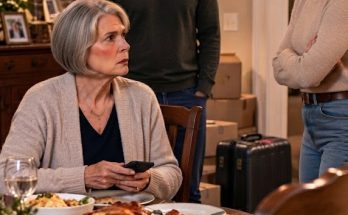
For several days after the meeting, I kept thinking about the way Brandon had spoken.
He had not defended me when I needed him most.
But he had finally acknowledged that the house was not his to claim.
I wanted to believe that was the beginning of something better.
I also knew better than to confuse one good conversation with a changed person.
Trust did not return simply because someone apologized.
It returned when their behavior became dependable.
I had learned that lesson during my nursing career, often from people who were frightened and struggling to accept a difficult truth.
Now I was learning it inside my own family.
The occupancy agreement was in place, and Brandon and Vanessa had sixty days to find another home. They were responsible for ordinary utilities and maintaining the property during that period.
Daniel kept copies of the documents.
I kept mine in a folder beside Richard's estate papers.
For the first time since the funeral, I knew exactly where I stood regarding the house.
I could make decisions without wondering whether someone would try to pressure me into signing something I did not understand.
That gave me peace.
It did not give me back the years I had spent believing my son would always stand beside me.
One morning, I opened the closet where I had stored the boxes from White Plains.
My mother's quilt was folded on top.
Beneath it sat our wedding photographs and the small wooden box containing Richard's anniversary cards.
I carried the box to the living room and placed it on the coffee table.
The first card I opened was from our tenth anniversary.
Richard had written only a few lines. He thanked me for the life we had built together and joked that I deserved a medal for putting up with him.
I smiled.
He had never been a man who used many words when a few would do.
I read another card.
Then another.
There were references to difficult shifts, family dinners, and small arguments about household expenses. One card mentioned a weekend trip we had postponed because Brandon needed help paying a college bill.
I remembered that weekend.
Richard had told me not to worry about the money.
We could take the trip later.
We had always believed there would be another opportunity.
Sometimes there was.
Sometimes there wasn't.
I closed the box and sat quietly.
The fortune Richard had accumulated was astonishing, but the life we had shared had never felt like a fortune.
It had been ordinary.
We had worked, paid bills, raised our son, and planned small pleasures around our responsibilities.
We had believed that if we did our best, our family would eventually be secure.
I did not regret helping Brandon.
I regretted that he had mistaken help for a promise that we would always solve his problems.
I also regretted how long I had made excuses for him.
That afternoon, Daniel arranged another meeting to discuss the trust's financial structure.
I brought a list of questions.
I wanted to understand how the assets were managed, which decisions required approval, and what expenses I should anticipate.
Daniel answered each question carefully.
He explained the role of the trustees and the importance of keeping my personal decisions separate from the trust's legal obligations.
I took notes.
There was a comfort in understanding the details.
I did not have to become an expert in every investment.
I needed to know enough to make informed choices and recognize when professional advice was necessary.
Richard had arranged for me to be protected.
I intended to protect myself by remaining involved.
At the end of the meeting, Daniel asked whether I had considered what I wanted to do with the money beyond maintaining my own security.
I looked down at my notebook.
"I haven't decided everything."
"There's no need to rush."
I knew he was right.
I had only recently begun to feel comfortable in the penthouse. I was still learning how to live without Richard, and I did not want to fill every quiet hour with a new responsibility.
But there was one thing I had been thinking about.
During my years as a nurse, I had met young people who worked long shifts while studying. Some struggled to afford textbooks, transportation, and professional examinations.
I remembered one student who had arrived at a hospital placement after working late the night before.
She was exhausted but determined.
She had apologized for looking tired.
I had told her that learning to care for herself was part of learning to care for others.
I wondered what had happened to her.
I wondered how many other students had abandoned their ambitions because the cost became too difficult to manage.
Richard had always admired people who worked hard without expecting special treatment.
He would have understood why those students mattered to me.
That evening, I took a notebook to the dining table and began writing down what I knew about nursing education and financial assistance.
I did not have a complete plan.
I had an idea.
And for the first time in a long while, I was looking forward to something that had nothing to do with the dispute over our home.
Over the following weeks, I spoke with people who understood how scholarships could be structured and managed responsibly.
I wanted the support to reach students who genuinely needed it.
I wanted the arrangements to be clear.
I wanted the program to continue beyond a single donation.
Daniel helped me understand the legal and administrative steps involved in establishing a fund.
I considered different ways to organize it and what level of support would make a meaningful difference.
I did not want to create something merely because I could afford it.
I wanted to create something that reflected the life Richard and I had lived.
We had always believed that a little help at the right time could change a person's future.
Perhaps that was the best use I could make of what he had left me.
One evening, I stood near the windows and looked down at Central Park.
The city was beginning to glow with lights.
I thought about Richard sitting beside me, asking whether I had remembered to buy coffee or whether we had enough money set aside for our next trip.
He would probably have been amused by the size of the estate he had accumulated.
He might have reminded me not to spend recklessly simply because the money was there.
I could almost hear him saying that being able to afford something did not automatically make it worth buying.
I smiled.
Then I returned to the table and continued writing.
The plan was still taking shape, but I knew what I wanted its purpose to be.
I wanted to help young nurses build a future without having to choose between their education and their basic needs.
I wanted the help to carry Richard's name.
And I wanted to make the decision because it mattered to me, not because anyone expected something from me.
For forty years, I had been Richard's wife.
For much of that time, I had also been a mother who put her son's needs ahead of her own.
Now I was beginning to understand that the rest of my life could have its own purpose.
I did not need to abandon my family to find it.
I only needed to stop believing that loving them required me to put myself last.
Source: lessoninlife.net
Click here to continue reading: PART 10: The First Scholarship Ceremony Reminded Me of the Life I Had Lived Before Grief, and My Son Finally Asked About the Money
Five Days After the Funeral, My Daughter-in-Law Decided My Home Belonged to Her, and My Son Let Her Speak
Part 9 of 15