I thought the worst thing that could happen after losing my husband was learning how to live without him.
I was wrong.
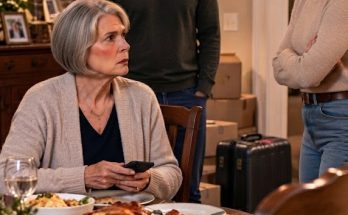
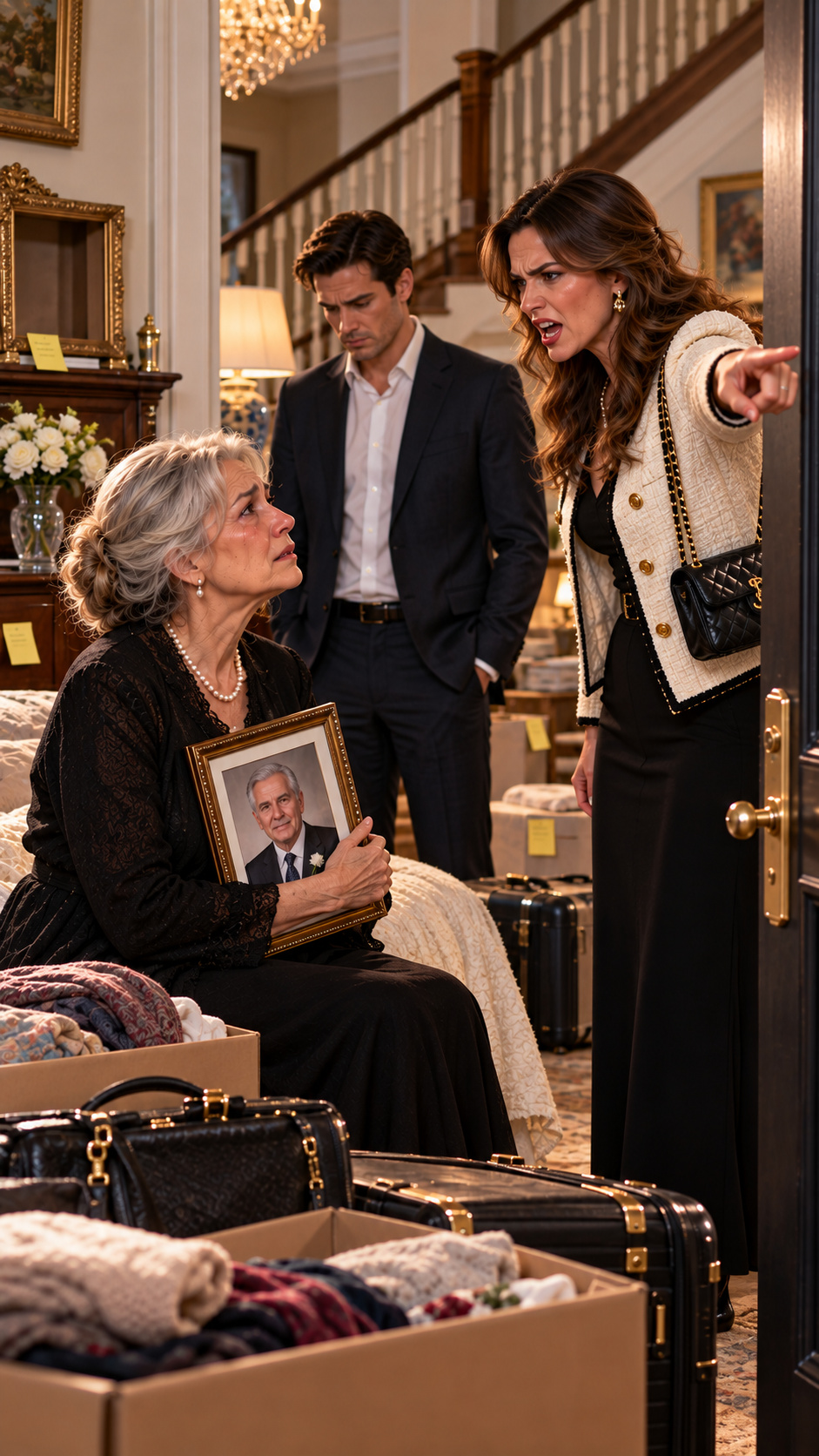
Five days after Richard was buried, my daughter-in-law told me to leave the house where I had spent forty years of my life.
My son stood beside the fireplace and said nothing that mattered.
I remember the yellow sticky notes most clearly.
Vanessa had been placing them on furniture all morning, marking the things she wanted to change. One was stuck to the dining room cabinet Richard had bought during our first year of marriage. Another was attached to the wooden bookcase he had assembled himself when Brandon was still a child.
There was a note on the living room wall, too.
Vanessa wanted to know whether it could be removed to make space for a larger television.
I watched her move through the rooms as though she had been waiting for an opportunity to take possession of everything.
Perhaps she had.
Outside, the March wind moved through White Plains, New York, rattling the bare branches near our driveway.
Inside, the flowers people had brought after Richard’s funeral were beginning to wilt.
I had not found the strength to throw them away.
I had not even put away the black dress I had worn to bury my husband.
At seventy, I was tired in a way I had never experienced before. The hospital visits, the nights spent listening to Richard struggle for breath, and the final days when I knew what was coming had left me feeling as though my body belonged to someone much older.
I wanted quiet.
I wanted my husband’s chair to remain where it was.
I wanted to make coffee in the morning and hear his familiar footsteps coming down the hallway.
Instead, I was watching Vanessa measure the windows.
She had brought a folder and a tape measure downstairs. Brandon followed her from room to room, occasionally looking up from his phone to answer a question.
They seemed to have forgotten that this was the house where their father and I had built our life.
Or perhaps they remembered perfectly well.
That was the part I did not want to consider.
“Margaret, can you come here for a moment?”
Vanessa was standing near the dining table.
I walked over slowly, resting one hand on the back of a chair.
She placed her folder on the table and opened it.
“We need to discuss what happens next.”
I looked at the papers.
“What happens next with what?”
“With the house.”
She said it as though the answer should have been obvious.
I glanced toward Brandon.
He was standing several feet away, staring at his phone. His expensive watch caught the light when he moved his wrist.
“Brandon, would you put that away for a minute?”
He looked up.
Vanessa folded her arms.
“Now that Richard is gone, we have to be realistic. This house is too much for you, Margaret. You should pack your belongings and find somewhere else to stay.”
I waited for her to smile.
I thought perhaps she was trying to discuss a future arrangement badly. Perhaps she had chosen the wrong words because everyone was grieving.
Then she pointed toward the front door.
“Brandon and I need this house.”
I heard every word.
For a moment, I could not make myself answer.
The refrigerator hummed in the kitchen. Somewhere outside, a car passed along the street.
Ordinary sounds.
That was what made the moment so strange. Nothing around me had changed, yet the woman standing across the table was telling me that I no longer belonged in my own home.
I turned to my son.
“Brandon, is that what you want?”
He slipped his phone into his pocket, but he did not come closer.
“Mom, Vanessa thinks it would be better for everyone if you moved somewhere smaller.”
“She thinks?”
He rubbed the side of his face.
“You don’t need all this space anymore.”
I looked at him for a long time.
He was forty-three years old. He had a job, a comfortable-looking life, a luxury SUV, and watches that cost more than some people’s monthly salaries.
He had also been the little boy who used to wait for me at the kitchen window when I worked late at the hospital.
I remembered the mornings I had packed his lunches before leaving for my own shift. I remembered sitting beside his bed when he had a fever, checking his temperature every hour because I was afraid something might happen while I slept.
When money was tight, Richard and I had made sacrifices so Brandon could attend college without worrying about every expense.
We had never asked him to repay us.
We believed parents were supposed to help their children find their feet.
I had never imagined that one day my own son would watch his wife tell me to leave my home and describe it as a practical solution.
“Where am I supposed to go?”
I asked the question quietly.
Vanessa answered before Brandon could.
“You can find an apartment. There are plenty of places for older people.”
Older people.
I looked down at my hands.
Those hands had spent decades caring for patients, changing dressings, holding frightened children, and comforting families who had no idea what to do next.
They had also held Richard’s hand through his final days.
Now they were trembling because I did not know where I would sleep.
“Have you already decided all this?”
Vanessa pulled the folder closer.
“We’re trying to make arrangements before things become more difficult.”
She opened the first page.
The document described a voluntary transfer of the property. It suggested that Brandon would take responsibility for the house while I moved into a smaller residence.
I read the page twice.
Something about the wording bothered me.
There were references to ownership and signatures, but the arrangement was not as straightforward as Vanessa made it sound. Richard’s name appeared in places where I expected different information, and the papers seemed to assume that certain decisions had already been made.
I did not understand every legal detail.
I understood enough to know that I should not sign something simply because another person was impatient.
“Who prepared these documents?”
I asked.
Vanessa’s expression changed.
“Does that matter?”
“Yes.”
“It’s a standard arrangement. Brandon will explain everything.”
My son looked uncomfortable.
He had not even read the papers closely enough to explain them to me.
“Mom, it’s just paperwork.”
I turned another page.
I had spent much of my working life watching people agree to things they did not understand because they were frightened, exhausted, or embarrassed to ask questions.
I had promised myself I would never do that with something important.
Not now.
Not when I had just lost the person who had shared every major decision of my adult life.
“I won’t sign this today.”
Vanessa let out a breath.
“Margaret, please don’t make this difficult.”
I closed the folder.
“I’m asking for time to review it.”
She looked at Brandon, and he gave a small shake of his head.
It was not a gesture of disagreement with her.
It was a gesture of frustration with me.
I noticed that.
I wish I could say I did not.
“Fine,” Vanessa said. “But we cannot keep waiting forever.”
She took the folder and walked toward the stairs.
Brandon followed her.
Within minutes, I could hear them talking about the bedrooms.
Vanessa wanted to turn the largest one into a dressing room. She was discussing where to put new furniture and whether the walls should be painted before they moved their things.
They spoke as if I were already gone.
I remained at the dining table.
Richard’s chair was still pushed slightly away from the table, just as he had left it the last morning he ate breakfast at home before his condition worsened.
I placed my hand on its back.
I could not bring myself to sit down.
For forty years, that chair had been part of the ordinary life I had taken for granted.
Now every familiar object seemed to be asking me the same question.
What had happened to my family?
That afternoon, I went upstairs to our bedroom.
Vanessa had already left the folder on the dresser, apparently expecting me to change my mind.
I moved it aside and opened the closet.
My clothes hung beside Richard’s suits. His shoes remained lined up beneath them. On the upper shelf sat the box where we kept old photographs and cards from our anniversary dinners.
I began packing because I needed something I could control.
I chose two sweaters, several changes of clothes, my nursing shoes, and my mother’s handmade quilt.
I placed my Bible in the suitcase.
Then I took the framed photograph from our wedding day.
Richard had looked so young in it.
His hair was darker, his shoulders straighter, and his smile less careful than it had become during the final years of his life.
I had kept that photograph through every house we had lived in.
I wrapped it in a sweater so the glass would not break.
When I opened the drawer beside Richard’s side of the bed, I saw the small velvet pouch.
I had placed it there three weeks earlier.
Inside was a brass key.
Richard had given it to me during one of his last hospital visits, when he was still able to speak clearly.
He had taken my hand and placed the key in my palm.
“Keep this somewhere safe, Margaret.”
I had asked what it opened.
He had looked at me for a moment before answering.
“I’ll explain when I can.”
He never got the chance.
At the time, I had assumed it belonged to an old storage box or some forgotten collection of documents from his working years.
Richard had spent most of his career in commercial property management. He understood leases, buildings, and financial arrangements far better than I did.
But he was not a man who liked to talk about money.
He dressed modestly, drove the same sedan for nearly fifteen years, and rarely discussed the details of his professional investments.
We had lived comfortably.
We had never considered ourselves wealthy.
I placed the key back inside the pouch and tucked it into the pocket of my handbag.
Then I looked around the bedroom.
My side of the closet was half empty.
Richard’s side had not changed.
I had been married for forty years, and I was preparing to leave the house because my daughter-in-law wanted more space.
I felt ashamed, although I could not have explained exactly what I had done wrong.
Perhaps I was ashamed because I had raised a son who could stand quietly while this happened.
Perhaps I was ashamed because part of me still wanted him to come upstairs, apologize, and tell me that Vanessa had gone too far.
I waited longer than I should have.
Nobody came.
By late afternoon, I carried my suitcase downstairs.
Vanessa was in the living room, speaking to someone about renovation costs.
Brandon stood beside the fireplace again, looking at his phone.
Neither asked whether I needed help.
Neither asked where I planned to stay.
I paused near the front door.
For one foolish second, I hoped my son would say something that would make leaving unnecessary.
He did not.
I opened the door myself.
The cold air touched my face.
I stepped outside with my suitcase in one hand and my handbag in the other.
Behind me, the door closed.
I stood on the front path, looking at the house Richard and I had shared for most of our adult lives.
I had no idea what would happen next.
But I knew I could not go back inside and pretend that afternoon had never happened.
Source: lessoninlife.net
Click here to continue reading: PART 2: A Brass Key, an Attorney on East 47th Street, and the Secret My Husband Had Carried Without Telling Me
Five Days After the Funeral, My Daughter-in-Law Decided My Home Belonged to Her, and My Son Let Her Speak
Part 1 of 15