The first thing my mother asked me was why I was making her stand outside.
Not whether I was well.
Not whether I had eaten.
Not even whether I wanted to see her.
She wanted the gate opened.
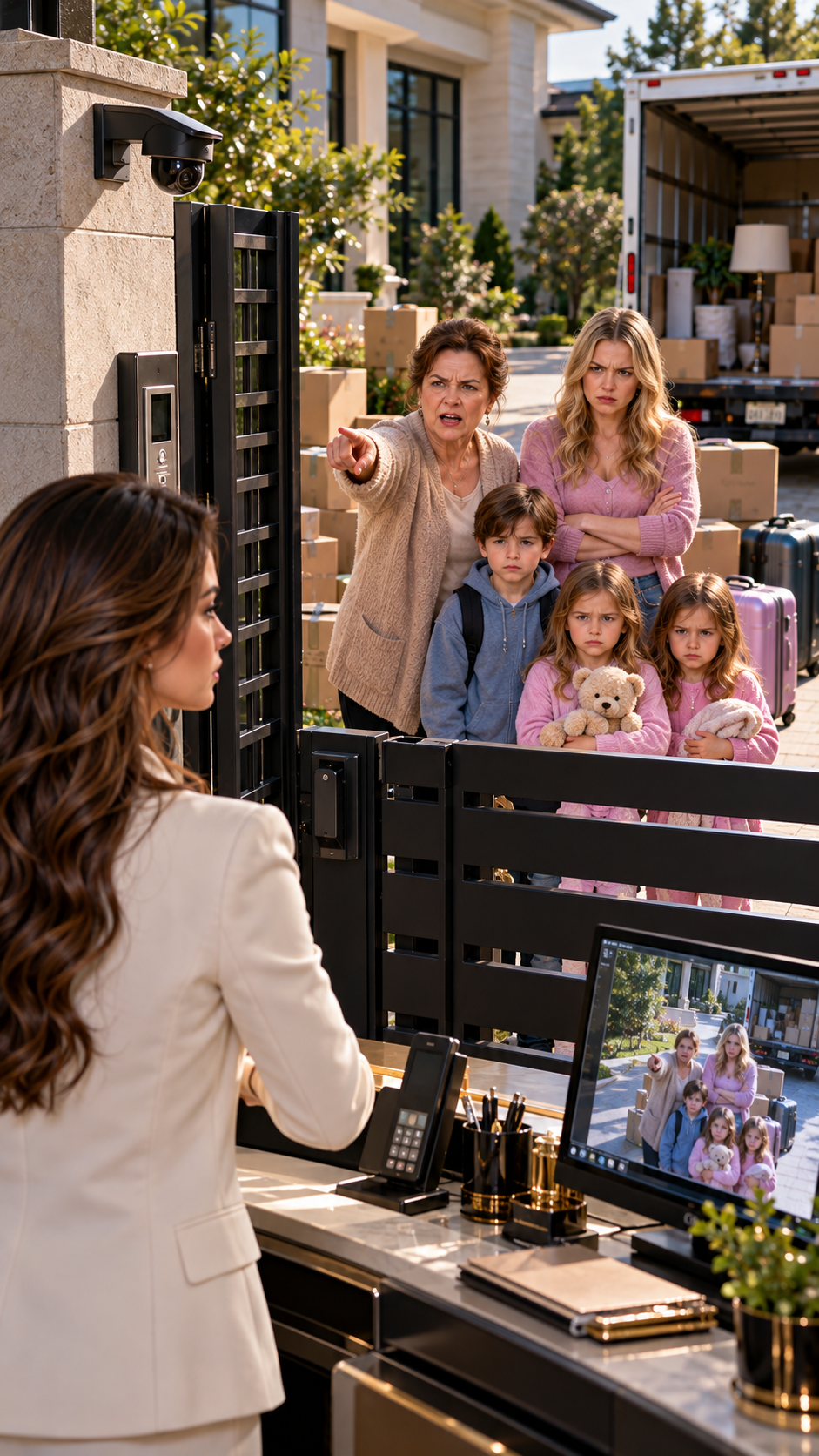
I watched her on the security monitor in my office, one hand resting on the intercom button and the other gripping her beige coat.
Behind her stood my twin sister, Mallory, her husband, Grant, and their three children.
A moving truck blocked half the driveway.
Cardboard boxes covered the gravel beside it.
They had brought everything they needed to move into my house.
The only thing they had forgotten was permission.
“Paige, open this gate,” my mother said. “We’ve been on the road for three hours, and the children are exhausted.”
I looked at the payroll spreadsheet on my computer.
Twelve employees depended on me to keep the business running.
A supplier was waiting for a payment confirmation.
My office manager had left a message about a delivery scheduled for the following morning.
I had a full day ahead of me.
And now my mother was standing outside my property, speaking as though I had inconvenienced her.
I pressed the intercom.
“Why are you here?”
She frowned at the camera.
“What kind of question is that?”
“A reasonable one.”
Mallory moved closer to the speaker.
“We’re coming inside, Paige. Mom wants the downstairs suite, and the children can take the bedrooms across the hall.”
I stopped moving my mouse.
She was already assigning rooms.
Grant wandered toward the metal fence separating my house from the workshop.
“Is that building yours, too?” he asked.
Mom answered before I could.
“Yes, it belongs to Paige.”
He looked through the bars.
“There’s enough room in there for me to set up a furniture business.”
Mallory nodded as though they had just settled an important detail.
I sat back in my chair.
They had been at my gate for less than five minutes, and they had already divided up my home and business.
My mother glanced toward the road.
“Don’t make a scene. The neighbors can see us.”
I almost laughed.
She was worried about the neighbors.
Not about the fact that she had arrived without warning after twelve years of silence.
Not about whether I wanted her there.
Only about how things might look if I refused.
I had imagined this moment more times than I cared to admit.
Sometimes I pictured myself telling them everything they had done to me.
Sometimes I imagined my mother apologizing.
In other versions, Mallory would finally admit that she had watched me suffer and done nothing.
I had spent years rehearsing conversations that never happened.
But when they finally appeared, I discovered that I didn’t have a speech prepared.
I had one question.
“Who told you that you could move in?”
My mother stared at the camera.
For a moment, nobody spoke.
Then she said, “We’re family, Paige.”
That was when I understood something.
They hadn’t come to ask whether I would help them.
They had come because they believed I would have no choice.
To understand why I kept that gate locked, you need to understand what happened when I was nineteen.
Mallory and I were born seven minutes apart.
Our mother, Diane Whitaker, treated those seven minutes as though they had established a permanent order of importance.
Mallory was the older twin.
That was enough.
She received the bedroom with the window.
She got new coats when winter arrived.
She had dance lessons, birthday parties, and the kind of childhood photographs that showed a girl who had never wondered whether she was wanted.
I wore her old clothes.
When she grew tired of a toy, it became mine.
When she wanted something I owned, Mom usually found a reason to give it to her.
“You’re the independent one, Paige,” she would tell me.
For years, I accepted that as praise.
I thought it meant she trusted me.
I didn’t understand that independence was the word she used whenever she wanted to leave me to manage something alone.
Mallory could be upset, and everyone stopped to comfort her.
I could be upset, and I was told to stop making things difficult.
If Mallory wanted the television, I was expected to let her watch.
If she wanted the last piece of cake, I was expected to be generous.
If I complained, Mom looked at me as though I had failed some simple test of character.
“You know your sister needs more attention,” she would say.
I learned to ask for less.
It was easier than arguing.
It was also easier than watching my mother become disappointed in me for having ordinary needs.
My grandmother, Elaine, was the only person who seemed to notice what was happening.
At her house, I could sit at the kitchen table without feeling that I had to earn my place.
She listened when I spoke.
She asked what I thought.
If I disagreed with her, she didn’t treat it as an insult.
She taught me how to repair damaged furniture in the small workshop behind her house.
We worked on old chairs, wooden cabinets, and tables that other people had decided were beyond saving.
She showed me how to examine a crack before filling it.
How to remove damaged material without destroying the good wood around it.
How to be patient with something that needed more than a quick repair.
One afternoon, while we were working on a scratched oak dresser, she noticed me watching a deep split near one of the drawers.
“Don’t be embarrassed by damage,” she told me. “Find out what caused it before you decide what to do.”
I didn’t know then how often I would remember those words.
Grandma died during my final year of high school.
After that, our home changed.
There was no longer anyone who questioned Mom when she favored Mallory.
No one who noticed when I went quiet.
No one who asked whether I was all right after another argument.
A few months after graduation, Mallory announced that she was pregnant.
Her boyfriend, Grant, moved into our rented duplex carrying two laundry baskets and a television so large it barely fit through the doorway.
He had no steady income.
He talked about business ideas, but most of them seemed to disappear before he could put them into practice.
Mom welcomed him anyway.
Within weeks, she decided that Mallory needed my bedroom.
The room had enough space for a crib and a dresser.
Mine had a door that closed properly, while the living room was too exposed for a newborn.
I understood the practical problem.
What I couldn’t understand was why the solution always involved taking something from me.
“Could I sleep on the couch until college starts?” I asked.
Mom was standing in my doorway, examining the room as though I were already gone.
“Grant has problems with his back,” she said. “He needs somewhere comfortable to sleep.”
“What about the basement?”
“We need that space for the baby.”
I looked at the bed, the dresser, and the small collection of books I had bought with money from my part-time job.
“Where am I supposed to go?”
Mom turned toward me.
“You’re nineteen, Paige. You need to learn that you can’t depend on me forever.”
I remember the way she said it.
Calmly.
Almost kindly.
As though she were giving me advice instead of telling me that I no longer had a place to live.
Mallory stood behind her with one hand resting on her stomach.
“You’ve always acted like you don’t need anybody,” she said. “You’ll be fine.”
I looked at my sister.
I waited for her to say something else.
Perhaps she would suggest sharing the room.
Perhaps she would tell Mom that I could stay until I found somewhere affordable.
Instead, she glanced at the television in the living room.
That was the end of the discussion.
I packed my clothes into two large trash bags.
I didn’t own enough luggage to need a suitcase.
One bag held my clothes and shoes.
The other held books, a few personal belongings, and the small wooden box containing Grandma’s letter.
I carried everything downstairs.
Nobody helped me.
Mom was watching television when I passed through the living room.
Mallory sat beside Grant, discussing where they would put the crib.
I stopped near the front door.
“Do you want me to call when I find somewhere?”
Mom barely looked away from the screen.
“If you need to.”
I knew what she meant.
She didn’t expect me to call.
She didn’t want me to.
Before I stepped outside, she handed me a few cans of soup and a packet of crackers.
“Take these. And if anyone asks, tell them you decided to move out on your own.”
I looked at the food in my hands.
For a moment, I couldn’t find the words.
Then I took it.
I was nineteen, frightened, and still hoping that if I behaved well enough, someone might change their mind.
I walked away carrying two bags.
I didn’t know where I would sleep that night.
For the first few weeks, friends let me stay on their floors.
I tried not to take up much space.
I washed dishes, bought groceries when I could, and promised I would leave as soon as possible.
Eventually, their families needed their rooms back.
I understood.
I had no money for a proper apartment, and my part-time wages barely covered food and transportation.
I bought an inexpensive tent and found a place to hide it behind some storage buildings near a flea market outside Ridge Hollow.
It wasn’t somewhere I would have chosen.
It was somewhere I could stay without being asked to leave.
Every morning, I washed in a gas-station restroom.
I kept my clean shirt inside a plastic grocery bag so it wouldn’t smell like damp grass.
I learned which public bathrooms were open early and which shops allowed me to sit outside without being chased away.
I counted every dollar.
I stopped buying coffee.
I skipped meals when I needed to pay for something important.
There were mornings when I woke up with cold hands and spent several minutes staring at the tent roof, trying to convince myself to get up.
I was embarrassed.
That was the part I found hardest to admit.
I was embarrassed that I had no home.
I was embarrassed when people asked where I lived.
I was embarrassed that my mother could tell relatives I had chosen to leave, and I had no easy way to explain what had really happened.
I didn’t want anyone to pity me.
I wanted someone to notice that I needed help without making me feel ashamed for needing it.
One rainy afternoon, I was collecting shopping carts outside a supermarket when I saw my mother’s car.
I recognized it immediately.
She was driving slowly through the parking lot.
Mallory sat in the passenger seat, laughing at something on her phone.
I was wearing a damp jacket.
My shoes were wet, and my hands were red from the cold.
For a second, I thought Mom might pull over.
She looked directly at me.
I knew she recognized me because her eyes met mine through the windshield.
I stood still, holding the handle of a shopping cart.
She could have stopped.
She could have lowered the window.
She could have asked where I was staying.
Instead, she continued driving.
Slowly enough for me to understand that it was a decision.
I watched the car turn toward the exit.
Mallory was still smiling at whatever she had seen on her phone.
Then they were gone.
I finished collecting the carts because I needed the money.
That evening, I sat inside my tent and took out my prepaid phone.
I stared at my mother’s number for nearly an hour.
I wanted to call her.
I wanted to ask why she had driven away.
I wanted to hear her say that she had made a mistake.
But I already knew what would happen if I called.
She would explain why Mallory needed her.
She would remind me that I was supposed to be independent.
And somehow, by the end of the conversation, I would be apologizing.
I put the phone away.
Then I made myself a promise.
I would build a life in which nobody could decide, without warning, that I no longer belonged.
Not my mother.
Not my sister.
Not anyone.
At nineteen, I had no idea how I would accomplish that.
I only knew that I had to begin.
Source: kaylestore.net
Click here to continue reading: PART 2: A Broken Oak Dresser Gave Me My First Chance, and the Tiny Room Above a Laundromat Taught Me What Security Really Meant
My Mother Told Me There Was No Room for Me at Nineteen, but Twelve Years Later She Expected Me to Open My Gate
Part 1 of 12