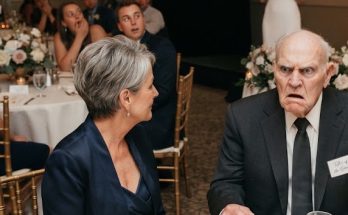
The next time I saw Calder and Liora, I told them I had met with my father.
We were sitting together after dinner.
Calder put down his glass.
“How did it go?”
I considered my answer.
“He apologized for some of what happened.”
Calder watched me carefully.
“And how do you feel?”
I looked at Liora, then back at him.
“I'm still figuring that out.”
He nodded.
He didn't ask me to forgive his grandfather.
He didn't tell me the conversation meant everything was finally right.
He let me speak at my own pace.
I explained that my father had acknowledged the years we had lost and admitted that his expectations had played a part in our separation.
I told them he had said he was proud of my accomplishments.
Calder smiled.
“I'm glad he finally said it.”
“So am I.”
Liora reached across the table and touched my hand.
“You don't have to decide everything now.”
I looked at her.
It was the same kind of fairness she had described at the wedding.
No demand for a particular outcome.
No insistence that one conversation had to settle the entire past.
Just room to consider what had happened and choose what came next.
I was grateful for that.
Over the following months, my father and I spoke occasionally.
Sometimes our conversations were brief.
Sometimes we discussed my work or the plans Calder and Liora were making.
We didn't return to the past every time we spoke.
That was important.
I didn't want our relationship to become a permanent examination of the night I left home.
But I also didn't agree to pretend it had never happened.
When my father slipped into old habits, I told him.
Sometimes he listened.
Sometimes he became defensive.
We were both learning how to speak without relying on the rules that had governed our relationship for so long.
There were no guarantees.
I didn't expect any.
Griffin and I continued to rebuild our own relationship.
We exchanged messages.
We spoke when we had something to say.
Occasionally, we discussed our childhood.
He began acknowledging the ways our father had shaped our family.
I began acknowledging that Griffin had lived under those expectations too.
We didn't become the siblings we might have been if I had never left.
We became two adults who were willing to understand each other more honestly.
That was enough to continue.
Calder and Liora remained the easiest part of the new arrangement.
They called when they wanted to talk.
They invited me to spend time with them.
They asked about my life without treating my career as the only interesting thing about me.
Sometimes Calder asked for advice.
Sometimes he simply wanted to tell me something funny that had happened during his day.
I came to value those ordinary conversations more than I could explain.
They were the conversations I had missed while he was growing up.
They were also proof that a relationship could be built without recovering every lost moment.
One evening, Calder sent me another photograph from the wedding.
It was the picture of the three of us beside the table.
The candle stood behind us.
My place card was visible in the corner.
I opened the photograph and looked at it for a long time.
I remembered how I had felt when my father approached me at the entrance.
I remembered the humiliation of being told I had no reason to be there.
I remembered looking at the place card and wondering whether I should leave.
Then I remembered Calder coming toward me.
I remembered Liora taking the microphone.
I remembered the dance.
Those moments had become part of the same evening.
My father's insult had happened.
It was real.
But it was not the only thing that had happened.
I had stayed long enough to discover that.
I saved the photograph beside the old picture from the park.
One showed me with a little boy in a stained shirt.
The other showed me with the man he had become.
Between those two photographs were thirty-one years.
Years of work.
Years of separation.
Years of unanswered questions.
And now, a beginning I hadn't expected.
I took the wedding card from the drawer and placed it beside the photographs.
I read the message one more time.
Then I smiled.
For much of my life, I had thought of family as a place I could lose.
A house.
A name.
A seat at a table.
My father had taught me that belonging depended on following his rules.
When I refused the marriage he had arranged, I believed I had lost the right to call myself part of the family.
I spent years trying to replace what I had lost with achievement.
I worked harder.
I learned more.
I accepted responsibilities that tested me.
I became a rear admiral.
I built a life I was proud of.
Yet none of those accomplishments could answer the question I had carried since nineteen.
Would my father ever accept me as I was?
For years, I believed the answer determined whether I had succeeded.
Now I understood that I had been asking the wrong question.
I could not control whether my father accepted my choices.
I could not make him understand every decision I had made.
I could not recover the years we had spent apart.
But I could decide whether his judgment would continue to determine how I saw myself.
I no longer wanted it to.
I was proud of my career.
I was proud that I had finished my education when the path became difficult.
I was proud that I had learned to accept help without surrendering my independence.
I was proud that I had remained open enough to answer Calder's message after so many years of believing the past was finished.
And I was proud that I had stayed at the wedding.
Not because I had endured my father's insult.
Because I had refused to let it make the decision for me.
I had remained for the people who wanted me there.
I had danced with my nephew.
I had listened to the bride tell a story about fairness.
I had spoken honestly with my brother.
I had given my father an opportunity to speak without promising him that his words would erase everything that came before.
Those were my decisions.
They belonged to me.
One afternoon, I opened the drawer again and looked at the place card.
I considered putting it in a frame.
Then I decided against it.
The card didn't need to become a monument to the past.
It was a small piece of paper from a wedding.
It had reminded me that someone had made room for me.
I didn't need to display it to keep that truth.
I returned it to the drawer.
Then I picked up my phone and sent Calder a message.
I told him I was glad he had found me.
I told him I was glad I had come to the wedding.
And I told him that whenever he and Liora wanted to have dinner again, I would be happy to join them.
His answer arrived a few minutes later.
He said they would be glad to see me.
Then he added a joke about finding a restaurant that served blue popsicles for dessert.
I laughed aloud.
For a moment, I was back in the park with a six-year-old boy who had tried to hide his tears.
I could almost see the stain on his shirt.
I could almost hear him insisting that the melting popsicle wasn't his fault.
I smiled at the memory.
Then I put the phone down and returned to my day.
There were still things I wished had happened differently.
I wished my mother had spoken at the dinner table.
I wished Griffin had challenged our father when I was nineteen.
I wished my father had understood that love did not require obedience.
I wished we had not lost thirty-one years.
Those wishes would always be part of my story.
But they were no longer the only part.
My father and I might continue building a relationship.
We might never become the family I had imagined when I was young.
I could accept that uncertainty.
I no longer needed to know the ending before I allowed myself to live the present.
The night I left home, I carried two suitcases down the front steps.
I believed I was walking away from the only place where I could ever belong.
I was wrong about that.
Belonging had followed me into classrooms where people helped me finish my education.
It had existed in friendships that didn't demand that I become someone else.
It had grown through years of work that taught me to trust my own judgment.
And it had survived in the memory of a little boy who remembered an afternoon in the park.
Thirty-one years later, that boy had become a man who invited me to his wedding.
He had written my name on a card.
He had made a place for me.
My father had looked at that place and believed I didn't deserve it.
But the place had never belonged to him.
It belonged to Calder's choice.
And my decision to stay belonged to me.
I was fifty years old.
I was a daughter, a sister, an aunt, and a rear admiral.
I was a woman who had made mistakes, endured losses, built a life, and learned that forgiveness could not be forced.
I was someone who could love her family without surrendering her own judgment.
For the first time, I no longer needed to ask whether that was enough.
It was.
I had finally stopped waiting for my father to decide whether I belonged.
And when I thought about the wedding, I no longer remembered only the words he had whispered at the entrance.
I remembered the handwritten message beneath my name.
I remembered Calder holding out his hand.
I remembered the music.
I remembered staying.
Source: 1millionstories.net
The End
Read more original stories on Feel Every Story.
My Father Made It Clear I Was Unwanted at My Nephew’s Wedding, but the Place Card Told a Different Story
Part 15 of 15