The first thing I noticed was the empty guitar stand.
I remember that because, at the time, I still believed the worst thing my son had done was disobey me.
I was standing in Julian’s bedroom with a basket of clean laundry against my hip.
His bed was unmade.
A pair of socks lay beside his desk.
His PlayStation controller was missing from the shelf, too, although I didn’t notice that until later.
All I saw was the empty space where his Fender Stratocaster should have been.
I checked behind the bedroom door.
Then I looked inside his closet.
I even went downstairs and searched the living room, thinking perhaps he had carried it out to practice somewhere else.
Nothing.
Julian had owned that guitar for years, and he treated it better than most adults treated their cars.
He wiped the strings after every practice session.
He kept the case closed whenever he wasn’t playing.
If anyone touched it without asking, he noticed.
So I knew something was wrong.
I waited until he came home.
He walked through the front door with his backpack hanging from one shoulder, greeted me, and headed toward the kitchen.
I followed him.
“Julian, where did you put your guitar?”
He stopped.
Not slowly.
He stopped as if someone had called his name in a room where he wasn’t supposed to be.
For a moment, he didn’t look at me.
Then he lowered his backpack to the floor.
“I sold it, Mom.”
I stared at him.
I had expected an explanation about school or a broken string or perhaps a friend who had borrowed it.
I had not expected those four words.
“You sold your Fender?”
He nodded.
I put the laundry basket down on the nearest chair.
“Why would you do that without talking to me?”
His eyes became shiny, but he didn’t try to change the subject.
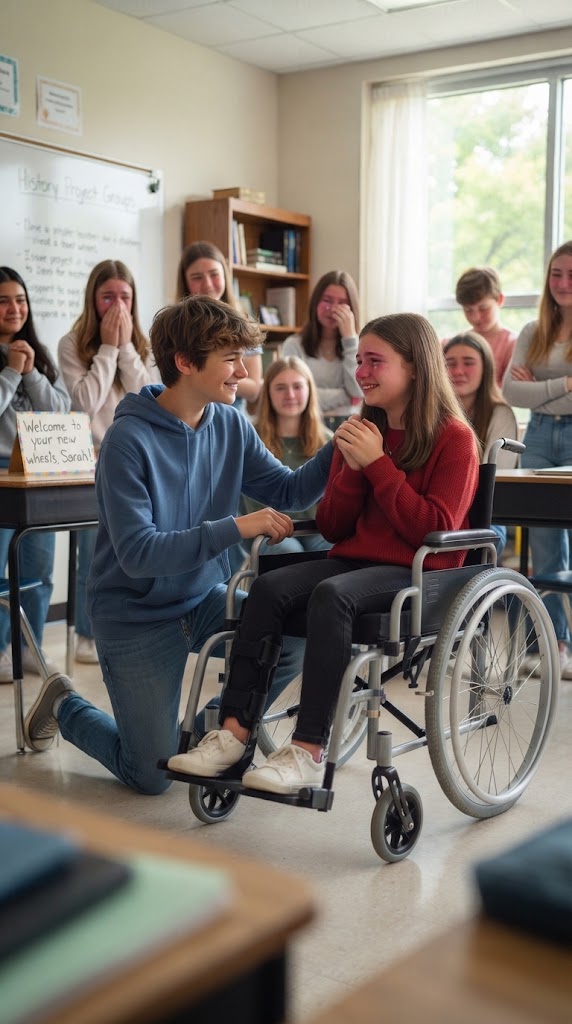
“Because Maya needed a wheelchair.”
That was when I stopped being angry long enough to listen.
Maya was in Julian’s eighth-grade class.
I knew her face from school events and had seen her moving through the hallways in her wheelchair.
I knew she was a quiet girl.
I didn’t know that her chair had become such a problem.
Julian explained that the front wheels sometimes locked up when she tried to move.
The frame had become difficult to handle, and the seat needed replacing.
Getting between classrooms could take far longer than it did for the other students.
Sometimes, the chair made noises that attracted attention.
Some children had made comments about it.
Julian didn’t repeat what they had said.
He didn’t need to.
“She acts like she doesn’t care,” he told me. “But I can tell it hurts her.”
I sat down.
He remained standing, looking at the floor.
He told me Maya’s family was dealing with medical bills and couldn’t afford the specialized wheelchair she needed.
He had watched her struggle at school and decided he couldn’t keep pretending he hadn’t noticed.
“So you thought you would sell your guitar?”
“I knew I could get money for it.”
“Julian, that guitar was important to you.”
“I know.”
He said it quietly.
Then he looked at me.
“But she needs a working chair more than I need that guitar.”
I didn’t know what to say.
His Fender had not been an ordinary purchase.
My husband and I had spent months saving for it.
Julian had wanted one since he was ten, and he had worked toward that goal with the patience I wished he would sometimes show with his homework.
He saved birthday money.
He earned a little by mowing lawns.
We covered the remaining cost and surprised him with the instrument on Christmas morning.
I could still picture him opening the case.
He had stared at the guitar for several seconds before lifting it out.
Then he had smiled so widely that my husband and I started laughing.
For two years, that instrument had been part of his everyday life.
Now he had sold it.
And he had done it for a girl who needed help.
I reached for him.
He came toward me, and I wrapped my arms around his shoulders.
“Oh, sweetheart.”
He pressed his face against my shoulder.
“I’m sorry I didn’t ask you.”
That apology mattered.
I wanted him to understand that he couldn’t make every major decision alone simply because his intentions were good.
But I also knew that if I responded only with anger, I would miss something important about the boy standing in front of me.
“We will talk about the decision you made,” I told him. “But I want you to know I’m proud that you cared enough to try to help her.”
He nodded against my shoulder.
For a little while, neither of us said anything.
I believed that was the whole story.
I was wrong.
That evening, after dinner, I asked Julian to sit with me in his bedroom.
The empty guitar stand was still beside his desk.
I kept looking at it.
“Tell me everything,” I said. “Start at the beginning.”
He sat on the edge of his bed and folded his hands.
Three days earlier, he had listed the Fender on a local musicians’ forum.
A man named Mr. Keller had contacted him.
Mr. Keller was part of the music group at our church, so his name wasn’t unfamiliar to me.
He offered Julian one thousand dollars.
“Did he know you hadn’t asked us?”
Julian’s shoulders tightened.
“He asked if you knew.”
“And what did you tell him?”
Julian took a breath.
“I told him you did.”
I closed my eyes for a second.
“Why?”
“I thought you’d say no.”
He wasn’t trying to excuse himself.
That almost made it harder.
“Julian, you understand why that was wrong.”
“Yes, Mom.”
“Selling something that expensive isn’t a decision you get to make secretly. And you shouldn’t have to handle something like this by yourself.”
He nodded.
Then he explained that the wheelchair cost approximately fourteen hundred dollars.
I looked at him.
“You received a thousand.”
He didn’t answer immediately.
Instead, he opened his desk drawer and removed a small savings tin.
He turned it upside down over his palm.
Nothing fell out.
“Where is your birthday money?”
“I used it.”
“All of it?”
He nodded.
I looked at the empty tin.
It was such a small object.
Yet seeing it in his hand made the sacrifice feel more real than hearing the amount.
Then he glanced at the shelf beneath his television.
“Mom, I sold my PlayStation, too.”
I followed his eyes.
The console was gone.
So were his games.
I had been so focused on the guitar that I hadn’t even noticed.
“You sold everything?”
“Everything I could use to help pay for the chair.”
I sat quietly while he explained what he had done.
He had researched different wheelchair models.
He had compared prices and looked for a lightweight design that would be easier to maneuver.
He had contacted a medical equipment supplier and learned which model he thought would suit Maya’s situation.
He had even spoken with an adult who understood the equipment.
He had not acted on a sudden impulse.
He had planned it.
That didn’t make the secrecy acceptable, but it helped me understand how seriously he had taken the problem.
I thought about Maya trying to move through the school corridors while other students walked past her.
I thought about Julian noticing the difficulty and remembering it after he went home.
He had carried her problem around in his mind until he decided to do something.
There was something beautiful in that.
There was also something worrying.
“Listen to me,” I said. “Helping Maya is a good thing. But you are thirteen. You need to tell us when you’re considering something this important.”
“I know.”
“You don’t need to give away everything you own to prove that you care.”
He looked at me.
“I wasn’t trying to prove anything.”
“I know, sweetheart.”
I reached across the space between us and held his hand.
“But next time, we work on the problem together.”
He nodded.
Then he asked the question I had been expecting.
“Are you mad at me?”
I considered giving him an easy answer.
Instead, I told him the truth.
“I’m upset that you lied about asking permission. I’m worried you thought you had to handle this alone. But I’m not disappointed in the part of you that wanted to help Maya.”
His expression softened.
He leaned against me, and I put my arm around him.
For the first time that evening, he seemed able to breathe normally.
Then he remembered something.
“Oh. I have this.”
He reached into his pocket and handed me a receipt.
The wheelchair was ready for pickup.
I read the information twice.
“You’ve already arranged everything?”
“Yes.”
He watched my face carefully.
“Can we collect it tomorrow?”
I looked at the receipt again.
Then I looked at my son.
He had sold his favorite instrument, given up his savings, and parted with the gaming system he used almost every day.
He had done all of that because he wanted a classmate to have an easier time getting through school.
I was still concerned about how he had handled it.
But I couldn’t deny the goodness behind it.
“We’ll go together,” I said.
His face brightened.
“Really?”
“Yes. And we’ll make sure the chair is appropriate for Maya before anything else.”
He nodded eagerly.
Then he picked up the empty savings tin and placed it back in the drawer.
I watched him do it.
I remember that small movement because I would think about it many times over the next few days.
At the time, I believed the hardest part of the story was already behind us.
I had no idea that before the week was over, two police officers would be standing at our front door.
Source: kaylestore.net
Click here to continue reading: PART 2: We Carried the New Wheelchair to Maya’s House, and My Son Finally Saw the Difference His Secret Sacrifice Could Make
I Found an Empty Guitar Stand in My Son’s Bedroom, and His Explanation Made Me Proud Before I Realized What He Had Done
Part 1 of 12