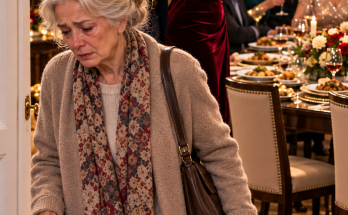
The house was quiet when I returned.
Peter had gone back to his security station, and the afternoon sun had begun to fade behind the trees.
I left my handbag on the kitchen table.
Then I took out the key.
For a long time, I simply held it.
I could have put it back in the drawer and continued with my day.
Instead, I walked toward Henry's office.
The corridor was familiar.
I had passed through it thousands of times, carrying books, laundry, cups of tea, and small things Henry had forgotten to bring upstairs.
After he died, I began walking through that corridor less often.
At first, I told myself I was giving myself time.
Later, I realized that I had been afraid of how much I would miss him when I entered the room.
The door was closed.
I fitted the key into the lock.
It turned smoothly.
I pushed the door open.
Nothing had changed.
The books still stood on the shelves.
The leather chair remained beside the desk.
The lamp sat near a stack of papers Henry had once intended to organize.
His hat still hung behind the door.
I stood in the doorway and let my eyes move from one familiar object to another.
I had spent three months worrying that strangers might have entered this room.
Now I could see that it remained untouched.
The relief was immediate.
So was the sadness.
I stepped inside and closed the door behind me.
The room smelled faintly of wood polish and old paper.
Henry used to complain that I opened the windows too often.
He said the drafts would disturb his papers.
I used to tell him that papers were meant to be moved, not worshipped.
He would smile and return to his work.
I could remember those conversations so clearly that, for a moment, I expected to hear his chair move.
But the room remained silent.
I sat at his desk.
The photograph of us as a young couple stood near the lamp.
We had been standing outside the estate when it was still an aging building that needed more repairs than we could afford at once.
Henry had one arm around me.
I remembered how excited we had been about the work ahead.
We had discussed which rooms to restore first, where to plant trees, and how to make the guest wing comfortable for visitors.
We had disagreed about paint colors and spent entire evenings comparing estimates.
We had made the house ours one decision at a time.
Neither of us had expected it to become so important to our lives.
I touched the edge of the photograph.
I had not built the estate to impress people.
I had not kept it because I wanted to show anyone how much I owned.
It was home.
And home was not measured only by the number of bedrooms or the size of the grounds.
It was measured by the years that had passed inside it.
I thought about Claire's announcement at the wedding.
She had offered me her old apartment as though she were doing me a favor.
I could still hear the confidence in her voice.
She had assumed that because I lived alone, I no longer needed the place Henry and I had built together.
Perhaps she had believed the estate was simply too much house for one older woman.
Perhaps she had never understood why I wanted to stay.
But I didn't need her to understand.
I only needed her to respect my decision.
That was the part I had struggled to say clearly before the wedding.
I had spent years trying to be accommodating.
I rarely refused Daniel when he asked for help.
When he needed advice, I listened.
When he needed money during a difficult period, I considered what I could reasonably offer.
When he wanted to bring friends to Aspen, I made up the guest rooms.
I had never expected him to repay me for being his mother.
But somewhere along the way, I had allowed my generosity to become an assumption.
Daniel had begun treating my willingness to help as a promise that I would always agree.
I had helped create that misunderstanding by avoiding difficult conversations.
That did not excuse what he had done.
Still, I had to be honest with myself.
I could not expect my son to respect boundaries I was unwilling to state.
I had to learn to say no without explaining myself until everyone else felt comfortable.
I stood and walked to the window.
From there, I could see part of the guest wing.
The rooms were still clean and ready for visitors.
There was no furniture piled in the hallways.
No boxes stood against the walls.
No one had moved a desk into Henry's office.
The sight brought back the photograph of the box labeled “Parents' Bedroom Permanent.”
I had been angry when I first saw it.
Now I was more interested in what it had taught me.
The Blake family had not asked because they did not want the possibility of refusal.
Daniel had not asked because he feared my answer.
Both decisions had treated my consent as an obstacle.
I could not control what they believed.
I could control whether I allowed that behavior to continue.
I returned to the desk and placed the recovered key beside the photograph.
The green ribbon looked small against the dark wood.
I wondered whether Henry would have been angry about what happened.
He had loved Daniel fiercely.
He would have wanted his son to have a happy marriage.
But he had also believed that a person should take responsibility for what he did.
He would not have asked me to surrender the house to avoid upsetting our son.
I could almost imagine him sitting across from me, telling me to stop blaming myself for other people's decisions.
That thought made me smile.
Only briefly.
Then I looked at the photograph again.
I missed him.
The wedding had reopened a kind of loneliness I had thought I was learning to manage.
I had lost my husband.
Then, in a different way, I had lost the ease I once felt with my son.
I could not repair either loss by pretending the past had never happened.
I could only decide what to do next.
I left the office and locked the door.
The key remained with me.
Over the following weeks, I began making a few changes.
I asked Peter to review the list of people authorized to enter the estate.
I made sure the security team knew that family relationships did not automatically grant access.
I also spoke with Mr. Harris about keeping property documents and personal papers properly secured.
None of those steps was dramatic.
They were ordinary precautions.
But they gave me peace of mind.
I stopped checking the gate every time a car passed the entrance.
I stopped wondering whether I had been too harsh by refusing to let the Blake family stay.
I had not refused them a home they owned.
I had refused them access to a home that belonged to me.
There was a difference.
One afternoon, Susan called.
She asked whether I had heard from Daniel.
I told her about his visit and the key he had returned.
She was quiet for a moment.
“Do you think you'll forgive him?”
“I hope so,” I said. “But I don't know when.”
She understood.
She did not tell me to hurry.
That meant more than she probably realized.
Later that evening, I made tea and sat in the library.
I opened one of Henry's old books and found a handwritten note in the margin.
He had underlined a passage, then written a few words beside it.
The handwriting was unmistakable.
I ran my finger over the ink.
For the first time in months, I felt able to remember him without immediately thinking about the people who had tried to take over his home.
The estate was still here.
The trees were still standing.
His books remained on the shelves.
And I was still allowed to live my life in the place we had created together.
I did not need to apologize for that.
Source: kaylestore.net
Click here to continue reading: PART 7: The Calls From My Son Became Less Frequent, and I Had to Decide Whether Silence Was Protecting My Peace or Hiding My Hurt
My Son’s Bride Offered Me a Small Apartment in Front of Hundreds of Guests, and I Almost Let Her Finish Speaking
Part 6 of 12