Winter approached slowly in Aspen.
The mornings became colder, and the garden staff began preparing the grounds for the season.
I spent more time indoors.
Some afternoons, I sat in the library with a book and a cup of tea.
Other days, I walked through the guest wing and checked that the windows were closed properly.
I no longer thought of those rooms as spaces someone else might claim.
They were simply part of the house.
That distinction mattered.
For months, I had allowed the wedding to define how I felt about the estate.
Every time I looked at the guest wing, I remembered the moving truck.
Every time I passed Henry's office, I remembered the box marked for Arthur's desk.
I had been living with the memory of an attempted intrusion even though the family had been removed from the property that night.
Eventually, I realized I was giving those people more space in my mind than they had ever managed to occupy in my home.
I wanted that to change.
So I began using the rooms again.
I opened the windows in the guest wing.
I checked the linens.
I moved a small table back to its original position near one of the windows.
There was nothing dramatic about it.
I was simply returning the house to its ordinary life.
One afternoon, I found myself standing in the doorway of the room Henry and I had once used to store artwork.
The light fell across the floor in a long rectangle.
I remembered the photographs Peter had sent me from the moving truck.
Boxes marked for rooms.
Furniture wrapped in plastic.
A label that had suggested someone intended to settle in permanently.
The images no longer frightened me.
They reminded me that I had acted before the situation went further.
I had called security.
I had asked the police to document what was happening.
I had contacted my attorney.
And I had refused to let pressure turn into permission.
I had done what I needed to do.
I didn't have to keep reliving it to prove that it had mattered.
Around that time, Daniel and I began exchanging occasional messages.
Sometimes he asked about the weather.
Sometimes he told me about something he had remembered from childhood.
I answered when I felt ready.
I did not ignore him to punish him, and I did not rush to reassure him.
I was trying to find a way to remain his mother without returning to the old habit of smoothing over every difficult moment.
He seemed to understand that the relationship would have to move slowly.
One evening, he called and asked whether I had been in Henry's office recently.
I told him I had.
“Does it still look the same?”
“Almost exactly.”
He was quiet for a moment.
“I keep thinking about Dad's desk.”
I waited.
He said he had been ashamed when he saw the photograph of the desk wrapped for transport.
He had known how much that room mattered to me.
Yet he had allowed himself to believe that the rest of the arrangement was acceptable because it was supposed to help Claire's family.
“I should have stopped it before the wedding,” he said.
“Yes,” I replied.
I did not soften the answer.
He took a breath.
“I know.”
We spoke for a few more minutes.
He did not ask to visit.
I did not offer.
When the call ended, I felt something I had not felt in a long time.
Not complete trust.
Not forgiveness.
A little peace.
I began to understand that our relationship did not have to be repaired all at once.
It could develop through small, honest conversations.
It could include love and disappointment at the same time.
I could miss him and still keep the gate closed.
I could want him to be happy and still refuse to let him make decisions about my home.
Those things were not contradictions.
They were boundaries.
Claire remained distant.
I occasionally heard from Susan that the marriage was still under strain, but I did not ask for details.
I did not want to become a participant in every disagreement between Daniel and his wife.
Their marriage was theirs to manage.
My home was mine to manage.
I had learned that trying to control both would only leave me exhausted.
One Saturday, I took a small box of old photographs from a cupboard in the library.
I had been meaning to organize them for years.
There were pictures of Henry and me during the early restoration of the estate.
There were photographs of Daniel as a child, standing in the garden with muddy shoes and a grin that showed two missing teeth.
I found one of him sitting beside his father in the stable building.
Henry was holding a tool, and Daniel was watching him with complete concentration.
I sat at the table and studied the picture.
The boy in that photograph had trusted his father to show him how things worked.
I had trusted that the man he became would remember what he had been taught.
The memory made me sad.
But it also reminded me that Daniel was more than the worst decision he had made.
He had done something deeply wrong.
He had also begun to acknowledge it.
I could hold both truths without pretending either one erased the other.
I placed the photograph back in the box.
Then I carried the box to Henry's office.
I set it on the desk and stood beside the window for a moment.
The recovered key remained in a small drawer nearby.
I had considered returning it to the original place, but I decided to keep it with the other important keys I controlled.
It was not a symbol of revenge.
It was a reminder.
Trust was valuable.
Access was not automatic.
And love did not require me to surrender my judgment.
That evening, I walked through the guest wing one last time before closing the windows.
The rooms were ready for visitors.
If a friend needed somewhere to stay, I could offer a room.
If Daniel came to see me one day and we both felt ready, I could welcome him inside.
But those decisions would be mine to make.
No one would arrive with a moving truck and expect me to accept the consequences afterward.
I switched off the hallway lights and returned to the main house.
The kitchen was warm.
A cup sat beside the sink, and a book lay open on the table where I had left it.
Ordinary things.
The kind of things I had once taken for granted.
I made tea and sat near the window.
Outside, the trees Henry had planted stood quietly against the darkening sky.
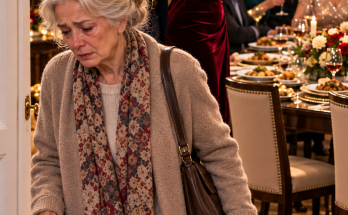
I thought about the woman who had stood in the ballroom on her son's wedding day.
She had wanted to avoid an argument.
She had wanted to protect her son's happiness.
She had wanted to believe that the people around her would treat her with the same consideration she offered them.
I did not blame that woman for wanting those things.
But I wished she had understood sooner that being kind did not mean accepting every demand.
I wished she had known that a peaceful life sometimes required an uncomfortable answer.
Most of all, I wished she had understood that she did not need to earn the right to remain in her own home.
I was learning that now.
The estate was still mine.
Henry's office was still his room in all the ways that mattered to me.
And Daniel, despite everything, was still my son.
I could love him without pretending that he had not hurt me.
I could hope for a better future without promising him an easy return to the past.
For now, that was enough.
I finished my tea and turned off the kitchen light.
The house settled into silence around me.
For the first time since the wedding, the silence felt peaceful rather than lonely.
I was home.
And I no longer needed anyone else to agree that I belonged there.
Source: kaylestore.net
Click here to continue reading: PART 9: The Difference Between an Apology and Change
My Son’s Bride Offered Me a Small Apartment in Front of Hundreds of Guests, and I Almost Let Her Finish Speaking
Part 8 of 12