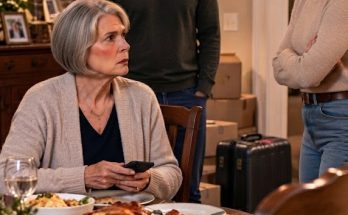
Sometimes, people asked Mom how everything had turned out.
They wanted to know whether the foundation had apologized.
They wanted to know whether Caleb had been punished.
They wanted to know whether we had ever found my father.
Mom answered honestly.
The foundation had cleared Dad's name.
The evidence had shown that Victor Hale had directed the fraudulent transfers through shell companies.
Caleb had admitted his part in the statement that helped blame Dad, and he had cooperated with the investigation.
The foundation had acknowledged the wrongdoing and corrected the record.
But Victor was dead, and the man who might have been Dad had not been conclusively identified in the coastal town's hospital records.
We had no proof that he was alive.
We had no proof that he was the man who had died there.
We had learned a great deal.
We had not learned everything.
When people heard that last part, they often looked disappointed.
They wanted a clearer ending.
They wanted the missing person found, the family reunited, and every unanswered question resolved.
I understood that feeling.
I had wanted those things too.
For years, I had imagined a day when the door would open and Dad would walk into our apartment.
I imagined him standing in the kitchen, looking older but still familiar.
I imagined asking him why he had gone.
I imagined him telling me that he had tried to return.
Sometimes I imagined that he would explain everything in a way that made every painful year suddenly understandable.
But those scenes existed only in my mind.
I couldn't make them happen by wishing harder.
And I couldn't build my whole life around waiting for them.
Mom taught me that without telling me to give up.
She never said I should stop loving Dad.
She never asked me to pretend he had never existed.
She simply kept living.
She went to work.
She cooked our meals.
She paid the bills.
She listened when I had questions.
She allowed me to be angry on some days and hopeful on others.
She showed me that carrying a loss did not mean I had to carry it in the same way every morning.
Some days, the photograph made me smile.
Other days, it made me sad.
Both reactions were honest.
The same was true of the foundation's letter.
I was grateful that it had been found.
I was angry that it had taken so long.
I was relieved that Dad's name had been cleared.
I was still hurt that he had not come home.
None of those feelings canceled the others.
One evening, Mom and I sat together at the kitchen table.
The old photograph was between us.
I had taken it down to look at the details again.
Dad's hand rested behind my head.
His other arm supported my small body.
His face was turned toward whoever had taken the picture, and he was laughing.
I looked so peaceful in his arms that it was hard to imagine the years that would come afterward.
“Do you think he knew how much I would miss him?” I asked.
Mom looked at the photograph.
“I don't know.”
“Do you think he wanted to come back?”
“I believe he wanted you to know he hadn't left because he stopped loving you.”
I rubbed my thumb over the edge of the frame.
“That isn't exactly the same thing.”
“No,” Mom said quietly. “It isn't.”
She did not try to make the answer easier.
That was one of the ways she had changed.
Before, she sometimes tried to protect me by hiding how uncertain things were.
Now she trusted me enough to tell me when she didn't know.
“I wish we could ask him,” I said.
“So do I.”
We sat together for a while.
Then Mom reached across the table and took my hand.
“We can love him without knowing every answer,” she said. “And we can keep living without pretending that we don't miss him.”
I held her hand.
I did not feel suddenly healed.
I did not feel as if the missing years had been returned to us.
But I felt less alone with the questions.
That was enough for that evening.
Later, I placed the photograph back on the shelf.
The old frame leaned slightly to one side, so I adjusted it until it stood straight.
Then I turned off the kitchen light.
In the months that followed, our lives continued to change in small ways.
Mom became more confident at work.
She helped train new volunteers and learned to manage the meal program's schedule without needing to check every decision with someone else.
We still lived in the apartment above the laundromat.
The machines still rattled beneath our floor.
The hallway still smelled of soap and warm clothes.
Our furniture was still old, and the kitchen table still had a scratch near one corner.
But we were more stable than we had been before.
Mom had a regular income.
We had a little money set aside for emergencies.
I no longer felt that every ordinary expense was a threat waiting to become a crisis.
The past had not disappeared.
It had simply stopped deciding every part of our future.
I also continued to think about Caleb.
I never became his friend.
I never told him that his apology had erased what happened in his office.
But I knew he had continued volunteering with the financial literacy program.
He had helped people understand records and contracts.
He had spoken honestly about the harm caused when people concealed mistakes or allowed fear to control their decisions.
I hoped he would keep doing that work.
Not because I owed him hope.
Because I wanted people to become more responsible when they had done something wrong.
I wanted the truth to matter before someone was forced to uncover it.
I wanted adults to remember that a child standing in front of them was still a person deserving of dignity.
And I wanted people to understand that the right decision could be difficult without becoming the wrong decision.
I thought about those things whenever I remembered the day Eleanor collapsed.
I had not stopped to help because I expected a reward.
I had not known she was connected to the foundation.
I had not known her recovery would lead to the discovery of Dad's letter.
I had not known that the same decision would cost me my job.
I had only known that someone needed help.
That was the truth I wanted to keep.
Not the story of a boy who had been punished and later rewarded.
Not the story of a powerful woman who arrived to fix everything.
Not even the story of a family that finally discovered every secret.
It was the story of a choice.
I had made that choice without knowing what would happen next.
And I would have to make choices like it again, in situations I could not predict.
I might get something wrong.
I might be frightened.
I might have to ask someone with more experience for help.
I might face consequences I could not control.
Being kind would not protect me from every difficult thing.
But I did not want fear to become the reason I walked past someone who needed help.
I also understood that kindness did not require me to put myself in danger unnecessarily.
I could call emergency services.
I could follow trained professionals' instructions.
I could tell the truth.
I could ask for help when a situation was beyond my ability.
I could protect myself without deciding that other people's suffering did not matter.
Those lessons had come from a day I would never forget.
They had come from the people who helped Eleanor, from Mom's steady courage, and from the truth that eventually emerged about Dad.
They had also come from the people who had failed us.
I did not need to approve of their actions to learn from them.
On some evenings, I still stood by the kitchen shelf and looked at Dad's photograph.
I wondered where he had gone after leaving the city.
I wondered whether he had ever seen the ocean in the town mentioned in the records.
I wondered whether he had carried my picture as long as his letter said he had.
I could not answer those questions.
I no longer tried to force an answer out of every silence.
I let myself miss him.
Then I went back to the things I could do.
I helped Mom with dinner.
I finished my schoolwork.
I prepared for the next day.
And when I walked through the neighborhood, I tried to notice the people around me.
An older person carrying too many bags.
A neighbor struggling with a heavy door.
Someone who looked confused about where to go.
Not every problem required me to solve it.
Sometimes, the most useful thing I could do was ask whether someone needed help.
Sometimes, I needed to call someone better equipped to handle the situation.
Sometimes, I needed to keep walking because the safest choice was to let a trained person take over.
But I did not want to stop noticing.
That was what I had learned.
A life could be changed by things we never expected.
A job could disappear in a moment.
A hidden letter could restore a name.
An apology could be sincere and still not repair everything.
A mother could build a more stable future without forgetting the person she had lost.
And a child could make a choice that mattered, even when the adults around him failed to understand it.
I was still Julian Parker.
I was still ten years old when the story began, and there were many things I did not understand.
I still had questions about my father.
I still had memories that hurt.
But I had learned that I did not need to know how every story ended before deciding what kind of person I wanted to be.
I could miss Dad and still laugh with Mom.
I could remember what Caleb had done and still hope he would choose better.
I could be grateful to Eleanor without expecting her to solve every problem in my life.
And I could carry the truth about my family without allowing it to become the only thing people knew about me.
The photograph remained on the shelf.
The laundromat continued to rumble below our apartment.
Mom kept doing work that mattered to her.
The neighborhood emergency response program continued helping people learn what to do when someone needed assistance.
And somewhere beyond the limits of what we knew, the truth about my father's final years remained incomplete.
I had wanted a perfect ending.
I had wanted every question answered and every loss repaired.
That was not the ending we received.
But it was not the end of our lives.
We still had mornings to wake up to, meals to share, work to do, and people to care about.
We still had the chance to make better choices than the ones that had hurt us.
And when the next difficult moment came, I would not be able to control everything that followed.
I would only be able to choose what I did next.
I had already learned that one choice could change more than I expected.
So I decided to keep choosing kindness—not because it guaranteed a reward, and not because it made the world fair, but because another person's need still mattered.
Even when I was afraid.
Even when I was tired.
Even when I could not know what would happen afterward.
Kindness was not a promise that nothing bad would ever happen to me.
It was a choice I could make every day.
And that was something I could carry forward.
Source: kaylestore.net
The End
Read more original stories on Feel Every Story.
I Thought Being Late Was the Worst Thing That Could Happen to Me, Until My Boss Made Me Choose Between My Job and My Conscience
Part 15 of 15