I used to think the hardest thing my father could do was throw me out of his house.
Thirty-one years later, I learned he could still make me feel like I was nineteen and had nowhere to go.
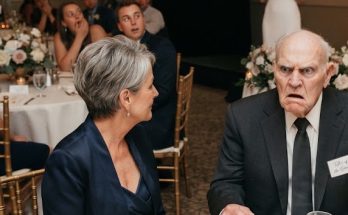
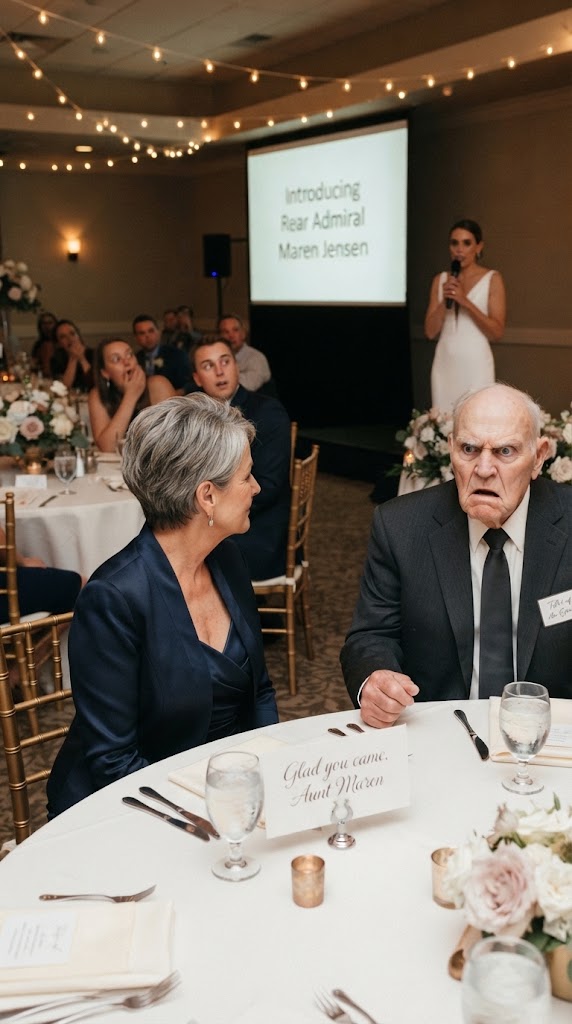
I had barely settled into my seat at my nephew’s wedding when he leaned toward me.
“If people hadn’t felt sorry for you, you wouldn’t have received an invitation.”
He spoke softly.
Not softly enough.
A couple at the neighboring table stopped talking. The woman looked at me, then quickly turned toward her husband.
I wished I had been holding something.
A glass. A napkin. Anything that would have given my hands a reason to move.
Instead, I looked down at the little card in front of me.
Maren Rowe.
My name was printed neatly across the center.
Beneath it, someone had added a handwritten message.
Calder was glad I had come.
I ran my thumb over the edge of the card.
Then I looked at my father.
“I came because Calder asked me to.”
Alden Rowe had a way of making silence feel like an accusation.
He gave me the same tight expression I remembered from my childhood.
“He has always let his feelings get the better of him.”
I was fifty years old.
I had spent most of my adult life learning how to stand in rooms where other people expected me to prove I belonged.
Yet one sentence from my father was enough to make me question whether I should leave.
That was the part I hated most.
Not that he could still hurt me.
That some part of me still waited for him to approve of my existence.
My father wore a black tuxedo that fit him perfectly.
His silver hair was carefully arranged, and his posture remained as straight as it had been when I was a child.
Age had changed his face.
It had not softened his judgment.
My older brother, Griffin, stood beside him with a whiskey in his hand.
He looked me over.
“You really decided to show up.”
I met his eyes.
“Hello, Griffin.”
His gaze moved to my dress.
I had chosen navy blue because it was appropriate for a wedding, comfortable enough to wear for several hours, and already hanging in my closet.
I hadn’t purchased anything new to impress my family.
I wasn’t there to compete with anyone.
Griffin seemed to think that was a problem.
“You could make a little effort to look happy.”
I almost smiled.
Thirty-one years of separation, and my brother still believed the problem was my facial expression.
Before I could answer, someone called my name from across the ballroom.
“Aunt Maren!”
I knew the voice before I turned.
Calder was walking toward us, moving quickly enough that a waiter carrying a tray had to step aside.
He was thirty-seven now.
Tall, broad-shouldered, and carrying the same uneven smile I remembered from when he was a little boy.
He reached me and wrapped his arms around me.
For a moment, I couldn’t speak.
“You came,” he said.
“I promised I would.”
“I know.”
He pulled back just enough to look at me.
“I still kept checking the entrance.”
Something in my chest loosened.
I hadn’t realized how badly I needed to hear that.
Calder didn’t look at my father for permission to hug me.
He didn’t ask Griffin whether he approved.
He simply held me as though my presence was the most ordinary thing in the world.
I wished I had known sooner how much that would mean.
When Calder was six, I had taken him to a neighborhood park one summer afternoon.
My father and Griffin were occupied with a business meeting at our house.
I was supposed to keep Calder entertained until they finished.
He fell from a swing.
It wasn’t a serious fall, but he landed hard enough to frighten himself.
He sat in the wood chips with his lips pressed together, fighting the tears that had already gathered in his eyes.
I asked if he was hurt.
He shook his head.
Then he told me his father believed boys who cried looked weak.
I sat beside him.
We stayed there until he stopped trying to hold everything inside.
Afterward, we walked to a nearby shop and bought blue popsicles.
He got more of the syrup on his shirt than he did in his mouth.
I remembered laughing while he insisted the stains weren’t his fault.
I hadn’t thought about that afternoon in years.
Apparently, he had.
Eight months before the wedding, a message arrived at my office through a public contact channel.
The sender identified himself as Calder Rowe.
He explained that he had been trying to find his aunt.
Then he mentioned the blue popsicle.
I read the message once.
Then I read it again.
And once more.
I had spent years telling myself that the past was finished.
I had built a life that didn’t require my father’s permission, my brother’s acceptance, or anyone else’s understanding.
I had become very good at not expecting anything.
Then a little boy’s memory appeared in the middle of an ordinary workday, and I couldn’t concentrate on anything else.
I answered him.
Our first phone call was awkward enough that we both seemed to be talking at once.
He apologized for taking so long to reach me.
I apologized for disappearing from his life.
Neither apology felt entirely fair.
He had been a child when I left.
I had been a frightened young woman trying to build a future without the family that had once controlled every part of mine.
We talked about work.
We talked about the years we had missed.
We talked about things that didn’t matter because neither of us knew how to approach the things that did.
Finally, Calder said something that silenced me.
“You don’t have to give me the whole explanation before I can have a relationship with you.”
I stared at the wall beside my desk.
Then I covered my mouth with one hand.
I had imagined that conversation so many times.
In some versions, he blamed me.
In others, he demanded answers I couldn’t give without reopening wounds that had taken decades to close.
I had never imagined he would make room for me before asking me to explain myself.
I started crying.
Quietly at first.
Then enough that I had to put the phone down for a moment.
Calder waited.
He didn’t tell me to stop.
He didn’t rush to fill the silence.
When I picked up the phone again, we continued talking.
That was how our relationship began.
Not with a grand reconciliation.
Not with a promise that everything would be forgiven.
With a boy who remembered a blue popsicle and an aunt who had spent too long believing she was no longer wanted.
Now, in the wedding ballroom, I stood with his hand resting on my shoulder.
My father cleared his throat.
“Calder, your grandfather and I were having a conversation.”
Calder looked at him.
“I heard what he said.”
Griffin shifted his glass from one hand to the other.
“This doesn’t need to become an issue.”
Calder’s expression changed.
He remained polite, but the warmth in his face disappeared.
“I invited Aunt Maren because I wanted her here.”
My father gave him a measured smile.
“Of course you did.”
“Then I don’t see what the problem is.”
Nobody answered.
The band continued playing across the room.
Waiters passed with trays of drinks, and guests laughed at tables where nobody seemed aware of what had just happened.
My father reached for Calder’s elbow.
“Come with me for a moment. We should discuss this privately.”
Calder didn’t move.
“After I make sure Aunt Maren is comfortable.”
I looked at the place card again.
The handwritten words were still there.
For the first time that evening, I let myself believe them.
I belonged at the wedding because Calder wanted me there.
Not because my father approved.
Not because Griffin had decided to tolerate me.
Because someone had made a place for me and meant it.
That should have been enough.
But I knew my father.
And I knew the story of how I had left home had never been told the same way by everyone involved.
Source: 1millionstories.net
Click here to continue reading: PART 2: The Marriage My Father Chose for Me Became the Reason I Lost My Home, My Family, and Thirty-One Years of My Life
My Father Made It Clear I Was Unwanted at My Nephew’s Wedding, but the Place Card Told a Different Story
Part 1 of 15