Calder's first message arrived on an ordinary workday.
I was at my desk when I noticed it.
The contact channel was public, and the sender had included enough information to make his identity clear.
He was my nephew.
He had been trying to find me.
For a moment, I wondered whether I had misunderstood.
I read the message again, paying attention to the details.
He remembered the park.
He remembered the blue popsicle.
He remembered me.
That last part was what I found hardest to accept.
I had spent so many years assuming my absence would become the only thing he knew about me.
I had imagined that, as he grew older, I would become a name occasionally mentioned during a family conversation.
Perhaps an example of what happened when someone disappointed my father.
Perhaps a story that ended with the claim that I had chosen to leave.
I hadn't considered that a six-year-old boy might preserve something as simple as an afternoon in the park.
I wrote back.
Then I waited for his reply with a nervousness I hadn't felt in years.
Our first phone call took place soon afterward.
Neither of us seemed to know where to begin.
He asked about my work.
I asked about his life.
We both apologized for the years between us, even though neither of us could explain how the other could have prevented them.
I wanted to ask what he had been told about my departure.
The question sat in my mind throughout the call.
But I didn't want our first conversation to become an argument about his father.
I had no idea how Calder would react to the truth.
So we talked about safer things.
His work.
My career.
The places we had lived.
The ordinary details that made two people feel less like strangers.
Then Calder said he didn't expect me to account for every missing year before he could know me.
I remember leaning back in my chair.
It was such a simple thing to say.
Yet I had spent decades believing that anyone who wanted a relationship with me would first require me to defend the circumstances of my departure.
Calder wasn't asking me to defend myself.
He was asking to know me.
After that conversation, we began speaking more regularly.
We learned about each other's lives in pieces.
Sometimes he asked about my work in the Navy.
Sometimes he wanted to know what I had been like as a young woman.
I answered what I could.
I didn't pretend I had always been wise or certain.
I told him about the difficult years, the education I had struggled to complete, and the work that eventually became my career.
I left some subjects alone until I understood whether he wanted to hear more.
He never demanded that I condemn his father.
I never asked him to choose between us.
That made the relationship possible.
Three weeks after our first conversation, Calder invited me to a video call with his fiancée.
He said she also served in the Navy.
He thought we might have something in common.
Then he added a joke about the haircut he had worn as a child.
I smiled before the call began.
I had seen photographs of him over the years, but photographs couldn't prepare me for the feeling of watching him introduce me to someone he intended to marry.
It meant he was making room for me in the life he had built.
When his fiancée appeared on the screen, she looked directly at me.
Then she stopped smiling for a moment.
“Admiral Rowe?”
I recognized her immediately.
Her name was Liora Vance.
Calder glanced between us.
“You two have met?”
Liora let out a short, surprised laugh.
“I've told you about her.”
I looked at Calder.
He looked completely lost.
I had met Liora two years earlier through an official matter connected to my command.
At the time, she had been dealing with the consequences of an incident during an assignment.
The initial report made the situation appear straightforward.
It identified a failure and presented the circumstances as though the responsibility had already been established.
But Liora's written response raised questions.
Her supporting documents contained details that didn't fit neatly with the first account.
She had provided information that deserved examination, and I didn't believe a final conclusion should be reached before those concerns were addressed.
The matter came through the command where I served.
I asked for the unanswered questions to be reviewed.
I wasn't the only person involved.
Other officers and reviewers examined the records, checked the documentation, and considered the responsibilities of the people involved.
The work took time.
The eventual findings differed from the original account.
Liora was able to continue her career.
I remembered her waiting outside my office with a folder held tightly against her body.
She had looked exhausted.
One corner of the folder was bent where her fingers had pressed into it.
I had spoken to her briefly.
I couldn't promise her a particular result.
I could only tell her that the material she had submitted would be considered.
Now, during the video call, she remembered that conversation.
“You told me you couldn't guarantee how it would end,” she said. “But you made sure my response was actually examined.”
I nodded.
“You deserved a fair review.”
She looked down for a moment.
When she looked back at the screen, her expression had softened.
“I didn't understand how much that mattered until afterward.”
Calder was still trying to make sense of the connection.
He leaned back in his chair and looked at Liora.
“You've talked about my aunt before?”
“Of course I have.”
Then she looked at me.
“I just didn't know she was your aunt.”
Calder shook his head.
“I can't believe neither of you mentioned this.”
Liora smiled.
“You never told me your aunt was a rear admiral.”
I laughed.
Calder turned toward me.
“You didn't mention your rank when we first talked.”
“You asked me whether I still disliked peas.”
“That was an important question.”
It was the first time in years that I had laughed with someone in my family without wondering what the laughter might cost me.
For a little while, we talked about the coincidence.
Then we returned to ordinary conversation.
Liora asked about my career.
I asked about hers.
Calder occasionally interrupted to remind us that he was also present.
It felt surprisingly natural.
I didn't want to turn the moment into a story about my accomplishments.
My rank was part of my life, but it wasn't the reason I had answered Calder's message.
I had wanted to know him.
That was all.
Later, Liora asked whether she could acknowledge me during the wedding reception.
I immediately told her not to make the wedding about my career.
It was her day and Calder's.
They had enough to celebrate without turning their reception into a discussion about my family history.
She listened.
Then she explained that she didn't intend to reveal private information about the case or identify anyone involved.
She wanted to speak about her own experience and the importance of being heard when the first account of a situation was incomplete.
I told her she didn't owe me anything.
She replied that she wasn't trying to repay a favor.
She was acknowledging something that had mattered to her.
I understood the distinction.
Still, I asked her to keep the focus on her marriage and the life she and Calder were beginning together.
She agreed.
I didn't ask her to defend me in front of my family.
I didn't ask Calder to make a public statement about why I had been absent.
I thought I could attend the wedding, congratulate them, and return to my own life without making the past the center of the day.
That was what I expected.
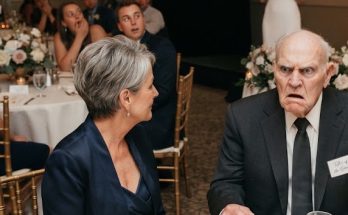
I didn't anticipate that my father would greet me as though my presence were an insult.
I didn't anticipate that Griffin would join him.
And I certainly didn't anticipate how quickly one remark could bring thirty-one years of family history into a crowded ballroom.
Source: 1millionstories.net
Click here to continue reading: PART 4: My Father Turned a Wedding Toast Into a Lesson About Loyalty, but the Bride Had Her Own Reasons for Taking the Microphone
My Father Made It Clear I Was Unwanted at My Nephew’s Wedding, but the Place Card Told a Different Story
Part 3 of 15