I used to think doing the right thing would protect me from being ashamed.
I was ten years old when I learned that it didn’t always work that way.
My name is Julian Parker, and until that morning, I had believed that if I worked hard enough, adults would eventually treat me fairly.
I was wrong.
For almost three years, I’d been helping out at a small marketing agency after school. I did the jobs nobody else wanted. I organized paperwork, carried supplies, cleaned desks, and prepared meeting rooms.
Nobody had hired me because I was talented.
They hired me because I was cheap, dependable, and willing to do almost anything.
At least, that was how I understood it.
The money went toward groceries, electricity, and whatever bill Mom couldn’t postpone any longer.
She never told me I had to work.
I had offered because I could see what she was carrying.
Mom worked during the day at a café and cleaned offices at night. Sometimes, when I woke up before sunrise, I found her asleep at the kitchen table with a calculator beside her and unpaid bills spread around her elbows.
I hated seeing her like that.
So I made myself useful.
I thought that was what a good son did.
That morning, I had one important responsibility at the agency. A group of potential clients was coming in, and I had to prepare the conference room before their presentation.
Mr. Caleb Morgan had reminded me about it twice.
He was the agency’s boss, and he cared about punctuality more than almost anything else.
He had once told an employee that being five minutes late showed a lack of respect.
I remembered that sentence because he had said it while looking directly at me.
I left home early that day.
My backpack contained my notebook, a lunch container, and the little pencil case Mom had bought me when I started working.
I was walking along the sidewalk when I heard a strange sound.
At first, I thought someone had dropped a bag.
Then I saw a woman beside a bench.
She was on the ground, one hand pressed against her chest. Her breathing came in short, desperate attempts, and her face had lost its color.
People passed her.
A man glanced over his shoulder and kept going.
A woman slowed down, looked at the crowd, and continued toward the bus stop.
I stood there for a second.
I was ten. I had no medical training, no money, and no idea what to do if somebody stopped breathing.
But I understood that she needed help.
I dropped my backpack.
“Ma’am, can you hear me?”
Her eyes moved toward me.
She tried to answer, but nothing came out.
I knelt beside her and pulled my phone from my pocket. My fingers were shaking so badly that I nearly dropped it before I managed to call emergency services.
The dispatcher answered.
I told her where we were and explained what I could see.
She asked me questions, and I answered as carefully as I could.
Then she gave me instructions.
I followed them.
I stayed beside the woman, spoke to her whenever she seemed able to hear me, and tried to keep myself from panicking.
“Please stay with me,” I whispered.
“I’ve called for help.”
Her hand trembled against mine.
I remember how cold her fingers felt.
I remember the traffic passing behind us.
And I remember looking up at the people who continued walking, wondering how they could see what was happening and decide they had somewhere more important to be.
The dispatcher remained on the line until the ambulance arrived.
The paramedics took over immediately. One of them asked what had happened, and I explained everything I could remember.
They asked whether I knew the woman’s name.
I didn’t.
Her handbag had fallen beneath the bench, so I retrieved it and gave it to them.
One paramedic thanked me before closing the ambulance doors.
Then they drove away.
I stood on the sidewalk with my backpack hanging from one shoulder.
For a moment, I felt relieved.
Then I checked the time.
I was already forty minutes late.
My stomach dropped.
I ran.
I ran past the bus stop, through the crowded streets, and toward the agency, thinking about the conference room and the clients who were probably waiting.
By the time I reached the building, my lungs hurt.
I pushed through the entrance and hurried toward the office.
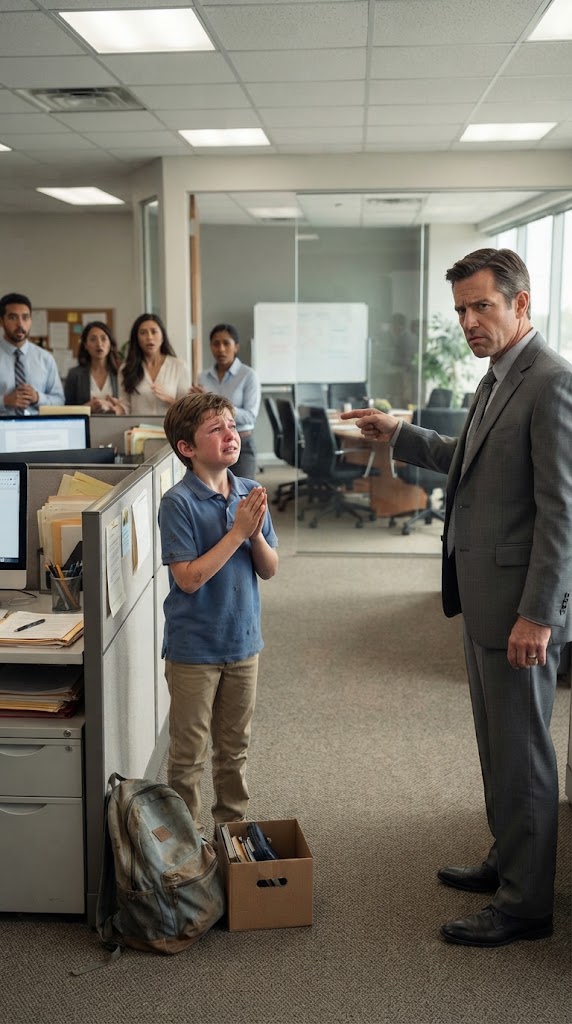
Mr. Morgan was waiting.
He came toward me so quickly that I stopped in the doorway.
“Where have you been?”
Everyone nearby went quiet.
I tried to catch my breath.
“I’m sorry, sir. Something happened on the way here.”
He folded his arms.
“Something?”
“A woman fell beside the road. She couldn’t breathe, so I called an ambulance and stayed with her.”
He stared at me as if I had offered an excuse he had heard a hundred times before.
“Was she related to you?”
“No, sir.”
“Was she a family friend?”
“No.”
His mouth tightened.
“Then explain why a stranger was more important than the work you were supposed to do here.”
I looked toward the conference room.
The chairs were arranged around the table. The presentation was still displayed on the monitor, and several empty water glasses sat beside the folders.
The visitors were gone.
My heart sank.
“I’m sorry,” I said again. “She was really struggling. I couldn’t just leave her.”
Mr. Morgan struck the nearest desk with his palm.
“Do you understand what you’ve done?”
I nodded, although I didn’t understand why he was so angry.
He pointed toward the conference room.
“We had an important client meeting this morning. The entire team was depending on you to have everything ready.”
“I know.”
“Clearly, you don’t.”
His voice carried across the office.
Several employees stopped what they were doing.
I could feel them watching me.
I wished he would lower his voice.
I wished I could explain myself without everyone listening.
Most of all, I wished the woman had been all right.
“Sir, I really did try to get here as quickly as I could.”
He laughed without any humor.
“You should have kept walking.”
I stared at him.
For a moment, I thought I had misunderstood.
“What?”
“You heard me. You should have left her to someone else. This company is not a place where employees can abandon their responsibilities whenever they feel like playing hero.”
I looked at the floor.
I wasn’t playing anything.
I had been frightened.
I had watched a woman struggle for air, and I had thought she might die before the ambulance arrived.
I didn’t know whether I had helped enough.
I only knew I couldn’t have walked away.
“Please, sir,” I said. “I know I’m late, but I can still finish the work. I’ll do whatever you need.”
He shook his head.
“The meeting is over. The clients have left.”
“I can clean the room. I can organize everything for the next meeting.”
“That’s not the point.”
I waited.
He looked at me with an expression I couldn’t understand.
“You’re fired, Julian.”
The words seemed to empty the room of air.
I had heard adults threaten to fire people before. I had never believed it could happen to me.
I was only ten.
I had done everything he asked.
I had never stolen anything, argued with him, or deliberately missed a shift.
“Please don’t do that,” I whispered.
He pointed toward the entrance.
“Get your things and leave.”
“My family needs this job.”
For one brief second, I thought he might reconsider.
Instead, he turned away.
“I don’t care about your family circumstances. You failed to do your job.”
Nobody spoke.
I looked around the office.
One employee studied his computer screen. Another began sorting papers that were already in order. Someone near the printer looked at me, then quickly lowered her eyes.
I had spent years trying to be the kind of worker nobody complained about.
I had stayed late.
I had carried boxes that were too heavy for me.
I had cleaned up other people’s messes without asking questions.
And when I needed one person to say that I had done the right thing, nobody said anything.
I picked up my backpack.
My hands were trembling, and I hated that everyone could see it.
I walked toward the door without looking at Mr. Morgan again.
Outside, the street seemed louder than before.
Cars moved through the intersection. People hurried past the storefronts. Somewhere nearby, a bus stopped and opened its doors.
I made it as far as the empty bus shelter before I started crying.
I tried to stop.
I wiped my face with my sleeve and told myself I needed to get home before Mom returned from work.
But the tears kept coming.
I wasn’t only afraid of losing the money.
I was ashamed.
I had spent so much time believing that being responsible meant never letting anyone down. Now I imagined Mom opening another bill and wondering how we would pay it.
I pictured her asking what happened.
I didn’t know how to explain that I had lost my job because I had stopped to help someone who might have died.
I also couldn’t stop thinking about the woman.
Had she survived?
Had the paramedics reached the hospital in time?
I wished I had asked her name.
I wished I had been able to do more.
That night, Mom was sitting at the kitchen table when I came home.
She looked up from the receipts in front of her.
“You’re early.”
I placed my backpack beside the chair.
“I don’t have to go back to work.”
She stopped sorting the papers.
“What happened?”
I told her.
I explained the woman, the ambulance, the meeting, and Mr. Morgan’s anger. I repeated his words as closely as I could remember them.
Mom didn’t interrupt.
When I finished, she sat quietly for a moment.
Then she reached across the table and took my hand.
“You did the right thing.”
I looked at her.
“But I lost the job.”
“I know.”
“We need the money.”
“I know that too.”
Her voice was gentle, but I could see how tired she was.
I wanted her to tell me that everything would be fine.
I wanted to believe her when she said we would manage.
Instead, I asked the question I had been afraid to ask all evening.
“What if we can’t?”
Mom squeezed my hand.
“Then we’ll work out what to do next. But I will not teach you that a person’s life matters less than a meeting.”
I lowered my head.
I was still worried about the money.
I was still frightened of what would happen tomorrow.
But for the first time since leaving the office, I stopped feeling ashamed of what I had done.
I didn’t know that the woman from the sidewalk was already trying to find me.
I didn’t know that she had a reason to return to the agency.
And I certainly didn’t know that my dismissal had concealed a problem much bigger than my lateness.
The next morning, I went back to collect my notebook and lunch container.
I expected an awkward conversation and a quick trip home.
Instead, before I reached Mr. Morgan’s office, I heard his voice through the partly open door.
He sounded nervous.
“Please, ma’am. I didn’t know who the boy was.”
A woman answered him.
“That doesn’t make your decision any better.”
I stopped walking.
I recognized her voice.
It was the woman I had helped.
Source: kaylestore.net
Click here to continue reading: PART 2: The Woman I Helped Returned to the Office, and Suddenly My Former Boss Had an Explanation He Couldn’t Bring Himself to Give
I Thought Being Late Was the Worst Thing That Could Happen to Me, Until My Boss Made Me Choose Between My Job and My Conscience
Part 1 of 15