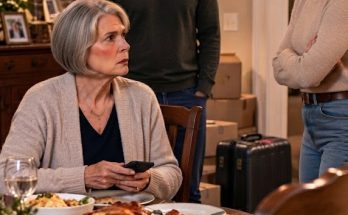
Mom sat down on the concrete floor.
She held Dad's letter in both hands, reading the final lines again as if they might change.
I crouched beside her.
"Mom, what does it mean?"
She shook her head.
"I don't know."
Eleanor examined the letter.
"Daniel appears to have trusted Caleb with the records. We need to understand why Caleb never delivered them."
I looked at the signature.
"He kept the letter for sixteen years."
"Yes," Eleanor said. "But we don't yet know what he did during those years."
A clerk approached us with another item from the crate.
It was a small packet containing a deposit receipt.
The account holder's name was Caleb Morgan.
The date was three days after Dad disappeared.
The amount was large enough to make Mom grip the edge of the table.
At the bottom, Dad had written two words.
Paid in full.
Beneath them was another sentence.
He thinks I am dead.
I looked at Eleanor.
"Does that mean Dad was alive?"
She examined the receipt carefully.
"It means he wrote those words at some point. We can't establish when from this document alone."
"Then why would Caleb have the receipt?"
"We need to verify the account and the transaction before drawing conclusions."
Mom took a deep breath.
"We should speak to Caleb."
Eleanor nodded, although she insisted that we involve a lawyer before making any accusations.
She called her legal adviser, Priya Shah, who agreed to meet us at the agency.
On the drive back, I sat beside Mom with the folder resting between us.
I couldn't stop thinking about Dad's words.
He thinks I am dead.
I wanted them to mean that Dad had survived and had somehow escaped the people who were trying to silence him.
But Mom had warned me not to build my hopes around a possibility.
I was beginning to understand why.
When we arrived at the agency, the office looked almost exactly as it had on the morning I was fired.
The same desks stood in neat rows. The same conference room waited at the end of the corridor.
Caleb wasn't in his office.
An assistant told us he was in the conference room.
We found him kneeling beside a floor vent with a screwdriver in his hand.
He froze when he saw Eleanor.
Then he noticed Mom and the folder.
His face changed.
"You found the records," he said.
Mom stepped into the room.
"You knew they existed."
Caleb slowly stood.
"I knew Daniel had left some documents."
"You knew he was innocent."
He looked down.
"I knew he had been telling the truth about the transfers."
Mom's voice became sharper.
"Then why did you let people blame him?"
Caleb didn't defend himself.
For several seconds, he simply stood beside the table.
Then he said, "Because I was afraid."
Priya arrived a few minutes later.
She introduced herself and asked everyone to leave the floor vent untouched. She wanted the area documented before anything was moved.
Caleb cooperated.
While Priya prepared her equipment, he turned toward me.
"Julian, I owe you an apology."
I said nothing.
"I shouldn't have fired you. And I shouldn't have blamed you for the failed presentation."
"Why did you do it?"
He looked at the empty chairs.
"The proposal contained a financial appendix that raised questions about old foundation accounts. I recognized several codes from the years when Daniel worked there."
Eleanor's expression hardened.
"You recognized the information before the presentation?"
"Yes."
"Then why was it included?"
"The agency had used an old template. I removed the appendix before the meeting, but the clients had already received a copy."
I remembered the morning he had shouted at me.
"You told me the clients left because I was late."
Caleb lowered his head.
"I was angry, and I was frightened. It was easier to blame you than explain what was happening."
"You made me think I had ruined everything."
"I know."
"You told me to leave that woman alone."
He looked at me.
"I was wrong."
His apology did not erase what had happened.
But this time, he didn't ask me to forgive him.
Priya finished documenting the area and turned toward Caleb.
"Tell us about the case."
He glanced at the floor vent.
"Daniel left it beneath the conference room floor years ago. I found it when the room was renovated. I moved it into the compartment beneath the vent."
"Why didn't you open it?"
"Because I was afraid of what it contained."
Mom stared at him.
"You had sixteen years to be afraid."
Caleb nodded.
"I know."
Priya removed the vent cover and lifted the narrow metal plate beneath it.
A dusty black case lay inside.
Caleb placed it on the conference table.
The brass key from Dad's letter fitted the lock.
Mom turned it.
The case opened.
Inside were USB drives, photocopied bank statements, and another envelope bearing Dad's handwriting.
Mom looked at Eleanor.
"Please read it."
Eleanor opened the envelope and examined the first paragraph before passing it to Mom.
Mom began reading aloud.
"Marissa,
If you are reading this, I failed to return when I promised. I never chose to abandon you or Julian. I thought the truth would protect us, but I was wrong about how far people would go to protect themselves.
Caleb has copies of the records. He is frightened, but he is not part of the theft. If he gives you these documents, believe that he waited too long because he was afraid, not because he wanted you to suffer.
I am going to meet someone who says they can help expose Victor Hale. If I cannot come home, please do not let Julian believe he was forgotten. Every day I was away, I carried his picture with me.
I love you both.
Daniel."
Mom couldn't continue.
She pressed the letter against her chest and began to cry.
I moved beside her and wrapped my arms around her waist.
For years, I had wondered whether Dad remembered me.
Now I knew he had carried my picture.
It didn't answer every question.
It didn't bring him home.
But it changed something inside me.
I no longer had to imagine that he had simply stopped caring.
I looked toward Caleb.
"What happened to my father?"
He shook his head.
"I don't know."
"Did he meet the person who could help him?"
"We believe he did. One of the USB drives contains messages between Daniel and an investigative reporter. The last message says Daniel was traveling to another city to provide evidence."
"Why didn't anyone find him?"
"The reporter died before publishing the story. The records were never released."
Priya carefully collected the drives.
"We can send these to specialists who can recover the data. The financial records will need independent verification."
Eleanor nodded.
"And the foundation will cooperate."
Mom wiped her face.
"I want Daniel's name cleared. I don't want revenge."
Priya closed the case.
"Then we begin with the evidence."
The investigation took several months.
Forensic accountants examined the financial records. Technical specialists recovered information from the USB drives. Investigators compared the documents with archived foundation accounts.
The recovered files showed that Victor Hale, the foundation's chief financial officer, had directed fraudulent transfers through shell companies.
The company registered under Dad's and Caleb's names had been used to conceal the movement of money.
Investigators established that Caleb's identity had been used without his knowledge.
They also confirmed that Dad had repeatedly tried to expose the scheme.
The deposit receipt was genuine.
But the money had not been paid to Dad.
Victor had transferred it into an account controlled by an intermediary. Dad had written the note after discovering that the money had been used to purchase someone's silence.
The person involved was an outside auditor who later admitted privately that he had known about the fraud.
He had never exposed it publicly.
The evidence persuaded authorities to reopen the investigation.
Victor Hale had died years earlier, so he could not be prosecuted.
Nevertheless, the foundation issued an official correction.
Daniel Parker was formally cleared of wrongdoing.
Mom read the announcement at our kitchen table.
She smiled, but tears ran down her face.
Dad's name had finally been restored.
Yet he was still missing.
Investigators examined old travel records and found that he had left the city under his real name before adopting another surname.
His trail eventually reached a coastal town thousands of miles away.
A hospital record suggested that a man resembling him had died from an illness eight years after his disappearance.
Nobody could establish his identity with certainty.
Mom refused to treat uncertainty as proof that he was alive.
One evening, she sat beside me with Dad's letter open on the table.
"We may never know exactly what happened," she said. "But we know he loved us. We know he tried to tell the truth. And we know he didn't leave because we weren't enough."
I kept Dad's letter in a wooden box beneath my bed.
The brass key rested beside it.
Caleb eventually resigned from the agency and cooperated fully with the investigation.
Before he left, he asked to speak with me.
We sat on a bench outside the building.
"I know I can't undo what I did," he said.
"No."
"And you don't owe me forgiveness."
"I'm not ready."
He nodded.
"That's fair."
He told me he planned to volunteer with a financial literacy program at the community center.
I asked him why.
"Because I spent too many years protecting myself from the consequences of my choices. I want to do something useful without expecting anything in return."
I considered his answer.
"That sounds like a good idea."
He gave a tired smile.
"Your mother would say it's the least I could do."
"She probably would."
Several weeks later, Eleanor invited Mom and me to the Bennett Community Health Foundation.
She had established a neighborhood emergency response initiative that provided free first-aid instruction and public defibrillator training.
At the opening ceremony, she asked me to stand beside her.
"You helped inspire this program," she said.
"I only called 911."
"That was where it began."
She explained to the audience that helping someone did not require extraordinary strength or special status. Sometimes, it began with noticing a person in trouble and choosing not to ignore them.
Mom stood in the front row, smiling through tears.
After the ceremony, Eleanor gave me a certificate recognizing my courage and compassion.
I held it carefully.
"Does this mean I can get another job?"
Eleanor laughed.
"You're still ten, Julian."
"I know. But I'm available after school."
Mom raised an eyebrow.
"No more working during emergencies."
I grinned.
"Deal."
I never returned to my old job.
The agency never offered to rehire me, and I never asked.
Instead, Eleanor helped Mom secure a position managing the foundation's neighborhood meal program.
Mom insisted that it wasn't charity. She was earning a salary for her work, and she wanted everyone to understand that.
Eleanor agreed.
Our lives didn't become perfect overnight.
We still lived above the laundromat. The windows needed repairs, and bills continued arriving.
But the fear that had filled our apartment for years began to ease.
Mom and I talked about money instead of pretending everything was fine.
We spoke about Dad without whispering.
I stopped believing that I had to solve every problem in our family by myself.
Sometimes, Mom still became quiet when she remembered him.
Sometimes, I felt angry that I had lost so many years with a father I barely remembered.
But I began to understand that healing wasn't something that happened all at once.
It happened gradually.
A year after Eleanor collapsed beside the sidewalk, I passed the same bench on my way home from school.
The bench was still there.
Traffic moved through the intersection, and people hurried along the pavement.
An elderly man stood near the crossing with a shopping bag in his hand.
The bag split, scattering oranges across the sidewalk.
I dropped my backpack.
"Sir, are you okay?"
He looked embarrassed.
"I'm fine. I just made a mess."
"It's all right. I'll help."
A woman nearby stopped to gather the oranges. Another passerby joined us.
Within a minute, we had collected everything.
The man thanked us repeatedly.
As I lifted my backpack, I noticed a small blue sign attached to a nearby pole.
It identified an emergency response station and pointed toward a defibrillator available inside.
The foundation's name appeared beneath the instructions.
I smiled.
When I arrived home, Mom was sitting at the kitchen table.
Dad's letter lay open beside an old photograph.
The picture showed him holding me when I was very young.
He was laughing, and I was asleep against his shoulder with one tiny hand gripping his shirt.
"Where did you find that?" I asked.
"It was in the storage box."
She handed it to me.
I studied the photograph for a long time.
"I think I remember something," I said.
Mom waited.
"Not clearly. I remember him telling me that being kind was never wasted."
Her eyes filled with tears.
"He said that often."
"Maybe that's why I stopped for Eleanor."
"Maybe."
I leaned against her shoulder.
"Do you think Dad would be proud of me?"
Mom kissed my hair.
"I know he would."
Outside, evening settled over our street.
The laundromat lights flickered on, and the familiar sounds of the city continued around us.
I still didn't know exactly where Dad had gone or what had ultimately happened to him.
There were questions that no letter, investigation, or official report could answer.
But I no longer believed that unanswered questions meant we had been abandoned.
Some truths took years to emerge.
Some apologies arrived long after the damage had been done.
And sometimes, a frightened person made the wrong choice, then spent years trying to find the courage to admit it.
I had lost a job because I stopped to help a stranger.
I had also discovered the truth about my father, watched my mother begin to heal, and learned that doing the right thing didn't guarantee an easy life.
It only meant I could live with my choice.
That morning, I had seen someone in trouble and decided to stop.
I would make that choice again.
Because kindness wasn't weakness.
It was something I could choose, even when the people around me chose differently.
Source: kaylestore.net
Click here to continue reading: PART 5: The Truth About My Father Changed How I Saw My Former Boss, but It Could Not Give Back the Years My Family Had Lost
I Thought Being Late Was the Worst Thing That Could Happen to Me, Until My Boss Made Me Choose Between My Job and My Conscience
Part 4 of 15