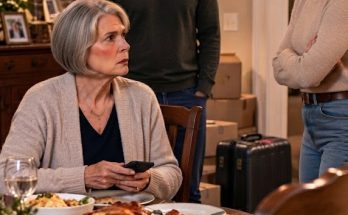
Mom's new job began the following week.
She was responsible for coordinating the neighborhood meal program, keeping track of supplies, and helping organize volunteers.
The work was familiar in some ways.
She had spent years preparing food and managing difficult shifts.
But this time, she didn't have to move between two jobs every day.
On her first morning, she stood in front of the mirror, adjusting the collar of her shirt.
"Does this look all right?"
I nodded.
"You look like someone important."
She gave me a doubtful look.
"I'm going to organize food deliveries, not run the country."
"Still important."
She smiled and picked up her bag.
When she came home that evening, she was tired.
But it was a different kind of tiredness.
She had worked a full day without spending the evening cleaning someone else's office.
She had eaten lunch.
And she had spoken to people who treated her as a colleague rather than someone they could ignore.
"How was it?" I asked.
"Busy."
"Good busy or bad busy?"
She thought for a moment.
"Good busy."
That answer made me happy.
Our apartment didn't change immediately.
The laundromat still shook the floor when its larger machines started. The kitchen window still stuck whenever Mom tried to open it.
We still checked prices before buying groceries.
But the money coming into our home became more predictable.
Mom stopped dividing every bill into a separate pile as soon as she arrived.
Sometimes she even left the receipts until the weekend.
I had never realized how much of our home had been organized around fear.
The fear of missing a payment.
The fear of losing work.
The fear that one unexpected expense could undo everything.
Now we had a little more room to breathe.
I also began spending more time with my friends after school.
Marcus noticed the change before I did.
"You don't look like you're thinking about a hundred things anymore," he said one afternoon.
"Was I?"
"All the time."
I laughed.
"I guess I was."
He handed me a pencil he had borrowed weeks earlier.
"I thought you might need this."
I took it.
It was ordinary, but I liked the way he remembered.
For years, I had believed that helping meant taking responsibility for everything around me.
Now I was beginning to understand that people could help each other in smaller ways, without making anyone feel indebted.
At home, Mom and I started talking more openly.
When a bill arrived, she explained what it was for.
When she felt worried, she told me rather than pretending she was fine.
And when I worried about Dad, she didn't change the subject.
One evening, I asked her whether she thought he had known how long he would be gone.
She sat quietly before answering.
"I don't think he understood how much time would pass."
"Did he think he could come back?"
"Yes. I believe he did."
"Then why didn't he send another letter?"
"I don't know."
She didn't try to invent an answer.
That mattered to me.
I was tired of explanations that sounded certain but left me feeling confused.
Mom reached across the table.
"Julian, I want you to understand something. Your father made a decision that hurt us, even if he believed he was protecting us. Loving someone doesn't mean every decision they make is right."
I thought about that for a long time.
"Can he be a good person and still have hurt us?"
"Yes."
"Can Mr. Morgan?"
She looked at me.
"People are complicated. But what they do still matters."
I remembered Caleb's apology.
He had admitted that fear explained his choices but didn't excuse them.
I hadn't forgiven him.
I also hadn't decided that he could never become a better person.
Both things could be true.
At school, we were asked to write about someone who had influenced our lives.
I considered writing about Eleanor.
Then I thought about Dad.
Finally, I wrote about Mom.
I described how she worked when she was exhausted, how she kept our home running, and how she continued showing up even when she didn't know what would happen next.
I didn't mention the foundation investigation.
I didn't mention the missing years.
I wrote about the woman who sat beside me at the kitchen table and admitted that she was frightened too.
When the assignment was returned, my teacher had written one sentence at the bottom.
You noticed the details that matter.
I carried the paper home.
Mom read it twice.
Then she folded it and placed it beside the photograph.
"Are you keeping everything now?" I asked.
"Only the things I want to remember."
I thought about that answer.
For years, our family had kept things because we were afraid of losing them.
Now Mom was keeping something because it made her happy.
That night, we ate dinner together.
Afterward, she asked me to help clear the table.
I collected the plates while she washed them.
Neither of us mentioned Dad.
Neither of us needed to.
For a little while, we were simply a mother and her son, sharing an ordinary evening.
And I began to understand that ordinary evenings could be a kind of healing.
Source: kaylestore.net
Click here to continue reading: PART 7: My Former Boss Tried to Make Amends, but I Had to Decide Whether His Regret Could Ever Change What He Had Done
I Thought Being Late Was the Worst Thing That Could Happen to Me, Until My Boss Made Me Choose Between My Job and My Conscience
Part 6 of 15