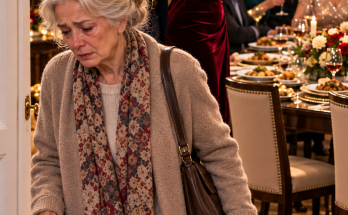
I used to believe that if I gave my family enough love, they would never make me feel like a stranger.
I was wrong.
I learned that on an ordinary afternoon in a grocery store, with a bottle of wine in my hand and my daughter's voice coming through my phone.
“Dad's wife will be spending Christmas with us this year,” Emily said.
I looked at the bottle.
It was the kind Richard used to choose for our Christmas dinners, back when he still pretended to care about the little things I liked.
Emily continued.
“We want her to feel comfortable with everyone, so maybe you shouldn't come this time, Mom.”
For a moment, I couldn't answer.
A refrigerator hummed somewhere behind me. A shopping cart squeaked as someone pushed it past the end of the aisle.
People continued picking out their groceries.
My daughter had just told me I wasn't welcome at Christmas, and the world hadn't even paused.
“Is that what you want, Emily?”
I tried to keep my voice steady.
She didn't answer immediately.
Then I heard a man's voice in the background.
Richard.
My former husband.
He said something too quietly for me to understand, but his impatience came through clearly enough.
Emily sighed.
“Please don't make this difficult.”
I closed my eyes.
There had been a time when that sentence would have sent me into a long explanation. I would have reminded her how many Christmas mornings I'd spent preparing breakfast, wrapping presents, and making sure everyone had what they needed.
I would have asked what I'd done wrong.
I would have tried to persuade her that I deserved a place at my own family's table.
Instead, I put the wine back on the shelf.
“All right, sweetheart.”
She seemed surprised by how quickly I agreed.
“Thank you for understanding.”
I almost laughed at that.
Understanding.
It was a word my family had used for years whenever they wanted me to accept something painful without making them feel guilty about it.
“Have a good Christmas,” I told her.
“You too, Mom.”
Then the call ended.
I stood there for another minute, holding my empty shopping basket.
I was fifty-two years old.
I had built a business, survived a divorce, and raised two children who were old enough to understand the difference between kindness and convenience.
Yet I had just been dismissed from Christmas as if I were an unwanted guest.
I went home without the wine.
That evening, I sat in my study and looked through the glass doors toward the dark garden.
Three years had passed since Richard and I separated.
In those three years, he had managed to rewrite our marriage so thoroughly that even our children seemed to believe his version.
According to Richard, I had become distant.
I had stopped caring about family life.
I had supposedly chosen work over the people who mattered most.
He never mentioned the nights I stayed awake checking construction budgets while he slept.
He never mentioned the investors I persuaded to take a chance on us when our company was little more than an idea and a stack of financial projections.
And he certainly never mentioned who had kept the company alive during its most difficult years.
Vale Urban Development was supposed to be our shared achievement.
I had developed the original business plan. I had built the financial models, negotiated with early investors, and helped secure the relationships that allowed the company to grow.
Richard was good at standing in front of a room.
He could shake hands, remember names, smile for photographs, and make people feel as if they were already friends.
I had been good at making sure there was something behind the smile.
He became the public face of Vale Urban.
I became the person who made the numbers work.
At first, I didn't mind.
We were married, and I thought we were building something together.
I believed that success belonged to both of us, even if only one of us received the applause.
That belief cost me more than I understood at the time.
Richard eventually became the chief executive officer. His name appeared in business magazines. His photographs appeared beside announcements about new developments.
When the company purchased a lakeside property, he spoke about his vision.
When we acquired the penthouse, he described it as a reward for years of hard work.
People congratulated him.
I smiled beside him.
Sometimes, I even helped him prepare the speeches in which he thanked everyone except the woman who had written the plans.
I told myself it didn't matter.
I was his wife.
I knew the truth.
Or so I thought.
Then he began seeing Vanessa.
She was fifteen years younger than Richard, polished in the way people become when they make a living presenting a perfect life to an audience.
She worked as a real-estate influencer, posting photographs of expensive interiors, elegant dinners, and carefully arranged celebrations.
She knew how to make an ordinary room look like a place everyone wanted to enter.
Richard seemed fascinated by her.
By the time our marriage ended, he had already begun behaving as if the life we had built together had always belonged to him.
Our divorce was painful, but I refused to turn it into a public war.
I agreed to let him remain CEO.
I wanted the company to survive, and I didn't want our employees to suffer because their leaders couldn't settle their personal differences.
I also wanted Emily and Noah to have a chance to maintain relationships with both parents.
Richard interpreted my decision differently.
He thought I had surrendered.
That was the first mistake he made.
The second was assuming that a divorce could erase twenty-four years of business records.
I still owned thirty-eight percent of Vale Urban Development's voting shares.
I still understood its financial structure.
And I still knew exactly where the company's rules were written because I had helped draft them.
But I hadn't spent the previous three years preparing revenge.
At least, that was what I told myself.
For a long time, I wanted nothing more than a quiet life away from Richard's ambitions.
I wanted to wake up without wondering which crisis he had created.
I wanted to stop checking whether a decision had been made because it was sensible or because it would make him look impressive.
Most of all, I wanted my children to grow up without feeling trapped between their parents.
I had tried to protect them from the worst parts of our marriage.
Perhaps I had protected them too well.
They knew their father was successful.
They knew their mother had worked in the business.
They didn't know how often Richard had dismissed my opinions in private before repeating them in meetings as his own.
They didn't know how he had mocked my age when he began talking about a future with Vanessa.
They didn't know how he had moved money out of our shared accounts before filing for divorce.
And they didn't know how he had threatened Noah's graduate-school tuition when I questioned the valuation of Vale Urban during the settlement.
I had kept those things from them because I thought the truth would hurt them.
Looking back, I understand that silence can protect people from pain.
It can also protect the person causing it.
That evening, my phone lit up again.
It was a message in the family group chat.
Richard had posted a photograph of the Christmas decorations at the penthouse.
Vanessa stood beside the dining table, holding a gold ornament. Emily was next to her, smiling at the camera. Noah stood behind them with one hand resting on a chair.
The room was familiar.
I recognized the tall windows, the pale curtains, and the dining table I had chosen years earlier.
I even recognized the small mark near the corner of the table where Noah had accidentally dropped a serving spoon as a child.
Richard had written a short caption celebrating the family's new Christmas traditions.
I studied the photograph until the screen dimmed.
Then I turned it back on.
I wasn't angry because Vanessa was standing in my old dining room.
I wasn't even angry because Richard had found someone else.
I was angry because my children were standing beside him, smiling as though the past had been neatly removed from the room.
They had not seen the years of work.
They had not seen the compromises.
They had not seen what it took to build the life they were now being told belonged to someone else.
I set the phone down.
Then I remembered something.
Six months before Richard and I separated, I had noticed withdrawals that didn't make sense.
The amounts were small enough to escape casual attention but frequent enough to bother me. Each one appeared to have a reasonable explanation, yet the explanations didn't fit together.
I had asked Richard about them.
He told me I was tired and reading too much into routine business expenses.
I wanted to believe him.
But I had worked with numbers for too long to ignore a pattern simply because someone I loved wanted me to.
I had copied the relevant records and asked a forensic-accounting colleague to keep a secure set of them.
I hadn't accused Richard.
I hadn't warned him.
I had waited.
At the time, I hoped the discrepancies would turn out to be mistakes.
Now, sitting alone in my study after my daughter had excluded me from Christmas, I understood that the records might mean something much worse.
I stood, crossed the room, and unlocked the bottom drawer of my desk.
Inside lay a blue folder.
The label on its cover was plain and unmistakable.
CONFIDENTIAL.
I carried it to the desk and opened it.
The first pages contained transaction records.
Behind them were company documents, payment summaries, and a board resolution bearing signatures Richard had apparently forgotten about.
I turned one page.
Then another.
My hands were steady.
That surprised me.
For three years, Richard had acted as though I had no power left in the company he led.
He had mistaken my restraint for surrender.
Now, as I looked at the evidence I had preserved, I began to see how badly he had misunderstood me.
The blue folder had not changed.
The facts inside it had not changed.
But my reason for keeping them had.
And for the first time since the divorce, I knew exactly what I needed to do next.
Source: kaylestore.net
Click here to continue reading: PART 2: The Blue Folder Held Eighteen Months of Records, and the Woman Who Had Been Pushed Aside Finally Had a Reason to Open It
My Daughter Uninvited Me From Christmas, and I Realized My Family Had Forgotten Who Paid for the Life They Loved
Part 1 of 12