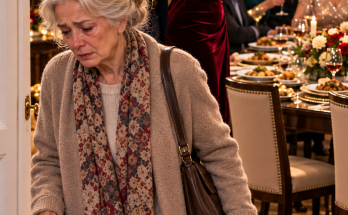
Emily's house smelled like roasted vegetables and cinnamon when I arrived.
Noah opened the door before I had finished knocking.
“You made it.”
“I said I would.”
“I know. I just wanted to see you.”
He took the food from my hands and carried it toward the kitchen.
Emily appeared from the hallway wearing an apron over a black sweater.
For one second, she looked like the little girl who used to run to the door when she heard my car.
Then she stopped, as though she were unsure whether she had permission to hug me.
I made the decision for both of us.
I stepped forward and put my arms around her.
She held me tightly.
“Thank you for coming,” she whispered.
“Thank you for inviting me.”
When we separated, her eyes were wet.
She wiped them quickly and pointed toward the dining room.
“I made room for you.”
“I can see that.”
The table was modest, the food was ordinary, and the decorations were slightly uneven.
One candle leaned to the left.
A paper snowflake had been taped crookedly to the window.
I loved all of it.
There was no expensive display meant to convince anyone that our family was perfect.
There were only three people trying to share a meal without pretending that the past had never happened.
We put the food away, warmed the dishes, and argued gently about where the extra serving spoons belonged.
Noah insisted he had already found one.
Emily opened the wrong drawer three times.
I laughed so hard that I had to lean against the counter.
The sound surprised me.
It had been a long time since laughter in my family had felt completely safe.
We sat down a little after six.
Emily said grace, thanking everyone for making the effort to be together.
She did not mention forgiveness.
She did not say that Christmas had healed us.
She simply thanked us for the food, the roof over our heads, and the chance to begin again.
When she finished, Noah raised his glass of water.
“To a quieter year.”
Emily laughed.
“That is the most ambitious thing you've ever wished for.”
We ate.
For a while, we talked about work, the weather, and the neighbor who had decorated his entire front yard with lights that flashed in a different sequence every thirty seconds.
Noah told us about a project that had gone wrong because someone had ordered the wrong materials.
Emily described a client who had sent her eleven messages about a decision she had already explained three times.
I listened more than I spoke.
I wanted to remember the sound of their ordinary voices.
Then Emily's phone lit up beside her plate.
She glanced at the screen.
Her face changed.
Noah noticed immediately.
“Is it Dad?”
Emily turned the phone facedown.
“Yes.”
Neither of us asked what the message said.
She took a breath and picked up her fork again.
“I don't want to spend tonight dealing with him.”
“Then don't,” Noah said.
The simplicity of his answer made her look at him.
“He says he just wants to wish everyone a Merry Christmas.”
“He can wish us a Merry Christmas without being part of this dinner.”
“He says it's cruel to exclude him.”
Noah set his fork down.
“Emily, we invited Mom. We agreed what this evening would be. We don't have to change it because Dad doesn't like the decision.”
She looked at me.
I could see the old fear working through her expression.
Richard had spent years making his disappointment feel like an emergency.
If he was unhappy, someone had to fix it.
If he felt excluded, someone had to prove that he mattered.
If he wanted something, saying no became an accusation against his character.
I had lived inside that pattern long enough to recognize it even when it was happening to someone else.
“You don't need to explain your invitation to me,” I told her.
Emily nodded slowly.
Then she picked up her phone and read the message.
Richard had written that he hoped we were enjoying a peaceful evening.
He said he missed the family.
He said he regretted that the circumstances had made everything so difficult.
He did not mention the decisions that had brought us here.
He did not mention the investigation.
He did not mention the years in which my place at the family table had depended on my willingness to remain quiet.
At the end, he wrote that he hoped we could all put the past behind us.
Emily stared at the screen.
“Why can't he just say what he did?”
I folded my napkin.
“Because he may not be ready to say it.”
“Does that mean we have to wait?”
“No.”
She looked at me carefully.
“You don't have to wait for someone else to understand your experience before you're allowed to protect yourself.”
Noah nodded.
“I'm not answering him tonight.”
Emily typed a short response.
We hope you have a peaceful Christmas. We are spending tonight as planned, and we are not discussing the investigation or Mom's decisions by text.
She showed it to Noah.
He read it and nodded.
Then she sent it.
The phone remained silent for several minutes.
We returned to dinner.
I was cutting a piece of turkey when another message appeared.
Emily read it, then let out a tired breath.
“What now?” Noah asked.
“He says he never thought his own children would turn against him.”
Noah leaned back in his chair.
“I'm not turning against him by telling the truth.”
He paused.
“I'm also not going to pretend that what happened to Mom was just a misunderstanding.”
Emily put the phone in a drawer.
“We can talk to him another day.”
“Only if he can have an actual conversation,” Noah said.
“Not another one where we spend two hours explaining why he's hurt.”
I looked at my children.
There had been a time when I believed protecting them meant absorbing every insult before it reached them.
I had mistaken silence for shelter.
Now they were learning to speak for themselves, and I understood that their strength did not require me to direct every word.
We cleared the plates together.
Noah washed while Emily dried.
I stood beside them, putting away the serving dishes.
The ordinary rhythm of the work gave me more comfort than any speech could have.
After dinner, Emily brought out a small box from the living room.
Inside were several old photographs.
She had found them while sorting through a cabinet earlier that week.
There was one of Noah at eight, standing beside a birthday cake with frosting on his nose.
There was another of Emily holding a school certificate while I tried to keep the wind from blowing it out of her hands.
In one photograph, Richard stood behind us, smiling at the camera.
I looked at it for a long moment.
“I remember that day,” I said.
“Dad had forgotten the time of the ceremony,” Emily replied. “You drove back across town to get him.”
“I remember.”
“I used to think that meant everything was fine.”
I placed the photograph on the table.
“It meant we had a good day. It didn't mean everything was fine.”
She absorbed that.
“I think I confused good memories with proof that nothing bad could be happening.”
“That is an easy mistake to make when you love someone.”
Noah picked up another photograph.
“Does this mean all the good things were fake?”
“No,” I said. “The good things were real. So was the harm.”
That answer seemed to settle something in him.
He returned the photograph to the box.
“We don't have to choose one version of our lives and throw the other away.”
“Exactly.”
We spent the next hour looking through the pictures.
Sometimes we laughed.
Sometimes we went quiet.
There were memories we could share without pain, and others that had become more complicated now that we understood what we had not known at the time.
I did not ask my children to reinterpret every moment.
I did not demand that they agree with every conclusion I had reached.
We were allowed to remember differently.
What mattered was that none of us had to use those memories to erase the truth.
Later, while Noah carried the empty dishes into the kitchen, Emily sat beside me on the sofa.
“Mom, I want to ask you something, and I don't want you to feel you have to answer tonight.”
“All right.”
“If Dad eventually apologizes, would you ever speak to him again?”
I looked toward the kitchen.
I could hear water running and Noah humming under his breath.
“I don't know what I would choose,” I said. “An apology would be a beginning, not a decision I owe him.”
“Would you want him back in your life?”
“I would want any future conversation to be honest, respectful, and safe. Whether that becomes a relationship is something I would decide when the time comes.”
Emily nodded.
“I think I understand.”
“You don't have to decide what your relationship with him will be either.”
She leaned against the sofa.
“I don't want to spend the rest of my life hating him.”
“You don't have to.”
“But I can't keep making excuses for him.”
“You don't have to do that, either.”
We sat quietly.
There was no need to turn the conversation into a lesson.
At ten, Noah checked the time and announced that he had to leave before the roads froze.
Emily packed leftovers for him.
I wrapped the remaining food and placed it in the refrigerator.
Before I put on my coat, Emily hugged me again.
“Can we do this another time?”
“Yes.”
“Not just Christmas.”
“I would like that.”
She stepped back.
“I know things aren't fixed.”
“No, they're not.”
“But I want to keep trying.”
I touched her cheek.
“Then we keep trying.”
Noah walked me to my car.
He checked the path for ice and waited while I unlocked the door.
“I'm glad you came,” he said.
“So am I.”
He hugged me carefully, then stepped away.
I drove home through quiet streets, passing houses with glowing windows and wreaths on their doors.
My phone stayed silent.
I did not check it to see whether Richard had written again.
When I reached home, I placed my keys in the bowl beside the door and hung my coat in the closet.
The pearl earrings came off last.
I set them on the dresser beside a small glass of water.
For years, I had believed that family peace depended on everyone agreeing to the same story.
That evening had taught me something different.
We could love one another without agreeing about everything.
We could acknowledge harm without turning every conversation into a trial.
And we could make room for one another without giving Richard the power to decide who belonged.
I turned off the bedroom light.
Christmas had not repaired my family.
It had given us one honest evening in which we had not asked anyone to pretend.
For now, that was enough.
Source: kaylestore.net
Click here to continue reading: PART 11: The Company Began to Recover When We Stopped Treating One Man’s Approval as the Price of Every Decision
My Daughter Uninvited Me From Christmas, and I Realized My Family Had Forgotten Who Paid for the Life They Loved
Part 10 of 12