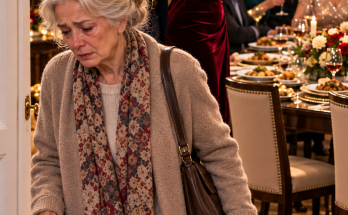
I bought the Christmas groceries on a Thursday afternoon, three days after Emily called.
I stood in the produce aisle longer than necessary, comparing apples I didn't particularly want, because the ordinary things were suddenly difficult.
For years, I had shopped for my family without thinking about whether I would be welcome at the table.
Now I was checking the calendar before buying a turkey.
I put one in my cart anyway.
Not because I was certain Christmas would happen as Emily imagined it, but because I wanted to make my decision without fear deciding for me.
My phone rang while I was choosing potatoes.
It was Noah.
“Mom, Emily told me you said yes.”
“I said I would consider coming if we could be honest with one another.”
“That sounds like you.”
I smiled at the potatoes.
“I'm not sure whether that's a compliment.”
“It is. You always knew when someone was leaving something important out.”
His voice softened.
“I should have listened to you sooner.”
I didn't answer immediately.
There were apologies I had waited years to hear, and I was learning that receiving one could hurt almost as much as waiting for it.
“You were trying to keep the peace,” I said.
“I was trying to keep Dad happy.”
“Those aren't always the same thing.”
“I know that now.”
I moved my cart away from the other shoppers.
Noah told me he had spoken to Emily the night before, and they had agreed not to make Christmas into a performance.
There would be no speeches about family healing.
No demand that I forgive anyone because the decorations were pretty or the food had taken hours to prepare.
They wanted me there, he said, but they understood that wanting me there did not entitle them to my forgiveness.
That was the first thing either of my children had said that made me believe the invitation might be real.
“Where are you having dinner?” I asked.
“Emily's house.”
“Will Richard be there?”
The silence lasted just long enough to answer me.
“He hasn't been invited.”
“Has he asked to come?”
“He sent Emily a message about family being together at Christmas.”
I felt the old pressure rise in my chest.
Richard had always been skilled at turning a boundary into a personal insult.
He could make a refusal sound cruel and an ordinary request sound like a moral obligation.
“What did Emily tell him?”
“She said Christmas was for the people she had invited.”
I set a bag of potatoes in the cart.
“Good.”
“She also told him she wouldn't discuss your decisions with him.”
I closed my eyes for a moment.
That was a small sentence.
It was also something I had needed to hear for years.
Before we ended the call, Noah asked if I wanted him to pick me up.
“I can drive myself.”
“Of course you can.”
“But you can arrive early and help me carry things inside.”
“I'll be there.”
When I returned home, I placed the groceries on the kitchen counter and noticed the blue folder beside my laptop.
It was the same folder that had held the documents connecting Richard to the decisions he had insisted I knew nothing about.
The paper edges had softened from being handled so many times.
I had once thought that finding the truth would make me feel powerful.
Instead, it had made me tired.
The truth did not return the years I had spent doubting my own judgment.
It did not erase the nights I had sat alone, wondering whether my family had forgotten who I was before Richard decided what I was allowed to know.
But it had given me something I could no longer surrender.
Certainty.
I closed the folder and put it in the locked drawer where I kept my legal records.
The investigation was still moving through its proper channels.
There were documents to verify, interviews to complete, and decisions that belonged to people with authority to make them.
I had learned not to confuse a promising development with a final result.
The board at Vale Urban Development had taken action against Richard's position, but that did not mean every question about his conduct had been answered.
The company's governance review continued.
So did the work of protecting its employees, its investors, and the projects that had nothing to do with our marriage.
I was determined not to turn that work into another weapon in a family argument.
My lawyer had reminded me that the cleanest account was the strongest one.
Facts first.
Evidence second.
Conclusions only when the evidence supported them.
I had repeated those words so often that they had become a kind of prayer.
The next morning, a woman named Denise called me about a housing project.
We had met months earlier at a meeting about financing affordable apartments, before everything involving Richard became impossible to ignore.
She had followed the public developments surrounding Vale Urban and wanted to know whether I was still interested in supporting a new project.
“I understand if you need time,” she said.
“I've had time.”
I looked out at the pale winter sky.
“What do you need from me?”
She explained that a group of women who had spent years managing housing developments, construction budgets, and tenant services were preparing a proposal.
They had the experience.
They had a workable plan.
What they lacked was a financing partner willing to look beyond the fact that none of them had inherited a company or arrived with a famous surname.
I asked her to send the proposal.
I did not promise money.
I did not promise influence.
I promised to read it carefully and arrange a meeting if the numbers and structure justified one.
When I hung up, I realized I had gone almost an hour without thinking about Richard.
The relief was so complete that I laughed.
It wasn't because I had forgotten what he had done.
It was because my life had finally made room for something else.
That afternoon, Emily sent me a photograph of her dining room.
She had placed a simple white cloth over the table, and a small green wreath hung on the wall behind it.
There were four chairs around the table.
One had a folded napkin beside it.
I stared at the photograph longer than I intended.
Then another message appeared.
I didn't know whether you'd want us to set a place for you, so I did. If you change your mind, I understand.
I typed three different answers.
The first was too cautious.
The second sounded as though I were apologizing for having been hurt.
The third was honest.
Thank you. I'll come.
She replied with a heart.
I left it there.
Two days before Christmas, Noah came over to help me check the car.
He looked at the boxes stacked beside the front door and shook his head.
“Mom, you're bringing enough food for a small restaurant.”
“I don't know what people eat at your sister's house.”
“Food, usually.”
“Then this should work.”
He laughed, and for a few minutes we sounded like ourselves.
He helped me carry the boxes to the kitchen.
While we worked, he asked whether the company had chosen a permanent leader.
“Not yet. The board is taking its time.”
“People online keep saying everything will collapse.”
“People online aren't responsible for keeping the company operating.”
I explained that the senior team was maintaining the projects, the auditors were reviewing the relevant records, and the board was working through its leadership process.
Noah listened without interrupting.
“Are you going back?”
“Not to the same position.”
“Do you want to?”
I considered the question.
Once, I would have answered by listing the reasons I had to return.
The employees who depended on the company.
The projects I had helped build.
The years I had invested.
The fear that walking away would allow Richard to define what happened.
Now I understood that those reasons did not automatically determine what I wanted.
“I want the work to be done properly,” I said. “That doesn't mean I need the same title to make it happen.”
Noah nodded.
“I think Dad always believed that if he lost control of something, he had lost everything.”
“That was his belief. It doesn't have to become ours.”
We finished loading the car.
Before Noah left, he stood near the door with his hands in his coat pockets.
“Mom, can I ask you something?”
“Of course.”
“Do you think you can forgive me?”
The question landed quietly between us.
I could have reassured him.
I could have said yes to relieve his guilt, just as I had said yes to so many things over the years because another person's discomfort seemed more urgent than my own.
Instead, I told him the truth.
“I think we can build a relationship that doesn't depend on pretending you never hurt me.”
He lowered his eyes.
“I can do that.”
“I hope you can. But I need you to understand that forgiveness isn't a date on the calendar.”
“I do.”
“And if you make a mistake, I need you to tell me before I discover it from somebody else.”
He looked directly at me.
“I will.”
I hugged him before he left.
It wasn't a declaration that everything was repaired.
It was a beginning that neither of us had to lie about.
On Christmas Eve, I laid my clothes across the bed and chose a dark green dress.
I wore the pearl earrings I had kept through every argument, every humiliating conversation, and every moment when I wondered whether my marriage had turned me into someone I no longer recognized.
They were not expensive.
Richard had given them to me years earlier, on a birthday when he still remembered the small details that mattered to me.
For a long time, I had associated them with the woman I had been before everything changed.
Now I wore them because they were mine.
I checked the blue folder in the drawer once before leaving.
The documents were secure.
The legal process would continue whether I spent Christmas alone or surrounded by my children.
That realization made it possible to lock the drawer and walk away.
I turned off the kitchen light.
I checked the front door.
Then I picked up my coat.
For the first time in years, I was going to a family gathering without preparing to defend my right to be there.
I did not know whether the evening would be easy.
I only knew that I would not disappear to make it easier for someone else.
Source: kaylestore.net
Click here to continue reading: PART 10: When Richard Tried to Turn Christmas Into Another Argument, My Children Finally Answered Him Themselves
My Daughter Uninvited Me From Christmas, and I Realized My Family Had Forgotten Who Paid for the Life They Loved
Part 9 of 12